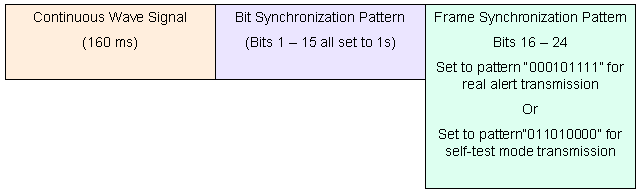
The structure of the 406 MHz message preamble is provided in the diagram below. The preamble of the 406 MHz digital message allows the receiver-processor to:
- detect the incoming signal and lock on its frequency, using the unmodulated carrier transmission;
- lock on the phase and bit timing of the modulation using the bit synchronization pattern; and
- identify the first data bit of the message using the frame synchronization pattern.
Therefore, this preamble must be fixed and identical for all Cospas-Sarsat 406 MHz beacons, and encoded according to the format outlined in the figure below.
Self-Test Mode Preamble
A 406 MHz beacon can be designed to perform a short self-test. The self-test transmission may consist of a short duration emission of a single burst. If the beacon transmits in the self-test mode, the self-test signal must have a frame synchronization pattern of 011010000 to ensure that the satellite or ground equipment will NOT process this test transmission. This eliminates the risk of a false alert being generated by the self-test burst. In addition, self-test transmissions must be kept to a minimum as they may interfere with “real” 406 MHz distress alerts.
In the self-test transmission mode the complete test transmission must be limited to one burst only, of a maximum duration of 440 ms for a short message or 520 ms for a long message. If a 440 ms transmission is used for a beacon encoded with the long format message, the message should be truncated without changing the format flag (bit 25).
Structure of Message Preamble