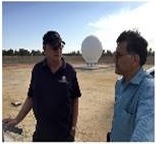
Chris Payne (left) and a manufacturer engineer at the Australian MEOLUT site, December 2015
16 Mar 2016
On Wednesday 9 March, AMSA held a morning tea to thank Chris Payne for his 38 years of service and to wish him well on his retirement. Chris started work in the Marine Operations Centre in the Department of Transport on 6 March 1978 before transferring to AMSA when it was formed on 1 January 1991.
Chris worked as a search and rescue mission coordinator before taking over the role as the advisor for the Cospas-Sarsat distress beacon detection system. Chris has played a major role in the success of Cospas-Sarsat in Australia and internationally, and is recognised as a world expert in the field.
Within Australia, Chris oversaw the first satellite tracking station in Alice Springs in 1992. He has managed the Australian Mission Control Centre and the Australian satellite tracking stations, now based in Bundaberg and Albany, as well as working with New Zealand on their satellite tracking stations.
Internationally, Chris has attended Cospas-Sarsat meetings, representing Australia for many years. Chris was Chair of the Operational Working Group at five Cospas-Sarsat Joint Committee meetings – an amazing contribution and recognition of Chris’ standing in the international Cospas-Sarsat community.
Since Australia’s and Chris’ work in Cospas-Sarsat commenced in 1982, 39,000 people have been saved the world over. In 2015 alone, 189 people were rescued in Australia due to Cospas-Sarsat beacon activities; while Australia has the highest per capita population of Cospas-Sarsat registered distress beacons in the world, numbering 415,000 in December 2015.
Chris has progressed slowly into retirement and has been working two days a week since 2012 with his final workday being yesterday (15 March) before his actual retirement at the end of June.
At the morning tea, Christine Macmillian acknowledged the enormous contribution that Chris has made to AMSA and to search and rescue around the world.