The Rescue Coordination Centre (RCCNZ) recently played a key role in rescuing 11 people around the Pacific over just a few days.
RCCNZ’s coverage area goes down as far as the South Pole and extends nearly up to the Equator.
It responds to approximately 1,200 search and rescue incidents each year.
During the period of 21-24 May 2022, two responses off the coasts of American Samoa and Kiribati saw 11 people rescued from three vessels.
“While this is the work our people are trained to do, it’s always fantastic to see positive results come from such complex missions, and I’m very proud of the work our operational staff put in.” Rescue Coordination Centre and Safety Services Manager, Justin Allan says.
“It was also a great example of collaboration with our partners, both here and internationally,” he says.
The first rescue occurred off the coast of American Samoa.
RCCNZ received an activation from a US-coded 406 beacon positioned 11 nautical miles east of American Samoa.
US Coast Guard in Pago Pago (American Samoa) was contacted for support and tasked a vessel.
Coast Guard in Honolulu provided registration details for the 36-foot vessel.
The vessel was en route back from an outlying island about 60 miles away.
A vessel with a small helicopter onboard heard the communications and tasked its helicopter to investigate.
The helicopter found the vessel capsized with four people in the water. They directed the marine patrol vessel and it rescued those four people.
“It’s always really special knowing the work we do ensures people can get home safely after being lost at sea,” Justin says.
He says it’s fantastic to work alongside talented and committed partners from around the world as well.
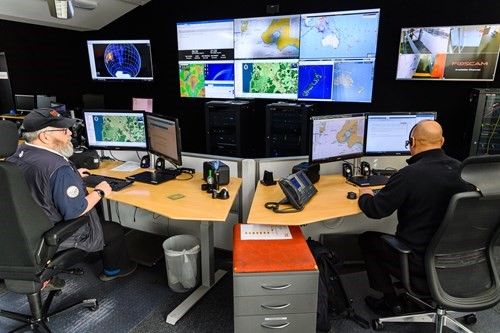
Photo: Behind the scenes at RCCNZ
The second involved two vessels off Kiribati, and started on the weekend of 20 May 2022.
It was a multi-day operation, which saw seven people rescued off two vessels, and included support from the New Zealand Defence Force (RNZDF).
Its P3 found both vessels.
RCCNZ’s initial involvement was looking for a vessel with three people onboard, while a second operation was getting underway with the US Coastguard looking for another vessel with three onboard.
The Orion left Auckland on 23 May and managed to track down both vessels. Survival packs were dropped and nearby vessels were contacted to rescue those onboard.
“Both vessels had drifted a substantial distance, and this is an incredibly isolated and remote part of the Pacific Ocean.
“The RNZDF did an amazing job locating both vessels, as the possible search area was over thousands of nautical miles.
“I know our team is really proud to be involved in successful rescues like these,” Justin says.