Pete Mesley’s trip to dive with whale sharks, giant mantas and hammerheads near remote islands off the coast of Mexico was a “mind-blowing” experience.
But when that experience became an emergency, luckily he kept his head, and his New Zealand-registered 406 personal locator beacon handy.
The Kiwi diver runs Lust4Rust and Shock&Awe Big Animal Diving Excursions, helping clients get close to some of the globe’s largest marine creatures and shipwrecks.
That’s what he was doing last month, with six multi-national clients, in the Revillagigedo Islands, nearly 580 km west of Mexico.
“We had just finished two days on a location called Roco Partida,” he says.
“This place was going off… a humpback whale and her calf, false killer whales and schooling tuna. It was mind blowing.”
But the adventure took a terrifying turn as their boat, with 14 passengers and 11 crew aboard, headed towards Socorro Island, 320km from the Mexico coast.
“It was about 2 am … the ship ploughed into the south-western end of the island.”
Passengers were “screaming” as the listing vessel was “lifted by the waves and smashed into the rocks”.
Crew called a nearby naval base for help, the life raft was deployed, and Pete grabbed his 406 personal locator beacon.
“Even though I was told that the call was made for assistance I wasn’t taking any chances with rescue efforts.”
About 10,000 kilometres away, the Lower Hutt-based Rescue Co-ordination Centre New Zealand (RCCNZ) was alerted through a global satellite system that raises the alarm for authorities in the country where the 406 PLB is registered.
Senior Search and Rescue Officer Nick Burt says the RCCNZ responded by contacting rescue officials in the United States and Mexico to make sure help was on the way.
Photo: Pete Mesley
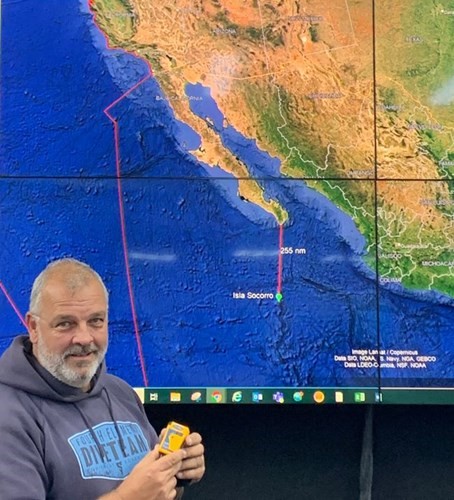
Kiwi diver Pete Mesley with the PLB that played a role in his rescue.
Pete visited the RCCNZ recently to thank those involved in the operation.
Later they were able to contact Pete’s family and inform them that everyone had been rescued and there were no serious injuries.
Nick says alerts from so far away are not common, but they’re a reminder of the value of 406 PLBs as a safety tool.
“We would definitely encourage anybody participating in remote activities, such as boating, aviation, climbing, tramping and hunting in the back country to carry a COSPAS-SARSAT 406 distress beacon, whether that be in New Zealand or overseas.”
Pete agrees. “It’s a no-brainer for me. They are not expensive and probably the best life insurance policy you can ever get.
“It’s amazing how quickly the RCCNZ responded and it’s super reassuring to know that even if I’m 7,000 miles away from home, there are people dedicated to ensuring my health and safety.”