Category: System Overview

  • 2014-11-03 Wasteful Four-Hour Helicopter Search Prompted by Obsolete 121.5 MHz Beacon

    A RCCNZ rescue helicopter was tied up for four hours searching for an obsolete beacon that was found floating below decks in a yacht in Waikawa Bay near Picton, New Zealand.

    Old or obsolete beacons need to be disposed of carefully: the battery needs to be disconnected and the beacon disposed of according to local regulations, as many beacons contain hazardous materials.

    Read more here:
    http://www.scoop.co.nz/stories/AK1410/S00798/obsolete-beacon-sparks-wasteful-search.htm


  • Motorcyclist Regains Consciousness in Remote Area, Activates Beacon

    Australian Search and Rescue Authority sent a helicopter to search a remote location in the North West where a motorbike rider had been thrown from his bike.

    Had he not been carrying an emergency beacon, said RACQ NQ Rescue Helicopter chief executive Alex Dorr, it may have been days before he was found and treated for his internal chest injuries and then transported to hospital.

    Read more here:

    http://www.northweststar.com.au/story/2651549/motorcyclist-lucky-to-be-alive-after-remote-crash/?cs=12


  • Rescued from Lurking Crocodiles near Darwin, Australia


    Unfamiliar with the unregistered 406-MHz beacon that did not have GPS, two fishermen struggled through crocodile-infested waters after their boat flipped while they slept, and did not activate it until they reached the shore.

    AMSA in Canberra was alerted by satellite, but because the beacon was not registered, it took a further forty minutes to resolve their position and send the Darwin Dornier and a CareFlight helicopter to rescue the dehydrated men who suffered from exposure but were otherwise unharmed.

    “Those waters are full of lizards and biters. We thought we were finished.”

    Read more here:

    http://www.abc.net.au/news/2014-10-22/fishermen-rescued-from-croc-infested-waters/5832954


  • Rescue from Breakdown En Route from Papua New Guinea to Australia

    After failed attempts to repair their yacht, a sailing couple activated their Cospas-Sarsat emergency beacon in the Coral Sea, approximately 70nm south east of Cooktown, Queensland.

    AMSA’s Cairns based Search and Rescue aircraft located the vessel and guided a nearby motor cruiser to the scene to provide assistance and then transferred them to a Cairns water police vessel for return to shore.

    Read more here:

    http://www.cairnspost.com.au/news/cairns/foreign-couple-rescued-from-stricken-yacht-near-cairns-after-getting-caught-up-in-rough-seas/story-fnjpusyw-1227097865757

  • Lifeboat Dropped to Burning Taiwanese Fishing Vessel in West Australia


    JRCC Australia received multiple satellite detections of a Taiwanese EPIRB, diverting two merchant vessels and three aircraft to respond by dropping a lifeboat to the vessel found burning with 15 people on board West of Carnarvon.

    Taiwanese fishing vessel Bahari 699 transferred the crew safely and intended to proceed to Bali, not requiring extra food or water from British Curlew, and allowing all SAR assets to be released from the task.

    Read more here:

    http://www.perthnow.com.au/news/western-australia/life-raft-dropped-to-burning-taiwanese-fishing-boat-off-was-carnarvon-coast/story-fnhocxo3-1227076159882?nk=807d133b327fcd2d8e106da2bdb6a84a


  • 2014-09-29 10 Fishermen Saved Thanks to a PLB as the Only Means of Alert

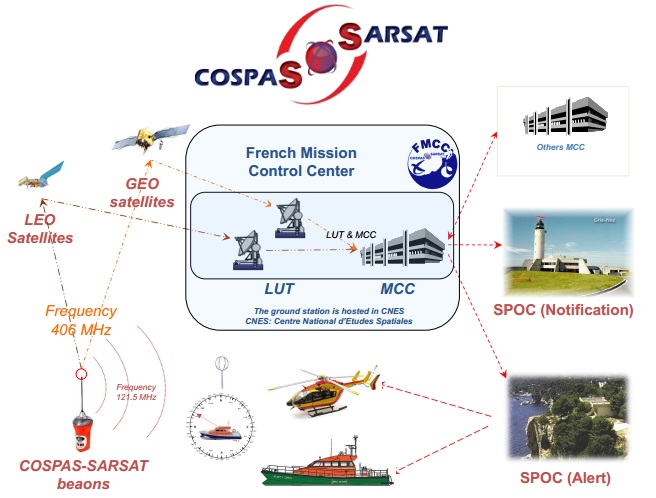
    18 September at 01:11 UTC the FMCC (FMCC: French Mission Control Center) received an alert from a personal locator beacon (PLB) from geostationary satellite GOES-15. Thanks to the fact that the PLB was fitted with a global navigation satellite system (GNSS) receiver, the location of the beacon and all other information was immediately sent to the Papeete Maritime Rescue Coordination Center (MRCC) in charge of the search and rescue region from which the PLB was emitting its signal.

    MRCC Papeete tasked a helicopter to go to the PLB’s position. As this PLB (coded with a French MID) was not registered in the French Database, it was not possible to know whether the distress signal came from an airplane or a maritime vessel, nor the number of persons in distress. The rescue helicopter, after an hour-and-a-half flight to the position of the beacon, notified that there was a fishing vessel found capsized with 10 people nearby in a life raft.

    The rescue helicopter took the first seven and brought them to the nearest island with a medical team, Bora-Bora, about 100 km from the accident. Meanwhile, the rescue helicopter diver remained with the last three people for more than two hours, when the rescue helicopter came back and brought them to Bora-bora as well. All 10 people found in distress are now safe and sound.

    Having a properly registered beacon allows the rescue coordination center to get supplementary information such as that regarding the vehicle’s type, color, length, etc., the number of persons on-board, the scheduled trip, etc., in order take the appropriate measures.

    The FMCC chief, Alex Génicot, insisted on the fact that all COSPAS-SARSAT beacons must be registered in the appropriate database, saying “Information contained in the beacon registration database can make the difference during a search-and-rescue operation, so help the rescuers help you!”


  • Cooperation Reinforced Between Stakeholders of the COSPAS-SARSAT System

    One of the most important goals for an RCC (Rescue Coordination Center) is to have a perfect understanding of how a system that provides distress alerts like the COSPAS-SARSAT system works. It is also important for the COSPAS-SARSAT organization to know the requirements of an RCC in order to improve the systems.

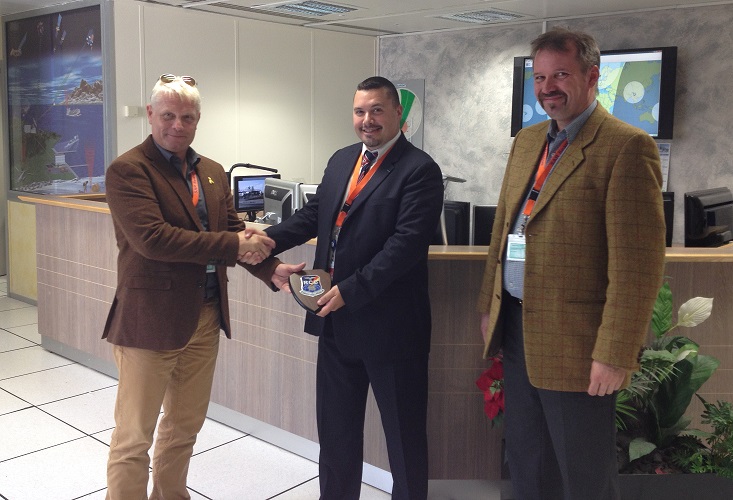
    In order to achieve this goal, a delegation of the Münster RCC (Germany) came to the French Mission Control Center (FMCC) on Wednesday 3 September 2014.

    The whole day was dedicated to explaining in detail, step by step, how the COSPAS-SARSAT system works:

    •         How the different types of beacon (ELT, PLB, EPIRB) can be triggered;
    •         How the signal is heard by the different constellations of satellites;
    •         How a LUT reception station (associated with appropriate antenna) is able to receive the signal;
    •         How precisely an MCC works (the core of the Center) and how it is managed by the operators;
    •         How the distress alert is forwarded and to whom.

    It was also a unique occasion to speak about the future MEOSAR system and for the FMCC to better understand the need for this RCC.

    This visit was considered very fruitful, helpful and very constructive by both groups.

    The visit was concluded with the offering of a gift from the head of the Münster RCC to the head of FMCC. 

    FMCC and RCC Germany 


    CSSystem

  • EPIRB Assists in Rescue of Two Tasmanians from Upturned Catamaran


    The 16-foot vessel overturned in increasingly high wind, and after trying to upright it the men “became tired and cold and subsequently made the right decision to activate the EPIRB before the situation got worse”.

    The vessel is still adrift near Marion Bay after the Westpac Rescue Helicopter and a police rescue swimmer brought the two hypothermic men out of the water to safety.

    Read more here:

    http://www.theadvocate.com.au/story/2559035/two-rescued-after-catamaran-is-upturned/ 


  • Costly beacon hoax at Sarina Beach, Australia


    Distress beacon hidden and activated in mangroves sends rescuers on costly wild-goose chase near Sarina Beach, Australia.

    Read more here:

    http://www.whitsundaytimes.com.au/news/beacon-hoax-costly/2382354/


  • Joint Australian-Danish effort to rescue yachtsman

    The solo sailor hit rough seas and his 406MHz distress beacon was detected by the AMSA Rescue Coordination Centre at 10:10 AM Friday morning.

    Four Australian rescue craft and a Danish flagged container ship were tasked with locating him in difficult conditions, and with the help of the RAAF C-130J Hercules crew using night vision goggles, the uninjured yachtsman afloat in his immersion suit was recovered by the container ship.

    Read more here:

    http://www.brisbanetimes.com.au/queensland/four-planes-ship-rescue-yachtsman-sailing-from-brisbane-20140905-10cuvz.html

This site is registered on wpml.org as a development site. Switch to a production site key to remove this banner.