
Coding the Maritime User Protocol (General)
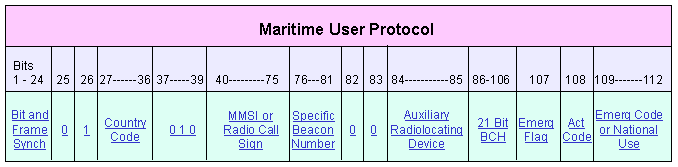
The Maritime User Protocol can be used to code either the vessel’s mobile service identity number (MMSI) or its Radio Call Sign (if it has 6 or fewer characters). Confusion between the two options is eliminated because the Radio Call Sign includes letters whereas the MMSI is composed entirely of digits.
Coding the Maritime User Protocol with MMSI
Bits 40 – 75 can be coded to designate the last 6 digits of the 9-digit MMSI using the modified-Baudot code shown in the table below.
Special care must be taken when coding this protocol in situations where the National administration has been allocated more than one country code (bits 27 – 36). When this option is used it is critical that the country code provided in bits 27 – 36 correspond to the first 3 digits of the vessel’s MMSI code.
Coding the Maritime User Protocol with the Radio Call Sign
Radio call signs of up to six characters can be encoded if the call sign complies with the ITU Radio Regulations on the formation of call signs (Article S19 of the Radio Regulations). This regulation requires that if alphabetic characters exist in the call sign, they can only occur in the first 4 characters. Consult the Radio Regulations for the complete requirements for establishing radio call signs.
Up to 6 alphanumeric characters using the modified-Baudot code presented in the table below can be accommodated with this protocol. If the radio call sign has fewer than 6 characters, blank spaces should be encoded to the left of the characters using the modified-Baudot symbol “100100”. If the radio call sign has seven characters it can only be encoded using the Radio Call Sign Protocol.
| Modified-Baudot Code | |||||
| Letter | Code | Letter | Code | Figure | Code |
| A | 111000 | N | 100110 | Space | 100100 |
| B | 110011 | O | 100011 | Hyphen | 011000 |
| C | 101110 | P | 101101 | / | 010111 |
| D | 110010 | Q | 111101 | 0 | 001101 |
| E | 110000 | R | 101010 | 1 | 011101 |
| F | 110110 | S | 110100 | 2 | 011001 |
| G | 101011 | T | 100001 | 3 | 010000 |
| H | 100101 | U | 111100 | 4 | 001010 |
| I | 101100 | V | 101111 | 5 | 000001 |
| J | 111010 | W | 111001 | 6 | 010101 |
| K | 111110 | X | 110111 | 7 | 011100 |
| L | 101001 | Y | 110101 | 8 | 001100 |
| M | 100111 | Z | 110001 | 9 | 000011 |
Maritime User Protocol
EXAMPLES OF 406 MHz BEACON CODES
Maritime User Protocol with MMSI
Bit Field Name |
Content |
Bit Field |
Bits |
| Message Format: | Short Message |
25
|
0 |
| Protocol Flag: | User Protocol |
26
|
1 |
| Country Code: | 257 Norway |
27-36
|
0100000001 |
| User Protocol Type: | Maritime |
37-39
|
010 |
| Trailing 6 digits of the Ship Station Identity (modified-Baudot code): | 743921 |
40-75
|
011100001010010000 000011011001011101 |
| Specific EPIRB: | 2 |
76-81
|
011001 |
| Spare | Not Used |
82-83
|
00 |
| Radio-locating: | 121.5 MHz |
84-85
|
01 |
| BCH-1: | 21-bit BCH Code |
86-106
|
101001011011010101000 |
| Emergency Code Flag: | Bits 109 – 112 for National Use |
107
|
0 |
| Beacon Activation: | Manual Only |
108
|
0 |
| Emergency/National Code or National use data: |
Not Used (Default Values) |
109-112
|
0000 |
Beacon 15 Hex ID (bits 26 to 85): A029C 2900D 97591
406 MSG (Short) (bits 25 to 112): 5014E 14806 CBAC8 D2DAA 00