
Serial User Protocol Coded with a Unique Beacon Serial Number –
ELT Serial Number (bits 44 to 63)
Administrations are responsible for ensuring that each beacon is coded in accordance with their own and Cospas-Sarsat requirements and has a unique 15 hexadecimal identification (bits 26 – 85). The serial number (bits 44 – 63) to be used in coding an ELT with this implementation of the Serial User Protocol may be directly assigned by the competent administration. Alternatively, the number can be assigned by the beacon manufacturer in accordance with the specific requirements adopted by the administration for controlling the allocation of serial numbers (e.g. the series of sequential numbers allocated to each manufacturer model approved by the administration)*.
If no allocation scheme has been defined by an administration, a unique identification can be achieved for a particular country code, by:
- setting bit 43 to “1”,
- including the beacon’s Cospas-Sarsat type approval certificate number in bits 74 – 83, and
- including the manufacturer unique beacon serial number in bits 44 – 63, in accordance with the coding provisions described in Cospas-Sarsat document C/S T.001 (Note: if this approach is adopted, the manufacturer must ensure that each beacon (of the type identified by the Cospas-Sarsat certificate number) has a different serial number).
*Note: Even when bit 43 is set to “1”, it still remains the responsibility of the relevant administration to decide policy regarding whether the serial number coded in bits 44 – 63 should be allocated by the administration or by the manufacturer. To minimise the possibility of a duplication of serial numbers individual competent administrations should provide a single policy on this issue (e.g. EITHER require the manufacturer to allocate the serial number for beacons coded with the administration’s country code, OR require the administration to allocate the serial number directly). Administrations should not allow both these policies to exist at the same time.
Serial User Protocol Coded with the Aircraft Operator Designator and a Serial Number (bits 44 to 61 and 62 to 73)
For an ELT using the Serial User Protocol coded with the aircraft operator designator and a beacon serial number:
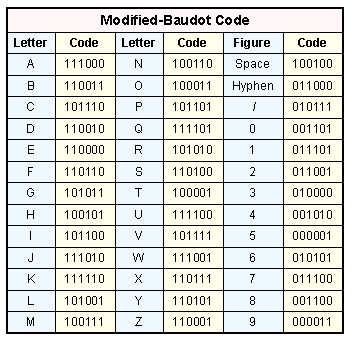
- The aircraft operator is identified with a 3 letter designation agreed by ICAO (see ICAO DOC 8585). These three letters are encoded into bits 44 – 61 using the modified-baudot code provided below.
- The beacon serial number identification is provided in bits 62 – 73 in binary notation with the least significant bit to the right. This allows for serial numbers ranging from 0001 to 4095. The serial number is normally assigned by the aircraft operator, who must ensure that the resulting beacon identification (bits 26 – 85) is unique and that information on which beacon is installed on each aircraft in its fleet is made available to SAR services on a 24-basis.
Serial User Protocol Coded with the Aircraft 24-Bit Address (bits 44 to 67 and 68 to 73)
For ELTs using the serial user protocol coded with the aircraft 24-bit address, the following requirements apply:
- Bits 44 – 67 provide the aircraft 24-bit address as assigned by the responsible administration in accordance with ICAO guidance in Annex 10 of the ICAO convention on Civil Aviation .
- Bits 68 – 73 is a 6 bit specific ELT number, in binary notation with the least significant bit on the right, when more than one ELT is carried on the same aircraft and encoded with the same 24-bit address. When there is only one ELT with the same 24-bit address, bits 68 – 73 should all be set to “0”.
Serial User Protocol Coded with a Unique Beacon Serial Number –
EPIRB Serial Number (bits 44 to 63)
Administrations are responsible for ensuring that each beacon is coded in accordance with their own and Cospas-Sarsat requirements and has a unique 15 hexadecimal identification (bits 26 – 85). The serial number (bits 44 – 63) to be used in coding an EPIRB with this implementation of the Serial User Protocol may be directly assigned by the competent administration. Alternatively, the number can be assigned by the beacon manufacturer in accordance with the specific requirements adopted by the administration for controlling the allocation of serial numbers (e.g. the series of sequential numbers allocated to each manufacturer model approved by the administration)*.
If no allocation scheme has been defined by an administration, a unique identification can be achieved for a particular country code, by:
- setting bit 43 to “1”,
- including the beacon’s Cospas-Sarsat type approval certificate number in bits 74 – 83, and
- including the manufacturer unique beacon serial number in bits 44 – 63, in accordance with the coding provisions described in Cospas-Sarsat document C/S T.001 (Note: if this approach is adopted, the manufacturer must ensure that each beacon (of the type identified by the Cospas-Sarsat certificate number) has a different serial number).
*Note: Even when bit 43 is set to “1”, it still remains the responsibility of the relevent administration to decide policy regarding whether the serial number coded in bits 44 – 63 should be allocated by the administration or by the manufacturer. To minimise the possibility of a duplication of serial numbers it is recommended that individual competent administrations provide a single policy on this issue (e.g. EITHER require the manufacturer to allocate the serial number for beacons coded with the administration’s country code, OR require the administration to allocate the serial number directly). Administrations should not allow both these policies to exist at the same time.
Serial User Protocol Coded with a Unique Beacon Serial Number –
PLB Serial Number (bits 44 to 63)
Administrations are responsible for ensuring that each beacon is coded in accordance with their own and Cospas-Sarsat requirements and has a unique 15 hexadecimal identification (bits 26 – 85). The serial number (bits 44 – 63) to be used in coding a PLB with this implementation of the Serial User Protocol may be directly assigned by the competent administration. Alternatively, the number can be assigned by the beacon manufacturer in accordance with the specific requirements adopted by the administration for controlling the allocation of serial numbers (e.g. the series of sequential numbers allocated to each manufacturer model approved by the administration)*.
If no allocation scheme has been defined by an administration, a unique identification can be achieved for a particular country code, by:
- setting bit 43 to “1”,
- including the beacon’s Cospas-Sarsat type approval certificate number in bits 74 – 83, and
- including the manufacturer unique beacon serial number in bits 44 – 63, in accordance with the coding provisions described in Cospas-Sarsat document C/S T.001 (Note: if this approach is adopted, the manufacturer must ensure that each beacon (of the type identified by the Cospas-Sarsat certificate number) has a different serial number).
*Note: Even when bit 43 is set to “1”, it still remains the responsibility of the relevent administration to decide policy regarding whether the serial number coded in bits 44 – 63 should be allocated by the administration or by the manufacturer. To minimise the possibility of a duplication of serial numbers it is recommended that individual competent administrations provide a single policy on this issue (e.g. EITHER require the manufacturer to allocate the serial number for beacons coded with the administration’s country code, OR require the administration to allocate the serial number directly). Administrations should not allow both these policies to exist at the same time.