Category: System Overview

  • 2023-01-11 | Electronic life insurance – electronic tools on the market to help keep you safer at sea

    Growing up in Maine, the orange Type II life jacket with a homemade chest harness and safety tether was very different to the modern personal flotation device (PFD) now worn by the author of this review article when boating.

    When it comes to safety at sea, modern mariners have two important pieces of satellite-based defense available: 406 EPIRBs and 406 PLBs.

    Both are underpinned by Cospas-Sarsat, which was founded decades ago by Canada, France, the United States and the former Soviet Union to provide a free emergency-signal relay service for mariners of all flags.

    Today, Cospas-Sarsat involves these founders plus 43 other nations (and two agencies) that share the goal of providing, maintaining and innovating a global distress-signal monitoring system that directs the correct rescuing authority to an unfurling ­emergency as quickly as possible.

    To date, Cospas-Sarsat has saved more than 50,000 lives.

    As of this writing, there are nine active GEOSAR satellites and five LEOSAR satellites; once the network is complete, there will be at least 75 MEOSAR satellites aloft.

    These satellites are supported by a global network of ground-based assets, including Local Users Terminals (LUTs), Mission Control Centers (MCCs) and local rescue coordination centers.

    Read the full article here:

    https://www.cruisingworld.com/gear/electronic-life-insurance/

  • 2023-01-11 | Electronic life insurance – electronic tools on the market to help keep you safer at sea

    Growing up in Maine, the orange Type II life jacket with a homemade chest harness and safety tether was very different to the modern personal flotation device (PFD) now worn by the author of this review article when boating.

    When it comes to safety at sea, modern mariners have two important pieces of satellite-based defense available: 406 EPIRBs and 406 PLBs.

    Both are underpinned by Cospas-Sarsat, which was founded decades ago by Canada, France, the United States and the former Soviet Union to provide a free emergency-signal relay service for mariners of all flags.

    Today, Cospas-Sarsat involves these founders plus 43 other nations (and two agencies) that share the goal of providing, maintaining and innovating a global distress-signal monitoring system that directs the correct rescuing authority to an unfurling ­emergency as quickly as possible.

    To date, Cospas-Sarsat has saved more than 50,000 lives.

    As of this writing, there are nine active GEOSAR satellites and five LEOSAR satellites; once the network is complete, there will be at least 75 MEOSAR satellites aloft.

    These satellites are supported by a global network of ground-based assets, including Local Users Terminals (LUTs), Mission Control Centers (MCCs) and local rescue coordination centers.

    Read the full article here:

    https://www.cruisingworld.com/gear/electronic-life-insurance/

  • 2023-01-11 | NZ Hiker rescued by police, helicopter and SAR team after forgetting 406 distress beacon

    Police have issued a warning to hikers after a woman had to be rescued in Southland, New Zealand when she forgot her 406 personal locator beacon.

    About 7pm last Saturday the woman called police to say she was lost in low cloud.

    She was well prepared for a day tramp and was quite experienced, but she only had her mobile phone.

    “The irony is, she owns a 406 Distress Beacon (Personal Locator Beacon) and didn’t think she would need it because she knew the area, but as it turns out – she did need it.”

    “The [406] PLBs are more powerful, accurate and provide a rapid response by emergency services.”

    “The [406] PLBs also have an important homing function for rescue aircraft to locate and pinpoint the position once the aircraft is on scene, even if the party are under a tree canopy.

    “We have found, with other devices, the information is delayed and often difficult to locate them without the homing function in rugged country.”

    “It was just pure luck that she had good mobile phone reception”.

    “Remember though, you can never rely on good luck when you are out in the great outdoors.”

    Read more here: https://www.nzherald.co.nz/nz/tramper-rescued-by-police-chopper-sar-after-forgetting-distress-beacon/RN7N3YUJEVBEFP5A7LTNKKBTLU/

  • 2023-01-11 | SARSAT Program assists in 387 total saves in the USA in 2022

    The USA’s SARSAT Program has circulated their yearly summary of saves for 2022. These include:

    1. Rescues at sea (406 EPIRBs and 406 PLBs): 265 people rescued in 77 incidents
    2. Aviation rescues (406 ELTs and 406 PLBs): 42 people rescued in 28 incidents
    3. Terrestrial 406 PLB rescues: 80 people rescued in 51 incidents  

    The top three states were: FL with 106 saves in 35 events, AK with 56 saves in 27 events, and UT with 20 saves in 5 events.

    The remaining rescues took place in 24 other US states, plus the US Virgin Islands, Turks and Caicos Islands, Bermuda, and Bahamas.

    Of the EPIRB events, 4 involved vessels with international homeports: 1 from France, 2 from Germany, and 1 from Great Britain.

    The single event with the greatest number of saves took place in Sandthrax Canyon, UT when a group of 17 hikers activated their 406 PLB after they became stranded on a ridge.

    Read more at https://www.sarsat.noaa.gov/

  • 2023-01-10 | The world may be at odds, but satellites are a reminder of our shared humanity

    One day, a satellite might save your life.

    In late July, a mountain climber was struck by a falling rock near Mount Waddington, one of British Columbia’s Coast Mountains.

    Despite the severity of the injury, the life-threatening accident was transformed into a rapid-rescue operation when the climber’s companion activated a handheld emergency 406 beacon.

    Within minutes, a satellite in orbit had received and relayed the precise location of the emergency signal to the Canadian Armed Forces’ Joint Rescue Co-ordination Centre in Victoria.

    A helicopter was deployed to rescue the injured climber and fly them to a hospital.

    Emergency responses like this occur every day in Canada, not only because it is the second-largest country on Earth, but also because it participates in the International Cospas-Sarsat Programme – a global network of satellites used to support search-and-rescue operations.

    Since 1982, Cospas-Sarsat has guided the rescue of more than 50,000 people worldwide.

    Its diverse membership includes China, Russia and the United States, all of whom contribute satellites or ground stations.

    Emergency beacons connected to the network are required by law to be present on planes and ships.

    They are also carried by any responsible person who ventures into the remote wilderness.

    Apparently, saving innocent lives is an imperative on which otherwise antagonistic countries can agree.

    During these dark times, space-based co-operation in search-and-rescue and disaster relief is a welcome recognition of our shared humanity.

    Somewhere in Canada, or Russia, someone will need rescuing today.

    And when they do, it might just be a satellite from another country that receives and relays the emergency signal.

    Read more here: https://www.theglobeandmail.com/opinion/article-the-world-may-be-at-odds-but-satellites-are-a-reminder-of-our-shared/

  • 2022-12-08 | First Return Link Distress Alert under the Coverage of the new SAR Galileo MEOLUT

    From 1982 to 2022, 40 years of lives saved by Cospas-Sarsat

    La Réunion EU MEOLUT, a cornerstone new infrastructure for SAR Galileo delivery in the Indian Ocean

    Amidst the celebration of the 40th anniversary of the first use of satellite technologies by Search and Rescue (SAR) forces earmarked on 10 September 1982 as well as the 40th anniversary of uninterrupted SAR operations of the French Mission Control Center (FMCC), the SAR/Galileo is enlarging its contribution to the Cospas-Sarsat (C/S) system of international SAR efforts cooperation with a fourth MEOLUT (Medium Earth Orbit Local User Terminals) facility deployed in the Indian ocean La Reunion island.

    SAR/Galileo Services were designed to support the Cospas-Sarsat (C/S) in the context of the MEOSAR system (Medium Earth Orbit Search And Rescue) providing uninterrupted Search and Rescue services globally which account for more than 2,000 lives saved a year. 

    Galileo is already the largest ground (in terms of MEOLUTs) and space segment (L-band SAR payloads) provider within C/S in addition to being the only offering exclusively the Return Link Service (RLS).

    Galileo SAR MEOLUTs Key Components of the SAR Ground Segment 

    La Reunion/ EU MEOLUT facility has been installed in an Orange Site at Rivière-Des-Pluies in the French La Reunion island in close vicinity of a combined Uplink Station (ULS) and Ground Sensor Station (GSS) existing Galileo remote site. The new MEOLUT successfully passed the required C/s commissioning tests and started providing operational alert data to the French Mission Control Center (FMCC) in a coverage area equivalent to a circle of a radius of 2,500 km for the first-generation C/S beacons and ELT(DT) detection coverage area of a radius of 6,000 km.

    Further to the commissioning activities already performed, the MEOLUT is soon to undergo a dedicated SAR/Galileo service validation phase before fully being an integral part of the SAR/Galileo Ground Segment and becoming the fourth EU MEOLUT joining the three already operational located in Larnaca (Cyprus), Maspalomas (Spain) and Spitsbergen (Norway).

    Galileo instrumental to achieve Cospas-Sarsat global Coverage including ELT(DT) beacon detection and distribution. 

    The Galileo SAR Programme continue to strive in providing world-class Search and Rescue services, the addition of the fourth MEOLUT facility in the Indian Ocean will underpin the efforts to achieve the Cospas-Sarsat MEOSAR global coverage but also ensure that C/S meets the ICAO deadline for the provision of a Global Aviation Distress and Safety System (GADSS) Automatic Distress Tracking capabilities in aircraft through ELT(DT) beacons.

    The following figure illustrates the contribution of the SAR/Galileo la Réunion MEOLUT, represented in a yellow dot while the blue colour represents detection compliance status.
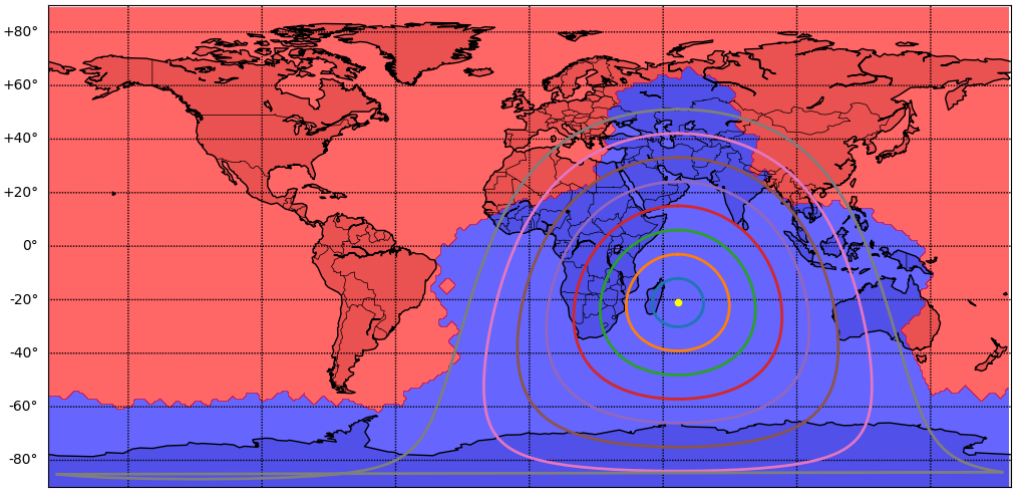
    La Réunion EU MEOLUT Service Coverage Area
    La Réunion EU MEOLUT Service Coverage Area

    The case in point: First Return Link Distress Alert under the Coverage of the new SAR Galileo MEOLUT

    As we commemorate the anniversaries of C/S, FMCC and the new SAR/Galileo MEOLUT, the 1st Return Link Service distress alert was recorded by Galileo coincidentally within the area of coverage of the newly inaugurated SAR/Galileo MEOLUT.

    On 18 November, the Asteria, an 11m sailing boat captained by Helsinki life-long skipper Tapio Lehtinen, competing in the Golden Globerace noticed a strong unidentified water intake from astern. Tapio had only time to put on his survival suit, grab the grab-bag and jump into open seas with the liferaft, where at 8h 44min 44sec activated his SAR/Galileo Return Link PLB and saluted the Asteria for the last time as she was sinking.

    The Asteria sunk in a little less than 5 minutes somewhere around 37°24’14.4″ S, 44°11’50.4″E roughly 2000km South-West of La Rénion MEOLUT Service Coverage. The first detection was received by C/S a minute after activation (8h45min34s) where the first confirmed location occurred at 8h 48min 34sec (4 min after), the latter triggered the Return Link Message request to the Galileo Return Link Service Provider (RLSP) which in turn delivered the automatic acknowledgement back to Tapio’s PLB back to the originating beacon through the Galileo constellation Signal in Space (I/NAV E1) with a lightning fast response of just 14 seconds and a confirmed reception time 8h 48min 49s.
    The Galileo Return Link Service is a free-of-charge global service available through Cospas-Sarsat RLS-compatible beacons fully operational since January 2020 and is designed to increase survival rates by giving an important psychological boost to people in distress such as Tapio’s case.


  • 2022-10-20 | Coastguard rescues sailor 700 miles off Irish coast in Atlantic Ocean – urges all seafarers to have a 406 EPIRB

    The UK Coastguard coordinated the rescue of an experienced sailor 700 miles off the Irish coast after their mast snapped off in stormy conditions.

    The Coastguard praised the experienced American sailor for having two properly registered emergency beacons, which had been his only method of communication.

    The Coastguard’s Joint Rescue Coordination Centre (JRCC) received two 406 distress beacon alerts from the yacht 700-miles west of Ireland on Friday evening.

    The vessel had extensive damage and was drifting in very poor weather conditions.

    Two aircraft and three vessels were tasked in “a lengthy and complex search and rescue mission”.

    “The signals from the [406] EPIRBs were the only means we had of knowing where the sailor was and that he was in distress. All other communications methods had been destroyed during the event that led to his dismasting.”

    “I’d really encourage anyone who sets to sea to carry an EPIRB and to register it with their national authority – in the UK that is HM Coastguard. An up to date registration means we have additional information to help with any rescue that’s required.”

    Read more and view video here:

    https://www.newsletter.co.uk/news/coastguard-rescues-sailor-700-miles-off-irish-coast-in-atlantic-ocean-urges-all-seafarers-to-have-an-epirbs-beacon-3883415

    https://youtu.be/qpAaypRsMn0

This site is registered on wpml.org as a development site. Switch to a production site key to remove this banner.