Cospas-Sarsat is commemorating the 40th anniversary of the first person rescued through its system of international cooperation. Forty years since, 45 governments are now participants in this effort which has helped in the rescue of over 55 000 people. To learn more about that first rescue, see http://cospas-sarsat.int/images/stories/SystemDocs/Current/bul25%20v%2021102013.pdf
Category: System Overview
-
2022-08-24 | 406 Beacon Alert Leads to Rescue of Two Rowers
This was the first time the RAF has dispatched a Poseidon P8 aircraft to be used for UK search and rescue.
The aircraft was scrambled to the position and supported efforts by providing an overview of the rescue and a communications link from the scene back to the UK.
The boat of the two crew members, from the Faroe Islands, had capsized nearly 800 nautical miles off the British coast in Cornwall, with the 406 beacon signal sent to the JRCC at about 06:10 UKT on Thursday.
They boarded their life raft and were eventually saved by the merchant ship, which had been diverted to the origin of a radio distress beacon in the Atlantic Ocean.
‘World-leading capability of the Poseidon’
JRCC Commander Rob Priestley said: “We are very grateful to the merchant vessel that stopped its busy schedule to rescue these survivors in very challenging weather conditions, and thankful to our friends at the RAF who provided such good support for this incident.”
Wing Commander Adam Smolak, commanding the RAF’s 201 Squadron, said: “We were delighted to support the Coastguard in this search and rescue operation.
“This operation showcases the world-leading capability of the Poseidon aircraft and, coupled with the highly skilled crews, we were able to bring to bear the capability at short notice and help rescue the rowers.”
View video and read more here: https://www.forces.net/technology/aircraft/rafs-poseidon-helps-rescue-rowers-stranded-atlantic-ocean
-
2022-07-20 | Sailboat crew and dog rescued in Corsica, France
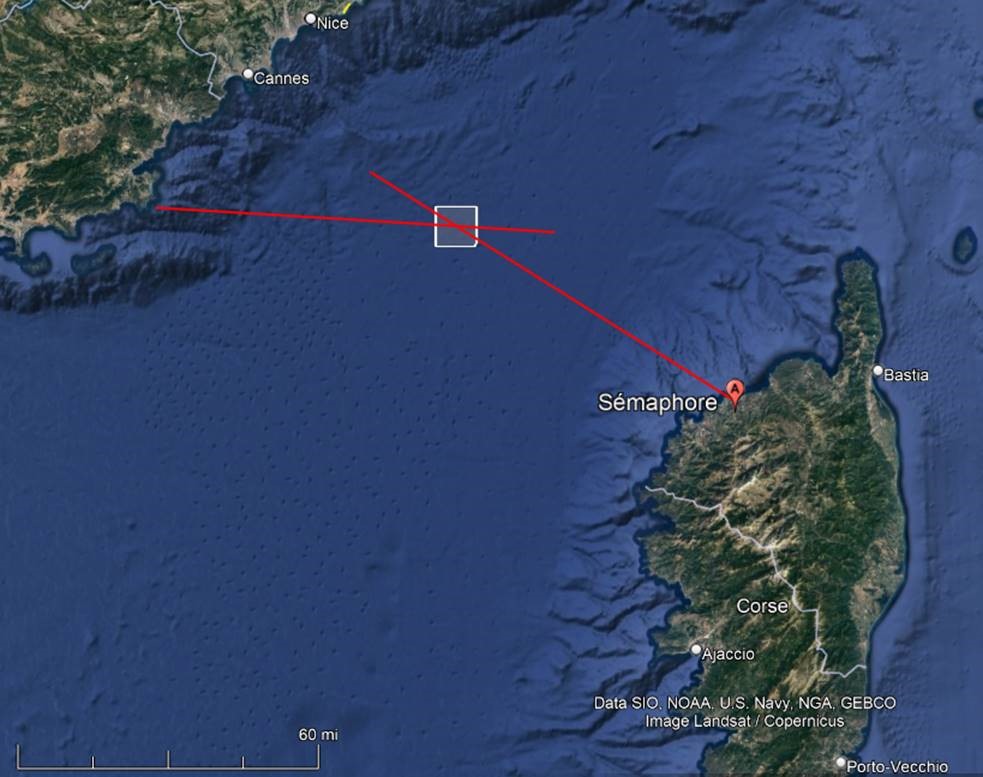
On Tuesday July 19, at a position northwest of the small town of Calvi, Corsica, France, a 50-foot vessel named OCCITAN suffered a water ingress and began to sink.
The crew sent a MAYDAY call via VHF radio, but no position indication and no clear reason for the distress was received by the Maritime Rescue Coordination Sub-Centre (MRSC) in Ajaccio.
Information from two coast stations receiving the VHF distress call initially allowed MRSC Ajaccio to triangulate the position and define a wide search area.
Two helicopters, DRAGON 2B of the French Civil Security and PUMA SAR of the French Air Force, as well as the rescue boat SNS 062 “MARIUS OLIVERI” of the French SNSM of Calvi were assigned to investigate.
Shortly after, the independent position sent by the EPIRB of the OCCITAN was received by the Cospas-Sarsat System, and transmitted to the SAR assets to facilitate the search operation.
Arriving on the scene, DRAGON 2B quickly winched the two people on board and their dog and transported them to Calvi Hospital. The life raft was then recovered by the rescue boat SNS 062, but the sailboat sank at a depth of 2,600 m.
The distress position information of the 406-MHz beacon was used as valuable supporting data, sending SAR units less than 1.2 NM from the actual position of the sinking vessel, enabling quick and efficient rescue of the crew and their dog.
-
2022-07-19 | Summary of FMCC activity – June 2022
Please click to access the Summary of FMCC activity – June 2022
-
2022-07-07 | 406 PLB leads team to a man mauled by a grizzly bear in Wyoming, USA
A 406 personal locator beacon was set off, prompting a rescue crew to think it might be from a crashed aircraft.
Rescuers discovered that a 68-year-old backpacker had set it off after being severely mauled by a grizzly, and tasked two helicopters to bring him to hospital.
Read more here:
https://www.cbsnews.com/news/grizzly-bear-attack-rescue-beacon-wyoming/
-
2022-07-07 | Helicopter in Bengaluru, India traced within six minutes from 406 beacon signal
Istrac MCC received a 406 beacon alert from a helicopter forced to make an emergency landing 100 km off the coast of Mumbai.
In six minutes, they traced the helicopter and transmitted location information to rescue teams.
The article highlights that Cospas-Sarsat alerts have helped save more than 2,350 lives in 164 incidents since 1991.
The INMCC also plays a major role in providing 406 distress alert information to SAR Points of Contact (SPOCs) of seven neighbouring countries.
Read more here:
-
2022-07-07 | “It’s Probably the Best Life Insurance Policy you Can Get”: RCCNZ Responds to Beacon Activation 10,000 Kilometres Away
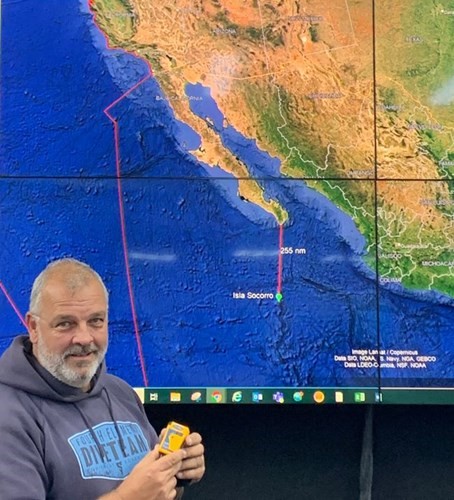
Pete Mesley’s trip to dive with whale sharks, giant mantas and hammerheads near remote islands off the coast of Mexico was a “mind-blowing” experience.
But when that experience became an emergency, luckily he kept his head, and his New Zealand-registered 406 personal locator beacon handy.
The Kiwi diver runs Lust4Rust and Shock&Awe Big Animal Diving Excursions, helping clients get close to some of the globe’s largest marine creatures and shipwrecks.
That’s what he was doing last month, with six multi-national clients, in the Revillagigedo Islands, nearly 580 km west of Mexico.
“We had just finished two days on a location called Roco Partida,” he says.
“This place was going off… a humpback whale and her calf, false killer whales and schooling tuna. It was mind blowing.”
But the adventure took a terrifying turn as their boat, with 14 passengers and 11 crew aboard, headed towards Socorro Island, 320km from the Mexico coast.
“It was about 2 am … the ship ploughed into the south-western end of the island.”
Passengers were “screaming” as the listing vessel was “lifted by the waves and smashed into the rocks”.
Crew called a nearby naval base for help, the life raft was deployed, and Pete grabbed his 406 personal locator beacon.
“Even though I was told that the call was made for assistance I wasn’t taking any chances with rescue efforts.”
About 10,000 kilometres away, the Lower Hutt-based Rescue Co-ordination Centre New Zealand (RCCNZ) was alerted through a global satellite system that raises the alarm for authorities in the country where the 406 PLB is registered.
Senior Search and Rescue Officer Nick Burt says the RCCNZ responded by contacting rescue officials in the United States and Mexico to make sure help was on the way.
Photo: Pete Mesley
Kiwi diver Pete Mesley with the PLB that played a role in his rescue.
Pete visited the RCCNZ recently to thank those involved in the operation.
Later they were able to contact Pete’s family and inform them that everyone had been rescued and there were no serious injuries.
Nick says alerts from so far away are not common, but they’re a reminder of the value of 406 PLBs as a safety tool.
“We would definitely encourage anybody participating in remote activities, such as boating, aviation, climbing, tramping and hunting in the back country to carry a COSPAS-SARSAT 406 distress beacon, whether that be in New Zealand or overseas.”
Pete agrees. “It’s a no-brainer for me. They are not expensive and probably the best life insurance policy you can ever get.
“It’s amazing how quickly the RCCNZ responded and it’s super reassuring to know that even if I’m 7,000 miles away from home, there are people dedicated to ensuring my health and safety.”
-
2022-07-07 | Two Collaborative Rescues Save Lives in the Pacific
The Rescue Coordination Centre (RCCNZ) recently played a key role in rescuing 11 people around the Pacific over just a few days.
RCCNZ’s coverage area goes down as far as the South Pole and extends nearly up to the Equator.
It responds to approximately 1,200 search and rescue incidents each year.
During the period of 21-24 May 2022, two responses off the coasts of American Samoa and Kiribati saw 11 people rescued from three vessels.
“While this is the work our people are trained to do, it’s always fantastic to see positive results come from such complex missions, and I’m very proud of the work our operational staff put in.” Rescue Coordination Centre and Safety Services Manager, Justin Allan says.
“It was also a great example of collaboration with our partners, both here and internationally,” he says.
The first rescue occurred off the coast of American Samoa.
RCCNZ received an activation from a US-coded 406 beacon positioned 11 nautical miles east of American Samoa.
US Coast Guard in Pago Pago (American Samoa) was contacted for support and tasked a vessel.
Coast Guard in Honolulu provided registration details for the 36-foot vessel.
The vessel was en route back from an outlying island about 60 miles away.
A vessel with a small helicopter onboard heard the communications and tasked its helicopter to investigate.
The helicopter found the vessel capsized with four people in the water. They directed the marine patrol vessel and it rescued those four people.
“It’s always really special knowing the work we do ensures people can get home safely after being lost at sea,” Justin says.
He says it’s fantastic to work alongside talented and committed partners from around the world as well.
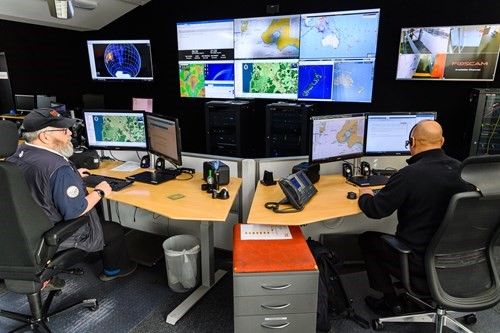
Photo: Behind the scenes at RCCNZ
The second involved two vessels off Kiribati, and started on the weekend of 20 May 2022.
It was a multi-day operation, which saw seven people rescued off two vessels, and included support from the New Zealand Defence Force (RNZDF).
Its P3 found both vessels.
RCCNZ’s initial involvement was looking for a vessel with three people onboard, while a second operation was getting underway with the US Coastguard looking for another vessel with three onboard.
The Orion left Auckland on 23 May and managed to track down both vessels. Survival packs were dropped and nearby vessels were contacted to rescue those onboard.
“Both vessels had drifted a substantial distance, and this is an incredibly isolated and remote part of the Pacific Ocean.
“The RNZDF did an amazing job locating both vessels, as the possible search area was over thousands of nautical miles.
“I know our team is really proud to be involved in successful rescues like these,” Justin says.
-
2022-06-23 | Summary of FMCC activity – May 2022
Please click to access the Summary of FMCC activity – May 2022
-
2022-05-05 | Summary of FMCC activity – April 2022
Please click to access the Summary of FMCC activity – April 2022