Dear colleagues,
Please be informed that a new revision of document C/S S.007 “Handbook of Beacon Regulations” is available on our website.
Dear colleagues,
Please be informed that a new revision of document C/S S.007 “Handbook of Beacon Regulations” is available on our website.
NOAA showcases Sarsat technology and a beneficiary of the SAR work that Cospas-Sarsat supports on Sarsat Media Day.
Interviews on CTV-76 in Florida with a survivor and leading players from NOAA’s USA Cospas-Sarsat core delegation.
Watch the video here:
https://www.youtube.com/watch?v=t58lVEP-Ew4&feature=youtu.be
And read more here:
http://www.nesdis.noaa.gov/news_archives/rescue.html
A once-in-a-decade swell impacted the West Australian coast, punching a hole in the deck of the ‘Grey nomad’s’ yacht and letting in water faster than the pump could cope.
The sailor, who has circumnavigated the globe numerous times, rang the RCC by satellite phone and a few minutes later the beacon was detected.
He said the ordeal lasted two-and-a-half hours before he was finally rescued.
“Amazing job these guys did — they backed up to the boat and came alongside,” he said.
“The footage looks quite mild but the sea was quite confused, very huge and I thought ‘Geez, I don’t know how they’re going to do this, I’ll probably get on board with a broken arm or leg or something’. I’m pretty lucky.”
Read more here:
http://www.abc.net.au/news/2015-06-28/renowned-sailor-jon-sanders-blames-huge-swell-for-yacht-rescue/6579042
https://au.news.yahoo.com/thewest/wa/a/28593218/sanders-high-seas-scramble-to-safety/
Exceeding all expectations, RCCNZ coordinated the rescue of three sailors from their stricken US yacht in remote waters 150 nm south of Niue, New Zealand.
The skipper woke the others when a fire in the engine compartment engulfed the yacht just after midnight, managing to reach the German-registered EPIRB before abandoning to the life raft.
Read more here:
http://www.maritimenz.govt.nz/news/media-releases-2015/20150624a.asp
RCCNZ reminds beacon users that irresponsibly dumped distress beacons are wasting tens of thousands of dollars and risking lives by diverting resources from genuine rescues.
The battery needs to be disconnected and the beacon disposed of according to local regulations, as many beacons contain hazardous materials.
Read more here:
A three-day Search and Rescue Exercise in Tok Bali launched with advice and information for owners of fishing boats regarding the devices.
The beacons are part of the Cospas-Sarsat satellite system that can detect and determine the position of distress signals operating at 406 MHz.
Read more here:
Trapped between Boo Boo Hut and Crawford Junction Hut in Westland, New Zealand, a man and a woman trapped by rising flood waters spent a very wet Wednesday night in a makeshift shelter after activating their PLB.
The Greymouth-based Coal and Carbon Rescue Helicopter winched the pair to safety, and then later in the day rescued another PLB-wielding tramper from nearby upper Whitcombe Valley who had injured his knee.
Read more here:
https://www.maritimenz.govt.nz/news/media-releases-2015/20150522a.asp
A 406 beacon was detected registered to a 4.5m runabout with one person on-board.
The RAC Rescue Helicopter deployed from Perth located one man in the water next to his capsized vessel and winched him to safety.
“The EPIRB saved his life – if he had been in the water for a long-time he would have got hyperthermia,” Bunbury Sea RescueCommander James Armstrong said.
Read more here:
http://www.bunburymail.com.au/story/3094166/bunbury-man-winched-from-the-sea-after-boat-capsizing/
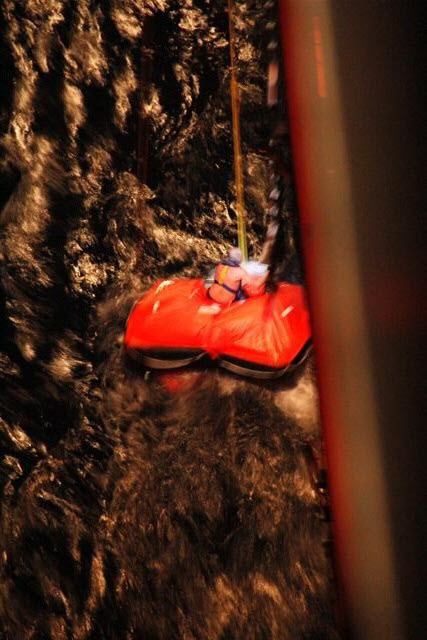
AMSA assisted the Port Moresby Maritime Rescue Coordination Centre in the rescue of six people from a liferaft after their boat sank.
Search and rescue authorities were alerted to the boat sinking after detecting a Philippines-coded EPIRB set off about 170km off the coast of Papua New Guinea.
A Taiwanese bulk carrier diverted course to its location and rescued the six people, all reported to be in good health.
View photos here:
https://www.facebook.com/AustralianMaritimeSafetyAuthority/posts/1104718472877393
Stranded several hundred meters from the ground while climbing in New South Wales, Australia with his friend, the pair called for assistance and set off their emergency beacon.
Rescue crews scaled 30 metres down from the top of the cliff and helped him to a lower ledge from which crews supervised him as he gently lowered himself safely to the ground.
Read more and watch video here:
http://www.9news.com.au/national/2015/05/31/18/43/daredevil-rock-climber-lucky-to-be-alive-after-getting-tangled-in-rope-on-cliff-face