Category: System Overview

  • 2019-04-16 Task Group Meeting on Second-Generation Beacons (SGBs) and SGB/FGB ELT(DT)s

    The 2019 Task Group Meeting on Second-Generation Beacons (SGBs) and SGB/FGB ELT(DT)s was held in Montréal, Canada from 8 to 12 April 2019.

    Mr. Jesse Reich (USA) chaired the meeting.

    67 delegates from 12 Cospas-Sarsat Participants, 1 Observer Organization and the Secretariat took part in the meeting.

    Group Photo

  • 2019-04-16 406 Day – USA Coast Guard responds to over 200 beacon alerts annually

    April 6 (4/06) was 406 Day – a national campaign run by NOAA to spread awareness of the importance of emergency position indicating radio beacons (EPIRBs) that broadcast their emergency signals on the protected band, 406 MHz.

    EPIRBS are used for boating safety, and personal locator beacons (PLBs) are also used on boats, as well as in a variety of remote outdoor activities. For aviation, emergency locator transmitter (ELT) beacons are used.

    In 2018, the Eighth Coast Guard District responded to over 200 distress signals from beacons aboard aircraft and boats in the USA.

    This capability forms part of the International Cospas-Sarsat Programme, an international co-operative programme that supports search and rescue worldwide through a satellite-aided communication system.

    Beacons that are type-approved by Cospas-Sarsat function with their LEOSAR, GEOSAR, and now MEOSAR systems of satellites and the signals are relayed to the rescue infrastructure available to all States on a non-discriminatory basis.

    Beacons that are in the Cospas-Sarsat System are purchased and used on a subscription-free basis.

    It is important to register your beacon and keep these details up to date to enable the rescuers using the System to respond more efficiently to any alert.

    406 Day encourages aviators, boaters and outdoor enthusiasts to update their beacon registration, check their battery expiration date, and self-test their beacons to make sure they are working perfectly.

    It is also an opportunity to celebrate the 43,000+ lives saved worldwide since the mid-1980s by using emergency distress 406 MHz beacon signals and the Cospas-Sarsat System.

    For evidence of the effectiveness of beacons check out SurvivorClub, which provides real-life testimonies shared by people of all ages and from all walks of life, who thanks to their beacon, have lived to tell the tale.

    Read more here:
    https://www.workboat.com/news/government/epirbs-awareness-day-april-6/
    https://www.acrartex.com/stories
       
    https://www.powerboat-world.com/news/216076/Benefits-of-EPIRBs-and-Personal-Locator-Beacons 
    http://406.org 
  • 2019-04-04 MEOSAR advantage: Fishermen in Australia rescued after weight of two sharks sinks boat

    The new Cospas-Sarsat MEOSAR system gave about an hour advantage in this case over LEOSAR.

    The two fishermen were fishing 60 km offshore in New South Wales and had already hooked one shark that was brought onboard.

    Late in the afternoon they hooked another shark, but when they brought it on board the combined weight of the two caused the stern to tip and take on water.

    The winch operator aboard the rescue helicopter said that the men were well equipped to facilitate a rescue, both wearing lifejackets.

    They activated their 406 EPIRB and an emergency flare to alert authorities, and when rescuers arrived, the first thing they saw was the flare.

    The article calls it a GPS emergency beacon but the beacon didn’t have a global navigation satellite system receiver, and was not able to transmit an encoded location.

    The fishermen were being winched out of the water as the first LEOSAR detection was received.

    “They were extremely grateful to be winched aboard, and in good spirits too” said the winch operator.

    The fishermen’s boat was left out at sea, with the outline of one of the sharks still visible as the bow dipped below the water’s surface.

    Watch video of the rescue and read more here:
    https://www.9news.com.au/national/news-nsw-fishermen-rescued-after-shark-sinks-boat/aec756f8-fe01-4fb5-a9fa-26bf37104fab 

  • 2019-03-26 NZ Crayfish 10m commercial boat swamped but had new float-free 406 EPIRB.

    The carriage of float-free EPIRBs was made mandatory for commercial fishing vessels between 7.5m and 24m that operate outside enclosed waters in New Zealand, on January 1 2019.

    Friday morning, three crew were rescued off the Chatham Islands in New Zealand from a sinking crayfish boat thanks to a float-free 406 EPIRB that had only recently been installed.

    “The only way we knew they were in difficulty was the alert from the EPIRB distress beacon. It’s vital to have one on board,” a senior search and rescue officer from the NZRCC said.

    In this case the float-free capability of the beacon was essential as the skipper had attempted to manually retrieve the beacon to activate it without success. The float-free housing of the beacon deployed automatically, allowing it to float to the surface.

    Nearby boats were alerted by the rescue coordination centre and tuned into the VHF network to assist.

    A fishing boat was the first on the scene and picked up the stricken crew less than 1.5 hours after the NZRCC had received the alert and delivered them safely to land where they were treated for hypothermia, cuts and bruises.

    Read more here:
    https://www.odt.co.nz/slideshow-section/general/emergency-beacon-saves-lives-crew  
    and
    https://www.gme.net.au/2019/gme-float-free-epirb-instrumental-in-successful-rescue-of-commercial-fisherman-1.aspx 

  • 2019-03-22 CSC-61 Open Meeting

    The 61st Session of the Cospas-Sarsat Council was held in Montréal, Canada from 4 to 7 February 2019. Mr. Michael Donald (Canada) chaired the meeting.

    116 delegates representing 29 Cospas-Sarsat Participants, one Non-Participant participating as an observer, three Observer Organizations, and the Secretariat took part in the meeting. 

    CSC-61-OPN Group Photo


  • 2019-03-05 Discarded distress beacons do not belong in garbage dumps

    Rescue crews who spent two hours sifting through rubbish at a garbage dump in Sydney, Australia after a discarded distress beacon was activated have pleaded with the public to dispose of the devices correctly.

    By 4:00pm they had moved five tons of junk but still hadn’t found the beacon, chief executive officer Stephen Leahy said.

    “I had my rescue crews sifting through household rubbish and even animal carcasses, trying to find this beacon so we could turn it off,” he said.

    “Inadvertent activations of distress beacons potentially make vital resources unavailable for use in real emergency situations,” the spokesman said.

    It’s also another reason why registering your beacon and keeping your details up to date is so important.

    Read more here:
    https://www.abc.net.au/news/2019-03-04/distress-beacon-prompts-emergency-response-to-tip/10869214  

  • 2019-02-28 Testimonial from a grateful 406 PLB user in the UK

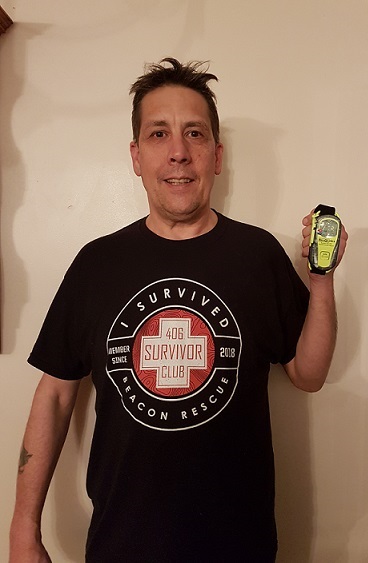
    Photo

    Hi,

    Just a photo of my PLB and T-shirt.

    I started off fishing just out of Lymington at 5 PM on an October afternoon. When I finished about 11 PM I decided to head in so lifted anchor and started paddling.

    I didn’t use my chart plotter as I knew I was only 5 minutes away from the main Lymington River, so off I went heading for the lights of the town.

    Little known to me, after about one hour, which I thought was strange, I ended up in Yarmouth on the IOW the opposite side to Lymington about two miles away. Ooops.

    So I then decided to set my chart plotter for Lymington and set off. After about one hour of getting nowhere, I realised I was caught up in a strong current that was just sending me in a huge circle.

    Now the time was around 3 AM and as I was getting nowhere, I gave in. I had only purchased my PLB a week before as I thought it would be a great safety net. Phew.

    “Ok, here we go,” I thought. So I activated my beacon and got on the radio to the coastguard, reported my issue and got the response of “WE HAVE YOUR POSITION FROM YOUR BEACON and have mustered the Yarmouth lifeboat.” They then picked me and my kayak up and took me back to Lymington.

    They did praise me for having all the correct equipment.

    My story is one of a happy outcome and although I knew I was in trouble at 3 AM in the pitch black with my mind trying to play tricks, I felt reassured and safe knowing I had my PLB. It really is a lifesaving device.

    After I wrote my story on the survivor club website I sent off my PLB and received a new one two weeks later along with a T-shirt.

    So along with them and yourselves at the coastguard RNLI I truly feel very safe whilst playing with Mother Nature in her playground.

    Many thanks,

    Darren

  • 2019-02-22 What is the advantage of having an EPIRB compared to a VHF radio?

    A search and rescue volunteer for over sixty years in Papua New Guinea outlines the benefits of having an EPIRB when on the open sea.

    A VHF radio is useful for communicating with other nearby boats and harbourmasters, but in remote areas without line-of-sight communication, an EPIRB is a cost-effective and more robust alternative if you run into difficulties.

    VHF radios are waterproof, but will not transmit underwater, while a handheld EPIRB will alert search and rescue authorities via satellite, often within minutes of being activated.

    Read more here:
    https://www.thenational.com.pg/its-the-locator-beacon-not-vhf-radio-that-will-save-your-life/ 

  • 2019-02-21 Cospas-Sarsat System Data No. 44

    Dear colleagues, the new issue of the “Cospas-Sarsat System Data” No.44 in English, French and Russian is now available on our website.

    https://www.cospas-sarsat.int/en/documents-pro/system-data

This site is registered on wpml.org as a development site. Switch to a production site key to remove this banner.