Category: Uncategorised

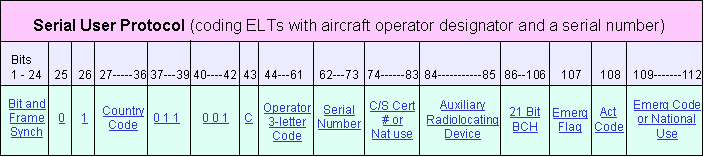
  • Serial User Protocol Coded with the Aircraft Operator Designator and a Serial Number

    You have selected the Serial User Protocol to be coded with the identification of the aircraft operator and a serial number. An interactive diagram depicting the information which should be coded into the beacon is provided below. Click on the hyperlinked fields of the diagram for additional information concerning the format, structure and content of the coding for that field.

    Serial user_ELT_op_designator


    Final Step: Register your beacon.

    Having purchased and coded your beacon, one of the most important actions that you must take to maximize its effectiveness is to register the beacon with the appropriate national authority. Registering your beacon provides search and rescue authorities with access to vital information (e.g. telephone numbers for emergency points of contact, type of aircraft, etc.) that is absolutely critical for efficiently conducting any search and rescue operation.

    For further details concerning beacons refer to the following documents (available for downloading):

    • C/S T.001, Specification for Cospas-Sarsat 406 MHz Distress Beacons;
    • C/S G.005, Cospas-Sarsat Guidelines on 406 MHz Beacon Coding, Registration and Type Approval.
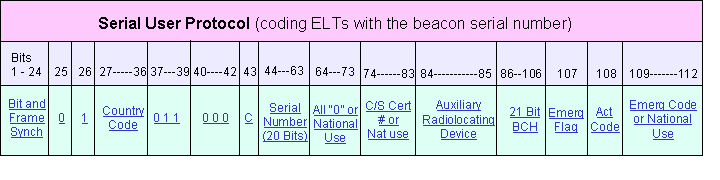
  • Serial User Protocol Coded with ELTs Unique Beacon Serial Number

    You have selected the Serial User Protocol to be coded with a beacon serial number identification. An interactive diagram depicting the information which should be coded into the beacon is provided below. Click on the hyperlinked fields of the diagram for additional information concerning the format, structure and content of the coding for that field.

    /Protocols/

    serial_user_elt_bnc_ser_number


    Final Step: Register your beacon.

    Having purchased and coded your beacon, one of the most important actions that you must take to maximize its effectiveness is to register the beacon with the appropriate national authority. Registering your beacon provides search and rescue authorities with access to vital information (e.g. telephone numbers for emergency points of contact, type of aircraft, etc.) that is absolutely critical for efficiently conducting any search and rescue operation.

    For further details concerning beacons refer to the following documents (available for downloading):

    • C/S T.001, Specification for Cospas-Sarsat 406 MHz Distress Beacons;
    • C/S G.005, Cospas-Sarsat Guidelines on 406 MHz Beacon Coding, Registration and Type Approval.
  • Step 4: Non-location Protocol Coding for ELTs

    So far you have confirmed that your distress beacon will be used as an aviation Emergency Locator Transmitter (ELT) and that it is a non-location protocol beacon. Four coding options have been developed for this type of beacon. However, your selection should be restricted to those protocols that have been authorised by your country’s competent authority on distress beacon matters (additional information concerning the authority/responsibility of States in respect of beacon message protocol selection is described at step 1 of this tutorial). From the protocols approved for use by your country’s designated authority on distress beacon matters, the option to be selected depends on the information that you would like programmed into the beacon and its intended use. To proceed select the option that best suits your needs.

    Serial User Protocol Coded with a Unique Beacon Serial Number: This option uses a serial number, allocated by either the competent national authority or the beacon manufacturer, to uniquely identify the beacon. A feature of this protocol is that it does not include information which directly identifies the aircraft in which it is installed, consequently, the ELT can be moved to another aircraft without necessarily requiring recoding. When this protocol is used, SAR services are 100% dependent upon beacon registration for obtaining any information concerning the aircraft or the operator of the beacon. Therefore, it is essential to ensure that the beacon is properly registered and that registration information is updated if the registration information changes or the beacon is moved to a different aircraft.

    Serial User Protocol Coded with the Aircraft Operator Designator & a Serial Number: This protocol was designed for use by operators of fleet(s) of aircraft (e.g. airlines). This option uniquely identifies the beacon using a combination of :

    • an aircraft operator designator code defined in accordance with International Civil Aviation Organization (ICAO) DOC 8585, accompanied by
    • a serial number between 1 and 4096 assigned by the operator.

    Since the beacon code identifies the operator, subject to national regulations, the operator will be able to change ELTs amongst its fleet, provided that the operator establishes a 24-hour point of contact available to SAR services for informing SAR personnel of which ELT is on which aircraft.

    Serial User Protocol Coded with the Aircraft 24-Bit Address: This option uses the unique 24-bit binary aircraft identification code assigned by National Administrations to encode the beacon identification. The format for the 24-bit code is described in Annex 10 to the Convention on International Civil Aviation. This code can only be used if your country assigns a 24-bit designator to your aircraft.

    Aviation User Protocol Coded with the Aircraft Nationality and Registration Marking: This option uses the unique alphanumeric aircraft registration marking assigned by National Administrations to code the beacon identification. The format for this designator is provided in Annex 10 to the Convention on International Civil Aviation.

    Note: The Convention on International Civil Aviation requires all 406 MHz ELTs to be registered with the appropriate national authorities.

    Return to Beacon Coding Tutorial Flow Chart

  • Step 4: Location Protocol Coding for ELTs

    So far you have confirmed that your distress beacon will be used as an aviation Emergency Locator Transmitter (ELT) and that it is a location protocol beacon. Three coding options have been developed for this type of beacon. However, your selection should be restricted to those protocols that have been authorised by your country’s competent authority on distress beacon matters (additional information concerning the authority/responsibility of States in respect of beacon message protocol selection is described at step 1 of this tutorial).

    It should also be noted that the beacon message protocols that have been verified during the type-approval testing are shown on the Cospas-Sarsat Type Approval Certificate issued by the Cospas-Sarsat Secretariat.

    In view of the above, the selection of protocol should be further limited to those that have been type approved for use with the beacon model selected.

    Having satisfied the two overriding criteria detailed above, the coding option to be selected depends on the information that you would like programmed into the beacon and its intended use. To proceed, select the option that best suits your needs.

    User Location Protocols: This option is formed by coding bits 1 through 106 of the ELT as a User Protocol, and providing the encoded location information to 4-minute resolution (approximately 6 miles or 10 kilometers) in the remaining bits. These protocols are only available in the long message format, and provide the lowest accuracy resolution of all long message format location protocols.

    Standard Location Protocols: This option uniquely identifies the ELT using either:

    • the 24-bit binary aircraft identification assigned by National Administrations,
    • a unique serial number allocated by either the competent national authority or the beacon manufacturer accompanied by the Cospas-Sarsat beacon type approval certificate number, or
    • the Aircraft Operator designator and a serial number.

    The Standard Location Protocols allow for location information of 4-second resolution to be encoded in the beacon message (approximately 120 meters). These protocols are only available in the long message format.

    National Location Protocols: This option uses a unique serial number allocated by the competent national authority to uniquely identify the beacon. The National Location Protocols allow for location information of 4-second resolution to be encoded in the beacon message (approximately 120 meters). These protocols are only available in the long message format.

    Return to Beacon Coding Tutorial Flow Chart

  • Step 3: Determine if ELT is a Location Protocol Beacon

    ELTs can be divided into two categories: location protocol ELTs and non-location protocol ELTs.

    A non-location protocol ELT does not have the capability to determine its own location, therefore, the distress position can only be determined by the Cospas-Sarsat System using Doppler location techniques.

    A location protocol ELT is able to determine its own location, normally using an internal or external satellite navigation device (e.g. GPS), and transmit this location information in the beacon’s message. In addition, location protocol beacons will also be located by the Cospas-Sarsat System using Doppler location techniques.

    An approved beacon model that is a location-protocol beacon will show a “Nav Device” available in its TAC Report, which can be viewed on the Professionals website (Pro/Beacons/Beacon Information/Approved Beacon Models (TACs)).

    Click on the appropriate beacon category to proceed to Step 4:

    For further details concerning beacons refer to the following documents (available for downloading):

    • C/S G.005, Cospas-Sarsat Guidelines on 406 MHz Beacon Coding, Registration and Type Approval,
    • C/S T.001, Specification for Cospas-Sarsat 406 MHz Distress Beacons.

    Return to Beacon Coding Tutorial Flow Chart

  • Step 2: Beacon Type

    There are many different beacon message protocols available. However, different protocols are defined for specific types of distress beacons. For example, a given protocol may be authorised for use with beacons installed on aircraft, but should not be used for beacons installed on maritime vessels.

    The choice of protocols is narrowed by the type of beacon to be coded. Select the type of beacon from the list below to proceed to step 3:

    • ELT – Emergency Locator Transmitter designed for installation on aircraft;
    • EPIRB – Emergency Position Indicating Radio Beacon designed for installation on maritime vessels;
    • PLB – Personal Locator Beacon designed to be carried by a person.

    Although it does not impact upon the selection of a beacon message protocol, beacon types can be further subdivided by their method of activation. In the aviation domain there are automatic and manual ELTs. Automatic ELTs are designed to be activated automatically using a crash sensor or G-switch, whereas manual ELTs can only be activated by the ELT operator. Similarly, in the maritime domain there are float free and non-float free beacons. Float-free beacons are designed to float away from a sinking vessel and activate automatically, whereas non-float-free beacons are activated manually.

    Later in the tutorial a detailed explanation of all beacon message protocols will be provided.

    Return to Beacon Coding Tutorial Flow Chart

  • Step 1: Contact your Country’s Administration

    States have the authority and responsibility to decide which beacon types, models and message protocols are authorised for use within their jurisdiction. Consequently, when considering which beacon message protocol would be most appropriate for your requirements, the first step should always be to contact the organization in your country responsible for distress beacon coding and registration to determine which beacon types (e.g. ELT, EPIRB, PLB), models, and message protocols are authorised or mandated. National Contacts for Beacon Matters are listed on the Professionals website (Pro/Contact Lists).

    Failure to take this step may result in the beacon not being accepted.

    Please advise the Cospas-Sarsat Secretariat at mail@cospas-sarsat.int if the point-of-contact information for your country is out of date.


    Proceed to Step 2

    Return to Beacon Coding Tutorial Flow Chart

  • Alert Data Distribution

    The Cospas-Sarsat Data Distribution Plan

    The purpose of the Cospas-Sarsat Data Distribution Plan (document C/S A.001, “the DDP”) is to:

    • establish basic data distribution principles, and
    • define procedures to be implemented by Cospas-Sarsat Mission Control Centres (MCCs) for distributing Cospas-Sarsat alert data and System information.

    The annexes to the DDP provide:

    • a description of the Cospas-Sarsat Space and Ground Segments (Part I), and
    • a detailed description of the operational procedures to be applied by MCCs (Part II).

    Data Distribution

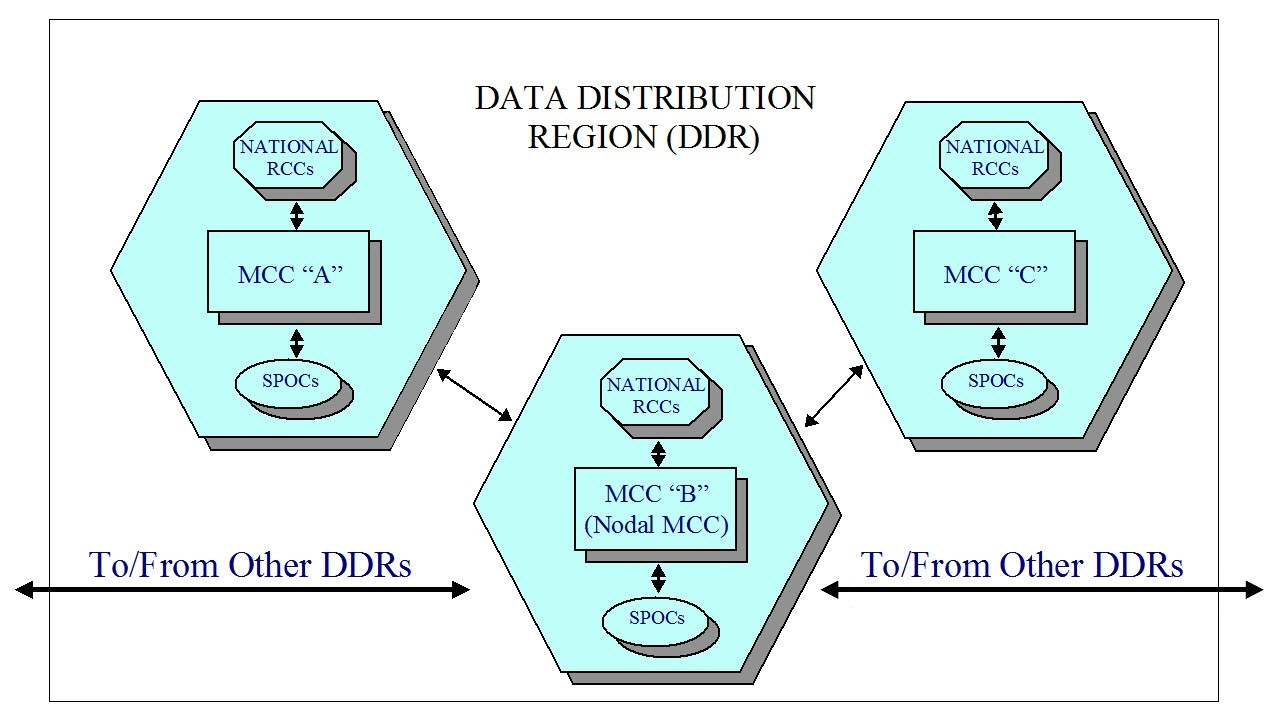
    Cospas-Sarsat alert data generated by LEOLUTs and GEOLUTs are distributed to the appropriate Rescue Coordination Centre (RCC) or Search and Rescue Point of contact (SPOC), according to the computed position of the distress and/or the country code of the beacon. Due to the high degree of redundancy in the Cospas-Sarsat Ground Segment (each operational LUT is capable of providing essentially the same data in the global mode of operation), such distribution must be coordinated and redundant data filtered out of the ground communication network. Each LUT is linked to an associated Mission Control Centre (MCC) and alert messages are forwarded to the appropriate RCC/SPOC through the MCC communication network, in accordance with the procedures described in the Cospas-Sarsat Data Distribution Plan (C/S A.001) (available under the “System Documents” section of our Professionals website – Pro/Documents).
    DDRalertdatadistribution

    For the purpose of distributing alerts, Cospas-Sarsat has established six data distribution regions (DDRs), each supported by a nodal MCC. Within each DDR there may be several MCCs responsible for the distribution of alerts for a specific geographic area (MCC service area). Alerts are routed by the Cospas-Sarsat data distribution network to the MCC whose service area supports the region where the alert was located. It is that MCC’s responsibility to forward the alert to the appropriate RCC or SPOC. Alerts that must be distributed beyond DDR boundaries are routed via nodal MCCs, and then on to the MCC responsible for the service area concerned. Cospas-Sarsat also sends the alert message to the RCC/SPOC associated with the country code of the beacon.


    Cospas-Sarsat MCC Service Area

    Each Cospas-Sarsat MCC is responsible for distributing all alert data for distresses incidents located in its service area. An MCC service area generally includes aeronautical and maritime Search and Rescue Regions (SRRs) in which the MCC’s national authorities facilitate or provide SAR services, and includes in addition such regions of other countries with which the MCC’s national authorities have appropriate agreements for the provision of Cospas-Sarsat alert data.

    MCC Service Areas are established following coordination among Cospas-Sarsat Ground Segment Providers (i.e., LUT-MCC Operators), working bi-laterally, taking into account:

    • geographical location and common SRR boundaries,

    • communication capabilities,

    • existing national SAR arrangements and existing bilateral operational agreements.

    Agreed MCC Service Areas are described in the Cospas-Sarsat Data Distribution Plan. When a Cospas-Sarsat beacon transmission is located outside the service area of the MCC that receives the alert, the alert message is either forwarded to the MCC serving the area where the distress has been located, or is filtered out if the alert data has already been received through another LUT/MCC.


    Message Formats

    Cospas-Sarsat alert messages are exchanged among MCCs according to standardized message formats. The detailed structure of messages for distribution of alert data and system information are described in document C/S A.002 “Cospas-Sarsat Mission Control Centres Standard Interface Description (SID)” (available under the “System Documents” section of our Professionals website).


    Communication Links

    The Cospas-Sarsat SID formats have been defined to allow for the transmission of alert messages on any communication system as agreed between MCCs and between a Cospas-Sarsat MCC and its associated RCCs or SPOCs. Alert messages in SID formats can be routed and processed by MCCs automatically.

    In addition to telephone (voice and/or facsimile) communications, all Cospas-Sarsat MCCs are required to have access to at least two international data networks for transmitting alert messages in order to provide maximum availability and adequate flexibility for the exchange of alert data. MCCs transmit alert data to other MCCs, SPOCs or RCCs using the following systems:

    • Automatic Fixed Telecommunication Network (AFTN) of Civil Aviation,

    • File Transfer Protocol over Virtual Private Network (FTP-VPN),

    • Facsimile/email (for SPOC/RCC communications only).

    AFTN addresses, telephone or facsimile numbers are provided on the Contacts page of the Cospas-Sarsat Professionals website (http://www.cospas-sarsat.int/en/contacts-pro/contacts-details-all). Coordination between the MCC operator and SPOCs in its service area to agree on communication systems and interfaces to be used is strongly encouraged.

    To ensure that Cospas-Sarsat alert and location data is distributed efficiently, IMO and ICAO have invited each of their Member states to designate a national SPOC and to provide the required information on available communication links either to IMO, ICAO, or the Cospas-Sarsat Secretariat.

    Cospas-Sarsat has also made available a template for a model agreement for cooperation between MCCs and SPOCs (https://www.cospas-sarsat.int/en/documents-pro/document-templates, under the System Documents tab on that page).

  • Participation in Meetings

    Cospas-Sarsat meetings are open only to designated representatives of the Administrations formally associated with the Programme and invited representatives of International Organisations.

    Simultaneous translation to and from the three languages of the Programme is provided at Council meetings. Meetings of subsidiary organs will normally be held in the English language only, with no interpretation (i.e., Joint Committees, Task Groups, Experts Working Groups).

     [module-210]
This site is registered on wpml.org as a development site. Switch to a production site key to remove this banner.