February 2019
Go to Table of Contents
1. INTRODUCTION / OVERVIEW
This document, the Cospas-Sarsat Quality Manual, defines the objectives and structure of the Cospas-Sarsat Quality Management System and is the permanent reference in the implementation and maintenance of that system.
In this document, the term Cospas-Sarsat encompasses the Cospas-Sarsat Council, Parties and Participants, as defined in document C/S P.011 “Cospas-Sarsat Programme Management Policy”. Specialized terms and acronyms relevant to the Cospas-Sarsat Programme can be found in document C/S G.004, Cospas-Sarsat Glossary.
1.1 The Cospas-Sarsat System
The International Cospas-Sarsat Programme provides accurate, timely and reliable distress alert and location data to help search and rescue authorities assist persons in distress.
The objective of the Cospas-Sarsat System is to reduce, as far as possible, delays in the provision of distress alerts to SAR services and the time required to locate a distress and provide assistance, as these have a direct impact on the probability of survival of the person in distress at sea or on land.
To achieve this objective, Cospas-Sarsat Participants implement, maintain, co-ordinate and operate a satellite system capable of detecting distress alert transmissions from radiobeacons that comply with Cospas-Sarsat specifications and performance standards, and of determining their position anywhere on the globe.
The Cospas-Sarsat System (Figure 1) is comprised of:
- satellites in low-altitude Earth orbit (LEOSAR), geostationary orbit (GEOSAR) and medium-altitude Earth orbit (MEOSAR) that process and / or relay signals transmitted by distress beacons;
- ground receiving stations called local user terminals (LUTs) which process the satellite signals to locate the beacon; and
- mission control centres (MCCs) that provide the distress alert information to SAR authorities.
The System supports distress beacons of various types: aviation Emergency Locator Transmitters (ELTs), maritime Emergency Position Indicating Radio Beacons (EPIRBs) and Personal Locator Beacons (PLBs) as well as beacons designed for special purposes, e.g., the Ship Security Alert System (SSAS) and emergency locator transmitters for ICAO specified autonomous in-flight distress tracking (ELT(DT)s).
These beacons must operate in the 406 to 406.1 MHz frequency band and meet Cospas-Sarsat requirements defined in the documents:
- C/S T.001 “Specification for Cospas-Sarsat 406 MHz Distress Beacons”,
- C/S T.007 “Cospas-Sarsat 406 MHz Distress Beacon Type Approval Standard”,
- C/S T.015, “Cospas-Sarsat Specification and Type Approval Standard for 406 MHz Ship Security Alert (SSAS) Beacons”,
- C/S T.018 “Specification for Second-Generation Cospas-Sarsat 406-MHz Distress Beacons”,
- C/S T.021 “Cospas-Sarsat Second-Generation 406-MHz Distress Beacon Type Approval Standard”.
Further details on the Cospas-Sarsat System can be found in document C/S G.003 “Introduction to the Cospas-Sarsat System”.
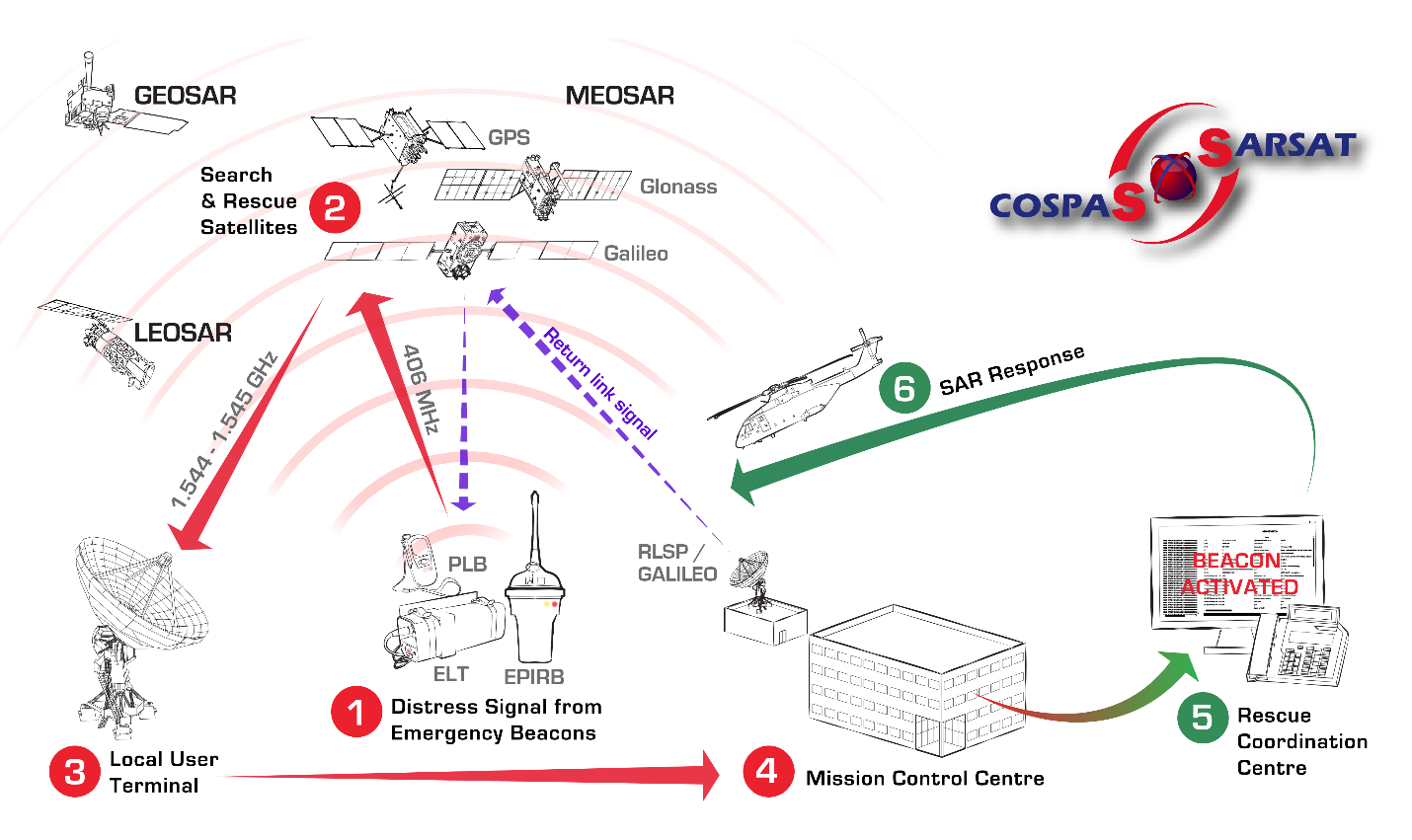
Figure 1: The Cospas-Sarsat System
1.2 Principles of Quality Management
The Cospas-Sarsat Quality Management System is based on the Seven Principles of Quality Management defined in the ISO publication “Quality Management Principles (ISBN 978-92-67-10650-2, 2015) and used as a basis for the ISO 9000:2015 and ISO 9001:2015 standard:
Principle 1: Customer focus
The primary focus of quality management is to meet customer requirements and to strive to exceed customer expectations.
Principle 2: Leadership
Leaders at all levels establish unity of purpose and direction and create conditions in which people are engaged in achieving the organization’s quality objectives.
Principle 3: Engagement of people
Competent, empowered and engaged people at all levels throughout the organization are essential to enhance its capability to create and deliver value.
Principle 4: Process approach
Consistent and predictable results are achieved more effectively and efficiently when activities are understood and managed as interrelated processes that function as a coherent system.
Principle 5: Improvement
Successful organizations have an ongoing focus on improvement.
Principle 6: Evidence-based decision making
Decisions based on the analysis and evaluation of data and information are more likely to produce desired results.
Principle 7: Relationship management
For sustained success, an organization manages its relationships with interested parties, such as suppliers.
1.3 The Process Approach
The effectiveness of an organisation implies the identification and management of numerous linked activities, each using resources to transform inputs into outputs. Often the output from one process directly forms the input to the next. The application of a system of processes within an organisation, together with the identification and interactions of these processes, and their management, can be referred to as the “process approach” (Figure 2).
Cospas-Sarsat recognises the need to fully implement a process approach in order to manage and control individual processes in an efficient and effective manner.
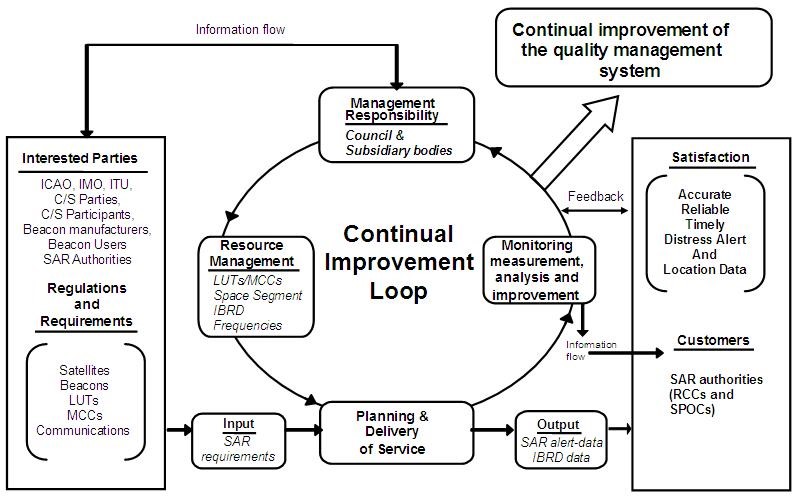
Figure 2: The Process Approach
2. REFERENCE DOCUMENTS AND DOCUMENT CONTROL
2.1 Document Control
Documents are controlled in accordance with the Cospas-Sarsat document management procedures defined in document C/S P.011 “Cospas-Sarsat Programme Management Policy”.
2.2 Reference Documents
Documents key to the management of quality within the Cospas-Sarsat System are available on the Cospas-Sarsat website (www.cospas-sarsat.org) and include:
- General (G – Series)
- Programme Management (P – Series)
- Operational (A – Series)
- Technical (T – Series)
- Reports (R – Series)
- International Beacon Registration Database (D – Series)
These reference documents are under the control of the Cospas-Sarsat Council.
3. INTERNATIONAL INSTRUMENTS
The International Cospas-Sarsat Programme Agreement (ICSPA) signed on 1st July 1988 formally establishes the International Cospas-Sarsat Programme structure and objectives. No provisions in this Cospas-Sarsat Quality Manual should conflict with the terms of the ICSPA. In the event of a conflict between the terms or provisions of the QMS and the ICSPA, the provisions of the Agreement shall prevail.
In addition to the four original Parties, other Participants in the System are formally associated with the International Cospas-Sarsat Programme as Ground Segment Providers or User States through the notification of their association to the Depositaries of the ICSPA, in accordance with the provisions of Articles 11 and 12 of the ICSPA and the notification procedures approved by the Cospas-Sarsat Council. Other instruments have been developed by Cospas-Sarsat to allow additional contributions to the System, specifically contributions to the Space Segment.
The ICSPA states that the purpose of the Programme is to, inter alia, “support, by providing distress alert and location data, the objectives of the International Maritime Organization and the International Civil Aviation Organization concerning search and rescue.” Pursuant to Article 13 of the ICSPA, “the Parties, acting through the Council, shall cooperate with the International Civil Aviation Organization, the International Telecommunication Union and the International Maritime Organization, as well as other international organisations, on matters of common interest. The Parties shall take into account the relevant resolutions, standards and recommendations of these international organisations.”
Therefore, the Cospas-Sarsat Quality Management System reflects, as appropriate, the objectives of relevant international organisations in respect of SAR and the provision of distress alerting. In particular, the Cospas-Sarsat Quality Management System strives to ensure that ICAO, IMO and ITU resolutions, standards and recommendations are followed in respect of:
- the electrical performance of 406 MHz distress beacon approved to operate in the Cospas-Sarsat System;
- the timeliness, reliability and accuracy of alert data provided to SAR authorities; and
- the worldwide availability of 406 MHz satellite alerting and positioning services to users and SAR authorities.
4. COSPAS-SARSAT QUALITY POLICY
Cospas-Sarsat is committed to maintaining a System that provides accurate, timely and reliable distress alert and location data. To ensure the quality of alert data, Cospas-Sarsat shall maintain and continually improve its Quality Management System and will endeavour to:
- maintain focus on search and rescue requirements; and
- understand and apply internationally recognised quality management principles.
Cospas-Sarsat is committed to a philosophy of quality and, to that end, will continue to facilitate the development of the skills of System providers and customers to:
- operate and utilize the System to its full potential; and
- endeavour to meet the Cospas-Sarsat quality objectives.
5. SYSTEM CUSTOMERS AND STAKEHOLDERS
The product and customers of the Cospas-Sarsat System are defined as follows, in accordance with the mission statement for the Programme:
- The product of the Cospas-Sarsat System is distress alert and location data.
- The customers of the Cospas-Sarsat System are the search and rescue authorities to whom Cospas-Sarsat delivers distress alerts.
Stakeholders include:
- beacon owners/users, who purchase, maintain and operate Cospas-Sarsat 406 MHz beacons, and supply registration data to Cospas-Sarsat; and
- manufacturers, who provide, install and maintain Space and Ground Segment equipment purchased by Participants, and beacons operated by the System users.
The Participants are the Parties to the ICSPA, and Ground Segment Providers, Operators and User States that have formally notified their association with the Programme. The Participants provide the Space and Ground Segment elements that comprise the Cospas-Sarsat System. Consequently, all Participants are committed through their formal association with the Programme to the Cospas-Sarsat quality management objectives set forth by the Council.
Administrations from other States not formally associated with the Programme also intervene either directly as System users, or indirectly through national regulations and user control, as stakeholders to the Cospas-Sarsat System. However, as for beacon owners or users, Cospas-Sarsat has no direct authority or control of the stakeholders who are not partners in the Cospas-Sarsat Quality Management System.
6. SCOPE OF THE COSPAS-SARSAT QMS
The scope of the Cospas-Sarsat Quality Management System (QMS) includes:
a) all responsibilities associated with the design, commissioning, operation and monitoring of:
- Local User Terminals (LUTs),
- Orbitography and reference beacons,
- Mission Control Centres (MCCs), and
- Communications.
b) relevant aspects of:
- the specification, type approval and monitoring of 406 MHz emergency beacons, and
- the management of the 406 MHz frequency band.
The scope of the Cospas-Sarsat QMS also includes the definition of requirements for the SAR payloads, their on orbit commissioning, operation and monitoring, and the monitoring of SAR satellite availability.
7. OBJECTIVES
The objectives of the Cospas-Sarsat QMS are to:
- ensure that Cospas-Sarsat consistently provides accurate, timely and reliable distress alert and location information to search and rescue authorities; and
- continually improve the overall Cospas-Sarsat System performance.
In order to accomplish these objectives, Cospas-Sarsat will endeavour to:
- monitor and assess the operational status of the Cospas-Sarsat System and its components is in a fair and objective manner;
- communicate assessment results both within and outside the Programme in an accurate and timely manner; and
- provide standardised reference and training material, to include maintaining the Handbook on Distress Alert Messages for Rescue Coordination Centres (RCCs), Search and Rescue Points of Contact
(SPOCs) and IMO Ship Security Competent Authorities, document C/S G.007 and providing up-to-date reference materials, including links to videos, on the Cospas-Sarsat website. Annexes to this document (currently under revision) also provide material to assist Cospas-Sarsat Participants in fulfilling their commitment to deliver high quality distress alert and location data (see Annex A, the Cospas-Sarsat Model Course outline, and Annex B, the Cospas-Sarsat Self-Assessment Questionnaire).
8. RESPONSIBILITIES
The roles and responsibilities for the management of quality within the Cospas-Sarsat System are divided between the Cospas-Sarsat Council and Participants. The Joint Committee, Task Groups and the Secretariat perform quality management tasks at the behest of the Council.
The Cospas-Sarsat Council holds the ultimate responsibility for the quality of the product, i.e. the distress alert and location data.
8.1 Council
- Establish the Cospas-Sarsat policy on quality management. Ensure the quality policy is linked to the goals and objectives outlined in the Cospas-Sarsat Strategic Plan.
- Establish the objectives and processes necessary to deliver the product in accordance with the quality management policy. Ensure progress towards the quality objectives is measured.
- Review any changes to quality management processes and procedures recommended by the Joint Committee and decide on final disposition of each change. The Council can approve or disapprove a proposed change, or send the proposal back the Joint Committee for further study. When the Council decides to approve a change to the QMS, the Council also makes a final decision on an implementation date.
- Promote awareness of the responsibilities of Participants in maintaining and implementing the QMS.
- Maintain and periodically review the established Quality Objectives and Quality Policy documented in the Quality Manual. Resolve any barriers to achieving the Quality Objectives.
- Review summaries of product quality measurements provided by the Joint Committee. Resolve issues by authorizing immediate corrective actions. Provide instructions for root-cause analysis and the development of long-term solutions. Follow up to ensure problems have been resolved.
- Regularly identify continual improvement opportunities. Ensure that the integrity of the Quality Management System is maintained when changes are planned and implemented.
- Ensure that responsibilities and authority are defined and communicated throughout the organisation.
8.2 Participants
- Implement the quality management processes necessary to deliver quality distress alerts, in accordance with the quality management policy.
- Routinely measure product quality, record results, and submit for consideration.
- Summarize results and report on the status of quality management processes and procedures as part of the annual System Status Report for consideration by the Joint Committee.
8.3 Joint Committee / Task Groups
- Monitor and measure quality management processes and products against policies, objectives and requirements for the product and report on the results.
- Specify baselines and standards for quality control and measurement systems.
- Report to Council on the performance of the QMS and any need for improvement or change to the QMS.
- Consider results of product quality measurements provided by Participants and summarize results for consideration by the Council (Quality Audit).
- Maintain and continuously improve the Cospas-Sarsat QMS.
8.4 Secretariat
- Maintain the Cospas-Sarsat Quality Manual and other documents describing Cospas-Sarsat quality processes and procedures. Maintain the master list of controlled documents, implementing version control for each document.
- Make all relevant quality management documents available on the Cospas-Sarsat website.
- Prepare summary Records of Council Sessions to record the regular review of the Quality Manual.
- Document the operational status of the Cospas-Sarsat System and its components.
- Communicate assessment results, as directed by the Council.
- Prepare reports on the implementation of the QMS for review by the Joint Committee and the Council.
9. PROCESSES
The Cospas-Sarsat QMS uses a process approach to meet its quality objectives. The QMS encompasses both Cospas-Sarsat and national processes.
National performance standards, operational requirements and training processes are used by Cospas-Sarsat Participants to ensure that their contribution to the Cospas-Sarsat System is made in accordance with Cospas-Sarsat QMS policies and objectives. These processes are controlled at a national level and support the Cospas-Sarsat QMS.
Cospas-Sarsat processes are described in System documents which provide performance standards for the major components of the Cospas-Sarsat System, and processes and procedures for System operation, monitoring, reporting and assessment.
9.1 Alert Production Processes and Performance Standards
The processes and performance standards required to produce timely and accurate distress alert and location data are described in documents:
- Specification for the Cospas-Sarsat 406 MHz Distress Beacons, C/S T.001
- Cospas-Sarsat LEOLUT Performance Specification and Design Guidelines, C/S T.002
- Description of the Payload used in the Cospas-Sarsat LEOSAR System, C/S T.003
- Cospas-Sarsat Orbitography Network Specification, C/S T.006
- Cospas-Sarsat GEOLUT Performance Specification and Design Guidelines, C/S T.009
- Description of the Payload used in the Cospas-Sarsat GEOSAR System, C/S T.011
- Cospas-Sarsat 406 MHz Frequency Management Plan, C/S T.012
- Cospas-Sarsat Frequency Requirements and Coordination Procedures, C/S T.014
- Cospas-Sarsat Specification and Type Approval Standard for 406 MHz Ship Security Alert (SSAS) beacons, C/S T.015
- Description of the 406 MHz Payloads Used in the Cospas-Sarsat MEOSAR System, C/S T.016
- Specification for Second-Generation Cospas-Sarsat 406-MHz Distress Beacons, C/S T.018
- Cospas-Sarsat MEOLUT Performance Specification and Design Guidelines, C/S T.019
- Cospas-Sarsat Data Distribution Plan, C/S A.001
- Cospas-Sarsat Mission Control Centres Standard Interface Description, C/S A.002
- Cospas-Sarsat Mission Control Centre (MCC) Performance Specification and Design Guidelines, C/S A.005
- Cospas-Sarsat MEOSAR Implementation Plan, C/S R.012
- Cospas-Sarsat Meteosat Second Generation (MSG) GEOSAR Performance Evaluation Report, C/S R.013
- Cospas-Sarsat Electro GEOSAR Performance Evaluation Report, C/S R.019
- Cospas-Sarsat Louch GEOSAR Performance Evaluation Report, C/S R.022
9.2 Cospas-Sarsat Quality Monitoring and Reporting Processes
The Cospas-Sarsat System management includes monitoring, reporting and assessment processes as described in documents:
- Cospas-Sarsat System Report Monitoring and Reporting, C/S A.003
- Cospas-Sarsat LEOSAR Space Segment Commissioning Standard, C/S T.004
- Cospas-Sarsat LEOLUT Commissioning Standard, C/S T.005
- Cospas-Sarsat 406 MHz Distress Beacon Type Approval Standard, C/S T.007
- Cospas-Sarsat Acceptance of 406 MHz Beacon Type approval Test Facilities, C/S T.008
- Cospas-Sarsat GEOLUT Commissioning Standard, C/S T.010
- Cospas-Sarsat GEOSAR Space Segment Commissioning Standard, C/S T.013
- Cospas-Sarsat Specification and Type Approval Standard for 406 MHz Ship Security Alert (SSAS) beacons, C/S T.015
- Cospas-Sarsat MEOSAR Space Segment Commissioning Standard, C/S T.017
- Cospas-Sarsat MEOLUT Commissioning Standard, C/S T.020
- Cospas-Sarsat Second-Generation 406-MHz Distress Beacon Type Approval Standard, C/S T.021
- Cospas-Sarsat MEOSAR Reference Beacon Network Design Guidelines, C/S T.022
- Cospas-Sarsat Mission Control Centre Commissioning Standard, C/S A.006
- Cospas-Sarsat Report on System Status and Operations, C/S R.007
10. QUALITY MANAGEMENT SYSTEM REVIEW
ISO 9001 specifies that management should conduct a periodic assessment of the Quality Management System to ensure its alignment with the ultimate objectives of the organisation, the evolving needs and expectations of customers and the providers’ required contributions.
10.1 Management Review
The suitability and effectiveness of the Cospas-Sarsat Quality Management System will be periodically reviewed by the Council on the basis of reports presented by Participants, the Secretariat and designated reporting bodies (e.g. Experts’ Working Group or Special Task Groups) appointed by the Council.
As a result of these management reviews, the QMS will be revised as necessary.
10.2 Cospas-Sarsat Quality Review
The Joint Committee shall prepare, as requested by the Council, a System Quality Report for review by the Open Meeting of the Council. The Report shall address:
- the past-year of System operations, including relevant statistics on the System performance and availability;
- the detailed current status of the System, including a list of non-conformities to performance objectives and quality requirements;
- the adequacy and effectiveness of monitoring and reporting tools and procedures; and
- the actions agreed by the Joint Committee to address the identified non conformities of the System elements.
During the management reviews of the Cospas-Sarsat System Quality Report, the Council should:
- decide on the operational status of System elements and the actions required to address non-conformities; and
- direct the Joint Committee on changes required to the Cospas-Sarsat QMS, with a view to continuously enhancing the System performance and its response to customer needs.
10.3 Incident Review
Nodal MCCs shall periodically review incidents to ensure compliance with the operational specifications in document C/S A.001 “Cospas-Sarsat Data Distribution Plan” and C/S A.002 “Cospas-Sarsat Mission Control Centres Standard Interface Description” and report the results to the Joint Committee annually. The data to be collected that may assist in the review is provided in Annex H of document C/S A.003 “Cospas-Sarsat System Monitoring and Reporting”. Nodal MCCs should coordinate such that one SAR incident analysis is submitted for the review of the Joint Committee each year.
Conduct of SAR incident analysis is also encouraged at regional Data Distribution Region (DDR) meetings.
11. COMMUNICATIONS, EDUCATION AND AWARENESS
The Quality Management System must be well understood to be effective. It is essential that appropriate communication means exist internally, within Cospas-Sarsat, regarding the effectiveness of the QMS. External communication, between Cospas-Sarsat and its customers and stakeholders regarding product quality, is also important. The Cospas-Sarsat Council holds the ultimate responsibility for ensuring that communication takes place regarding the processes and effectiveness of the Cospas-Sarsat Quality Management System.
The Secretariat maintains the Cospas-Sarsat website, which allows System stakeholders and customers full access to information regarding participation in the International Cospas Sarsat Programme and the procedures and specifications for proper operation of the System. Documents and relevant information hosted on the website include:
- The Cospas-Sarsat Quality Policy statement
- The Cospas-Sarsat Quality Manual, describing the Cospas-Sarsat Quality Management System
- Specifications for the design and operation of the components of the Cospas-Sarsat System, including the space segment, ground segment and beacons
- Performance standards and monitoring, reporting and assessment procedures
- A list of type approved beacons, including their manufacturer’s contact information and the design and performance characteristics of the beacon type, as established during the type approval process
- The operational status of Space and Ground Segment components depicted in appropriate tables and in web-based status boards, per recommendations of the Joint Committee and the requirements in document C/S A.003, Cospas-Sarsat System Monitoring and Reporting
- Information on standardised reference and training material (see Annexes A and B) and videos
Standardised reference material addresses the proper operation of the System, with the objective of maintaining a quality System.
Cospas-Sarsat makes outreach efforts to its external community by periodically attending and presenting information at meetings of various national and international standards bodies. Within Cospas-Sarsat, Participants have the opportunity to address Quality Management issues at least twice annually, at Cospas-Sarsat Council Sessions, Experts Working Group and Task Group meetings, Data Distribution Region meetings and Joint Committee meetings.
12. NON-CONFORMING PRODUCT, CORRECTIVE ACTION AND PREVENTIVE ACTION
12.1 Non-Conforming Product
To avoid unintentional use, it is important that any non-conforming product or service is identified as deficient and isolated from use until the non-conformity has been rectified. Management of non-conforming products or services incorporates four principal generic controls:
- Identification – non-conforming items should be clearly marked to prevent unintentional use.
- Segregation – if possible non-conforming items should be segregated from similar conforming items to prevent unintentional use.
- Reporting – non-conforming items should be reported to the appropriate responsible party to ensure they are effectively dealt with.
- Follow up action – any non-conforming product or service should be dealt with in one or more of three ways:
- eliminating the non-conformity (e.g., repair of equipment).
- authorising the use of the product or service under clearly understood controlled conditions, (e.g., the use of non-operational equipment in specific circumstances),
- taking action to prevent further use of the product or services, (e.g., the permanent withdrawal of an item of equipment or a service).
Before releasing a previously non-conforming product or service for further use, conformity should be verified and a record of verification retained.
To interpret these generic QMS principles when dealing with specific occurrences of non-conforming products or services in the Ground Segment, reference should be made to relevant Cospas-Sarsat System and QMS documents.
Records of non-conformities should be maintained. These should include the identification of the product or service, the nature on the non-conformity and actions taken, including those taken to authorise use under controlled conditions.
12.2 Corrective Action
Cospas-Sarsat Participants have a responsibility to minimise the risk of passing non conforming services or products to customers, and to improve the suitability and effectiveness of service delivery. Local corrective action should be taken wherever possible to resolve the non-conformity, in accordance with agreed Cospas-Sarsat procedures and practices. Records of corrective action should be retained.
12.3 Preventive Action
Identifying and dealing with non-conforming products or services is a key aspect of the Cospas-Sarsat’s Quality Management System to ensure the continued delivery of consistent high-quality service. Equally important is to identify non-conformities and take actions to prevent them occurring in the first place. This is achieved through preventive action.
The process for preventive action includes the following generic steps:
- Identification of a potential non-conformity,
- Identification of the root cause,
- Assessment of the action required to eliminate the occurrence of a potential non-conformity,
- Identification and implementation of appropriate preventive action,
- Maintenance of records of preventive action taken, and
- Review of the preventive action taken.
Preventive action may incorporate measures related to:
- Improvement of QMS processes,
- Modernisation or changes to the infrastructure or resources,
- Measures to improve working conditions and protection of staff, customers and the environment,
- Provision of staff training and qualifications, and
- Research and clarification of the requirements of customers and stakeholders.
Records of preventive actions should be retained.
ANNEX A -COSPAS-SARSAT MODEL COURSE
1. Concept of the Cospas-Sarsat System
2. Management of the Cospas-Sarsat Programme
- Council, Joint Committee, Task Groups and Experts’ Working Groups meetings
- Programme Agreement and Administrations responsibilities
3. Space Segment (LEO, GEO and MEO)
- Status of Space Segment
- SARP and SARR
- PDS downlink data content (time stamp, frequency and beacon ID)
- Orbit and SARP system information
- Satellite manoeuvres
4. Ground Segment
- Overview of worldwide disposition of LUTs and MCCs
- Status of the Ground Segment
- MEOLUT Hardware / Technology (i.e., parabolic vs phased array antennas)
5. LUTs
- Functions of a LUT
- MEOLUT Networking
- Manufacturers’ operational manuals
- Local LUT operator interface
- Monitoring of LUTs
- Orbit and SARP updates
- Communications to and from LUTs
- Alarms and warnings from LUTs
- Location data concepts and terminology, e.g., Doppler curve, A and B positions, TCA, CTA, number of points, TCA within and without points, partial Doppler curves, theoretical number of points given a particular satellite and CTA, trilateration, single-burst solution, multi-burst solution, uncorroborated alerts, EHE, CF, moving beacons, etc.
- Large location errors and possible causes
6. MCCs
- Functions of an MCC
- Manufacturers’ operational manuals
- Local MCC operator interface
- Monitoring of MCC
- Communications to and from MCC
- Alarms and warnings from MCC
7. Cospas-Sarsat Data Distribution Procedures
- Document C/S A.001 “Cospas-Sarsat Data Distribution Plan”
- Concept of service areas, DDRs and nodal MCCs
- Concept of RCCs and SPOCs and search and rescue regions
- Matching and merging of beacons
- Doppler to Doppler matching
- Doppler to encoded matching
- Encoded to encoded matching
- DOA to DOA
- DOA to Doppler
- DOA to encoded
- Concept of LEO/GEO/MEO alerts
- Data distribution
- Figure 1.1 “406 MHz Alert Data Distribution Procedures” of document C/S A.001 “Cospas-Sarsat Data Distribution Plan”
- Figure III/B.4 “Processing Matrix, Message Formats and Distribution of 406 MHz Alerts” of document C/S A.001 “Cospas-Sarsat Data Distribution Plan”
- Unlocated, unconfirmed and confirmed alerts
- Conflict alerts
- Continued transmissions
- NOCR service
- ELT(DT) and RLS beacons
- Data validation
- Figure III/B.1 “406 MHz Alert Message Validation” of document C/S A.001 “Cospas-Sarsat Data Distribution Plan”
- Concept of filtering redundant data and better quality alerts
- Based on same beacon event (SBE), poor quality flag indicators, distance criterion and image position determination
- Bit errors and how they are handled
- Ship security alerting
- Annual System level test check
8. Cospas-Sarsat Message Formats
- International character set as per Table 4.1 of document C/S A.002 “Cospas-Sarsat Mission Control Centres Standard Interface Description”
- MCC to MCC message formats and content
- MCC to RCC/SPOCs (SIT 185 formats)
- Concept of message fields
- Types of message alerts
- Unconfirmed, confirmed, unlocated, encoded, conflict and NOCR
- Interferer alerts
- System information
- Orbit vectors
- SARP calibration
- System status
- Narrative messages
- SIT 605
- SIT 915
- SIT 925
- SIT 926
- SIT 927
- SIT 985
- Future user guide that defines alert data formats for RCCs and SPOCs
9. Beacons
- Beacon specifications
- FGB coding and protocols
- User and Location protocols (User, Standard and National)
- SSAS
- Orbitography and reference beacons
- Time reference beacon
- SGB coding
- Unique Beacon ID
- Unique Vessel ID
- Beacon Hexadecimal ID
- FGB 15 Hex IDSGB 15 and 23 Hex ID
- Beacon homing and sweep
- Beacon registration information SIT formats (925,926)
- Beacon registration and IBRD
- Beacon testing policy
- Beacon disposal
- Beacon Types and features
- ELT
- ELT(DT)
- PLB
- RLS
- FGB vs SGB
10. Communications
- Networks used nationally
- Network security
- FTPV Standard
- AFTN Standard
- Email
- LUT to MCC communications
11. Contingency Procedures
- Back-up procedures in place and acquainted with
- Own back-up MCC and impact on other MCCs
- LUT data to non-parent MCC
- Use of email for transfer of SIT messages
- Re-routing alert data between MCCs
- System support staff contact numbers and availability
12. Documentation Set
- Manufacturers’ LUT and MCC operator manuals
- Operators to acquaint themselves with the contents
- Cospas-Sarsat documents relevant to MCC operators and are available for reference
- C/S A.001 – Cospas-Sarsat Data Distribution Plan
- C/S A.002 – Cospas-Sarsat Mission Control Centres Standard Interface Description
- C/S A.003 – Cospas-Sarsat System Monitoring and Reporting
- C/S T.001 – Specification for Cospas-Sarsat 406 MHz Distress Beacons
- C/S T.018 – Specification for Second-Generation Cospas-Sarsat 406-MHz Distress Beacons
13. Competency Check
TBD
14. On-the-Job Training
The MCC on-the-job training (OJT) is an important way in which MCC operators acquire knowledge to perform their functions at work. It should be performed after completing classroom instruction and should be carried out at the MCC operator station with supervision by a senior operator. To be most effective, an OJT program should include:
14.1 Working Time Schedule
- Documentation of the operator’s work hours
14.2 Training Plan (subjects to be covered)
- List of the MCC operator tasks and competencies, including at least:
- Tasks described at Annex G of document C/S A.006:
- Selectively report alert data for a particular beacon
- Selectively suppress or process transmission of alert data for a particular beacon
- Retransmit a specified message
- Respond to direct requests from MCC and SPOCs
- Retrieve information on request
- Use all identified communication links
- Monitor its national ground segment
- Account for all messages received and transmitted
- Transmit narrative messages (SITs 915, 925, 926 and 605)
- Access a beacon register
- Notify status if an anomaly is detected and implement back-up
- As applicable, the following suggested tasks and competencies:
- Conduct annual System test
- Use of MCC software
- Interpretation of SIT messages
- Decoding of 15, 22,23 and 30 Hex messages
- Actions upon receiving QMS warning messages
- Actions to be taken in case of beacon tests
- Use of the IBRD
- Use of MCC communication facilities (phone, SAR website, fax, etc.)
- Statistics recording and reporting
- Case handling and recording
- List of the nodal MCC operator tasks and competencies, including at least:
- Ensure orbit and SARP data have been transmitted to the DDR MCCs
- On receipt of QMS analysis report, review and transmit appropriate warning, non-conformity and conformity messages and update the Cospas-Sarsat website
- Aware of manufacturer and Cospas-Sarsat documentation
- Aware of nodal MCC back-up procedures plus any individual MCC procedures
- Respond to alarms and warnings and any sign of anomalies, especially data distribution anomalies, and seek system manager support if in doubt at any time
- Focal point for Cospas-Sarsat matters thus have a comprehensive knowledge of the system in general (see Annex F of C/S A.006)
- Support and assistance to developing MCCs within DDR (see Annex F of C/S A.006)
- Testing of communication links with all MCCs in DDR and for the back-up DDR (see Annex F of C/S A.006)
- Monthly communication checks with SPOCs and reporting to Cospas Sarsat Secretariat
- Monitor operation of Cospas Sarsat System in the DDR (see Annex F of C/S A.006)
- Constant monitoring of communications within DDR and outside to nodal MCCs
- Access to foreign language interpreters
- Assist system manager in the commissioning of new MCCs, if required
- Good knowledge of beacon testing procedures and policy
14.3 MCC Operator Checkout and Certification
- Upon completion of the practical training portion of the program, the new operator shall be given an MCC Operator Checkout to cover all the items in Annex A of C/S P.015.
14.4 Recurrent Training/Recertification
- Operator Recurrent Exam
- Operator Continuation Training (operator refresher training).
ANNEX B – COSPAS-SARSAT SELF-ASSESSMENT QUESTIONNAIRE
NB: The information in this annex is under revision.
Purpose:
1. This Questionnaire is a performance review tool for voluntary use by new and existing Participants. Performance reviews help to assess achievement of performance objectives. Such reviews are typically used along with quality management systems (QMSs) that help maintain continuous performance improvements.
2. The Cospas-Sarsat Mission Statement stipulates that: “The International Cospas-Sarsat Programme provides accurate, timely, and reliable distress alert and location data to help search and rescue authorities assist persons in distress”.
3. To accomplish this mission, Cospas-Sarsat is committed to maintaining a quality System that:
- maintains focus on SAR requirements, and
- applies internationally-recognised quality management principles and best practices.
4. The Cospas-Sarsat System must accomplish its mission effectively on a worldwide basis, and its level of performance be maintained to satisfy international requirements and needs of the SAR system that it supports. This Questionnaire is intended to help ensure that:
- Administrations already associated with Cospas-Sarsat comply with relevant programmatic, operational or technical responsibilities; and
- Administrations considering association with Cospas-Sarsat understand what will be expected of them.
5. The Questionnaire can be used for initial benchmarking, and then periodically to help check progress, by evaluating best practices and policies, technical and human elements as they may relate to Cospas-Sarsat System performance.
6. The review process not only helps with performance accountability but may also provide opportunities to provide training and expert advice and can culminate in a report and action plan to senior management. The Questionnaire results might also provide justification for requesting expertise and information from Cospas-Sarsat or other Administrations on making improvements.
7. This Questionnaire is not intended to serve as a tool to help achieve an ISO 9001 accreditation.
Discussion:
8. This self-assessment is intended as a tool to be used voluntarily by Administrations to assess their preparedness to fulfil their respective responsibilities related to Cospas-Sarsat and related SAR functions. The following Questionnaire can be used to help assess program and system performance, and can be used periodically to help document improvements in implementing key responsibilities.
9. The Questionnaire should be used in conjunction with the Administration’s Quality Management System (QMS) for its Cospas-Sarsat responsibilities. In this regard, it is recommended that supplementary national-level questions be added to the Questionnaire to help monitor best practices with requirements of the Administration that have not already been considered by this Questionnaire.
10. A successful assessment is one that verifies that best practices are implemented, or that identifies further steps that should be taken; this particular self-assessment is intended to help Administrations to assess their ability to meet Cospas-Sarsat obligations.
11. Use of this Questionnaire may help Cospas-Sarsat by:
- fostering improvements in the performance and reputation of the Cospas-Sarsat System;
- providing lessons learned that can be shared for the benefit of other Administrations; and
- stimulating ideas or concepts that Cospas-Sarsat could use to improve this Questionnaire or its QMS.
12. Regardless of the level of Government or industry where they are carried out, Cospas Sarsat responsibilities ultimately belong to the Government of the Administration concerned. Therefore, if an Administration delegates or contracts responsibilities, it still should monitor and account for the performance of those responsibilities.
13. By using a common Questionnaire with qualified reviewers, reviews can be carried out in a fair, objective and consistent manner.
14. Results of voluntary reviews using this Questionnaire may be held in confidence by the Administration and its reviewers, or the Administration may choose to voluntarily share information about a review or about its own QMS in a report to Cospas-Sarsat.
15. An Administration may ask Cospas-Sarsat to provide experts to conduct or assist with a self-assessment; Cospas-Sarsat will consider requests accounting for the availability of experts and other factors as necessary. Any assessments conducted by Cospas-Sarsat should be done in a manner and time frame that the reviewed Administration can contribute properly to the process. Cospas-Sarsat may ask the Administration to attempt a self-assessment and share the results with the experts beforehand. If the Administration concerned concurs, the Cospas-Sarsat experts will report the results of their assessment to the Council.
16. The Questionnaire covers the following six program areas:
- Responsible authorities;
- International organisations;
- Beacons and registration;
- Ground Segment;
- Staffing; and
- Customer support.
Questionnaire Instructions:
17. All questions are designed to be answered by checking one of the following “Status” indicators:
3 = Highly satisfactory; fully compliant with the intent; verifiable and well documented
2 = Satisfactory, but needs some improvement
1 = Unsatisfactory; improvement needed to ensure ongoing compliance and/or verification
N/A = Not applicable
18. A review score can be determined as a percent based on total status points divided by the total possible status points for applicable items. This scoring provides rough measures of performance and of changes in performance between reviews.
19. Information in the third column (Comments on Compliance and Related Documentation) or on an attached sheet should be provided by those being reviewed, and numbered comments by the reviewer should be provided at the end of the Questionnaire with the corresponding numbers provided in the last column (Number of Reviewer Comment(s)).
20. The third column also provides an indication, for each numbered question, of what deficiencies exist, and what measures are in place to achieve compliance. A suitable entry should be made for each applicable question in this column. In addition, information should be included about how the Administration, MCC or other entity documents its compliance.
21. The following are examples of responses that show how well a best practice has been addressed:
- Does not comply, but is taking certain steps to achieve compliance;
- Show evidence that the Administration is Party to a relevant instrument;
- Show applicable national regulations;
- Show records of contributions, actions or communications;
- Review how a commitment is satisfied;
- Produce documentation or evidence;
- Confirm in interviews; and
- Review national processes.
22. Administration reviewers who use this Questionnaire should ensure that senior managers, operators or others who have responsibilities that affect the outcome of the self assessment receive the results of the assessment along with any appropriate highlights, summaries or recommendations. It is recommended that the reviewers identify and propose possible “corrective actions” related to the outcome of the review. Ideally, the reviewers should prepare an action plan based on the results.
23. Priority attention should be given to correcting deficiencies where the status is unsatisfactory, or to improving areas that would apparently have the greatest affect on improving performance.
Acronyms:
| IBRD |
International Beacon Registration Database |
| ICAO |
International Civil Aviation Organization |
| ICSPA |
International Cospas-Sarsat Program Agreement |
| IMO |
International Maritime Organization |
| ISO |
International Organization for Standardization |
| ITU |
International Telecommunications Union |
| MCC |
Mission Control Center |
| MSC |
Maritime Safety Committee |
| N/A |
Not Applicable |
| PLB |
Personal Locator Beacon |
| QMS |
Quality Management System |
| RCC |
Rescue Coordination Center |
| SAR |
Search and Rescue |
| SOLAS |
Safety of Life at Sea |
| SPOC |
Search and Rescue Point of Contact |
| SSAS |
Ship Security Alerting System |
Related Documents:
International Cospas-Sarsat Program Agreement, 1988 (ICSPA)
Safety of Life at Sea Convention (SOLAS)
Convention on International Civil Aviation (Chicago Convention)
International Convention on Maritime Search and Rescue (SAR Convention)
IMO MSC 1/Circ.1210, Cospas-Sarsat International 406 MHz Beacon Registration Database
Cospas-Sarsat Data Distribution Plan (C/S A.001)
Cospas-Sarsat 406 MHz Beacon Type Approval Standard (C/S T.007)
International Aeronautical and Maritime Search and Rescue Manual (IAMSAR Manual)
Cospas-Sarsat Quality Manual (C/S A.007)
Handbook of Beacon Regulations (C/S S.007)
Introduction to the Cospas-Sarsat System (C/S G.003)
Guidelines for Participating in the Cospas-Sarsat System (C/S P.007)
Cospas-Sarsat Review Questionnaire
1. Are Cospas-Sarsat activities coordinated nationally; if more than one agency is responsible for Cospas-Sarsat operations and search and rescue (SAR), are the roles and responsibilities of each agency involved documented in a suitable agreement?
3 / 2 / 1 / N/A
Evidence of Compliance and Related Documentation:
2. Have the authorities responsible for coordination of aeronautical SAR over land and aeronautical SAR at sea been clearly designated?
3 / 2 / 1 / N/A
Evidence of Compliance and Related Documentation:
3. Is the authority or authorities responsible for coordination of maritime SAR been clearly designated?
3 / 2 / 1 / N/A
Evidence of Compliance and Related Documentation:
4. Is there an agreement or official designation identifying a RCC/SPOC or RCC/SPOCs capable of immediately and reliably receiving personal locator beacon (PLB) alerts and location data?
3 / 2 / 1 / N/A
Evidence of Compliance and Related Documentation:
5. Is there an agreement or official designation identifying a RCC/SPOC or RCC/SPOCs capable of immediately and reliably receiving emergency position-indicating radio beacon (EPIRB) alerts and location data?
3 / 2 / 1 / N/A
Evidence of Compliance and Related Documentation:
6. Is there an agreement or official designation identifying a RCC/SPOC or RCC/SPOCs capable of immediately and reliably receiving emergency locator transmitter (ELT) alerts and location data?
3 / 2 / 1 / N/A
Evidence of Compliance and Related Documentation:
7. Does the Administration involve its Cospas-Sarsat and/or SAR authorities in preparation for or representation at IMO, ICAO and ITU when matters are being dealt with important to Cospas-Sarsat?
3 / 2 / 1 / N/A
Evidence of Compliance and Related Documentation:
8. Are processes in place to ensure appropriate authorities are informed about relevant decisions of Cospas-Sarsat Council, IMO, ICAO and ITU on Cospas-Sarsat issues and appropriately implement these decisions?
3 / 2 / 1 / N/A
Evidence of Compliance and Related Documentation:
9. Has the Administration established processes to ensure that national positions on Cospas-Sarsat matters are coordinated consistently with Cospas-Sarsat, ICAO, IMO and ITU?
3 / 2 / 1 / N/A
Evidence of Compliance and Related Documentation:
10. Has the Administration notified Cospas-Sarsat of its contact information for receipt of distress alerts for inclusion in Cospas-Sarsat document C/S A.001, and is this information consistent and up-to-date?
3 / 2 / 1 / N/A
Evidence of Compliance and Related Documentation:
11. Is the Administration funding participation in relevant work and meetings of Cospas-Sarsat and sending appropriate national representatives?
3 / 2 / 1 / N/A
Evidence of Compliance and Related Documentation:
12. Does the Administration require carriage of 406 MHz beacons consistent with applicable requirements of the SOLAS Convention and the Chicago Convention? Reference: document C/S S.007.
3 / 2 / 1 / N/A
Evidence of Compliance and Related Documentation:
13. Has the Administration established and enforced requirements that distress beacons made or sold within the Administration comply with relevant 406 MHz specifications of ITU and Cospas-Sarsat? Reference: document C/S S.007.
3 / 2 / 1 / N/A
Evidence of Compliance and Related Documentation:
14. Does the Administration have suitable requirements and arrangements to register all types of authorized 406 MHz beacons, and to keep the registration data up to date? Reference: document C/S S.007.
3 / 2 / 1 / N/A
Evidence of Compliance and Related Documentation:
15. Are suitable arrangements in place to ensure that registration data is available at all times to MCC and SAR personnel?
3 / 2 / 1 / N/A
Evidence of Compliance and Related Documentation:
16. Will/Does the Administration have a national 406 MHz beacon registration database?
3 / 2 / 1 / N/A
Evidence of Compliance and Related Documentation:
17. Is the Administration using the International Beacon Registration Database (IBRD) in lieu of a national database?
3 / 2 / 1 / N/A
Evidence of Compliance and Related Documentation:
18. if using a national database will the administration make its registration data available to international SAR authorities?
3 / 2 / 1 / N/A
Evidence of Compliance and Related Documentation:
19. If the Administration wishes to control or limit the ability of its beacon owners to register their beacons in the IBRD, has it notified Cospas-Sarsat in writing of about this decision?
3 / 2 / 1 / N/A
Evidence of Compliance and Related Documentation:
20. Has the Administration notified Cospas-Sarsat of its IBRD point of contact?
3 / 2 / 1 / N/A
Evidence of Compliance and Related Documentation:
21. If the Administration has its own arrangements for beacon registration and does not permit use of the IBRD, has information about the database been provided to Cospas-Sarsat? Reference: document C/S S.007.
3 / 2 / 1 / N/A
Evidence of Compliance and Related Documentation:
22. Has the Administration established procedures or process to support the Cospas-Sarsat QMS, and to ensure that excellent and constantly improving Cospas-Sarsat services are provided to support SAR?
3 / 2 / 1 / N/A
Evidence of Compliance and Related Documentation:
23. If the Administration has QMS procedures or processes are they readily available for review and use by national Cospas-Sarsat management, staff and operators?
3 / 2 / 1 / N/A
Evidence of Compliance and Related Documentation:
24. If the Administration has QMS procedures or processes, has a person or committee been designated that has primary responsibility for the developing and implementing?
3 / 2 / 1 / N/A
Evidence of Compliance and Related Documentation:
25. Are procedures in place for implementing and documenting Cospas-Sarsat system updates?
3 / 2 / 1 / N/A
Evidence of Compliance and Related Documentation:
26. Does the Administration participate in exercises, studies, system tests, and testing of backup arrangements as necessary to assess system performance?
3 / 2 / 1 / N/A
Evidence of Compliance and Related Documentation:
27. As a ground segment provider, does the Administration adhere to technical specifications and operating procedures set by the Council to ensure adequate system performance?
3 / 2 / 1 / N/A
Evidence of Compliance and Related Documentation:
28. Does the MCC or other suitable authority collect appropriate data to monitor and assess system performance to help improve the system, and provide relevant data collected to Cospas-Sarsat or other national or international bodies?
3 / 2 / 1 / N/A
Evidence of Compliance and Related Documentation:
29. What national standards are in place to ensure compliance with Cospas-Sarsat specifications on operation and maintenance of the ground systems?
3 / 2 / 1 / N/A
Evidence of Compliance and Related Documentation:
30. Are suitable arrangements in place to maintain ground segment equipment and to ensure its critical functions can be continuously performed?
3 / 2 / 1 / N/A
Evidence of Compliance and Related Documentation:
31. Is operation and maintenance of the ground system properly budgeted and funded?
3 / 2 / 1 / N/A
Evidence of Compliance and Related Documentation:
32. Are suitable communications links and associated maintenance provisions in place among the ground system components and with SPOCs to ensure reliable and continuous operations?
3 / 2 / 1 / N/A
Evidence of Compliance and Related Documentation:
33. Are suitable written plans of operation in place for the ground system and associated communication links to guide the handling of any foreseeable events?
3 / 2 / 1 / N/A
Evidence of Compliance and Related Documentation:
34. Are regular communications checks carried out between the MCC and its associated SPOCs?
3 / 2 / 1 / N/A
Evidence of Compliance and Related Documentation:
35. Have suitable remote back up facilities/arrangements been established for fully operational MCCs?
3 / 2 / 1 / N/A
Evidence of Compliance and Related Documentation:
36. Have back up, Spares or redundant facilities/arrangements been established to mitigate operational LUT failures?
3 / 2 / 1 / N/A
Evidence of Compliance and Related Documentation:
37. Are ground system operators able to implement MCC backup capabilities or service restoration within one hour?
3 / 2 / 1 / N/A
Evidence of Compliance and Related Documentation:
38. If the Administration operates a nodal MCC, is it staffed seven days a week on a 24-hour basis?
3 / 2 / 1 / N/A
Evidence of Compliance and Related Documentation:
39. Is staffing judged to be sufficient for meeting current and anticipated requirements, and supervision sufficient for the needs?
3 / 2 / 1 / N/A
Evidence of Compliance and Related Documentation:
40. Are MCC personnel properly certified to have the pertinent knowledge and skills they need?
3 / 2 / 1 / N/A
Evidence of Compliance and Related Documentation:
41. Do MCC personnel have detailed job descriptions, and are personnel competency requirements clearly documented?
3 / 2 / 1 / N/A
Evidence of Compliance and Related Documentation:
42. Is a meaningful training-exercise policy and program in place for MCC personnel to ensure each person can competently perform their routine and emergency duties, is training provided before the introduction of new procedures or equipment, and are training records maintained for the staff?
3 / 2 / 1 / N/A
Evidence of Compliance and Related Documentation:
Reviewer Comments
Note: Reviewer comments may be provided on a separate sheet and should be numbered to correspond to the related question.
Reviewer Action Plan
Note: It is recommended that the reviewer(s) prepare an action plan of suggested corrective actions relevant to the results of the review.
History
| Issue 1 |
Approved October 2008 by CSC-41 |
| Issue 1 Revision 1 |
Approved October 2009 by CSC-43 |
| Issue 1 Revision 2 |
Approved October 2010 by CSC-45 |
| Issue 2 |
Approved February 2019 by CSC-61 |
CONTENTS
FIGURES
ANNEXES