
| Bits | Meaning |
| 0 | Encoded position data is provided by an external navigation device. |
| 1 | Encoded position data is provided by an internal navigation device. |
Category: Uncategorised
-
Position Data Source
-
Activation Code (Bit 108)
Bit 108 in User protocols indicate the method of activation that has been built into the beacon. A “0” indicates that the beacon is a type that can only be activated manually, whereas “1” indicates that the beacon can be activated both manually and automatically.

-
Identification or Identification Plus Position Data (Bits 37 – 85)
The content of these bits are determined by the protocol selected. These bits when combined with the protocol flag (bit 26) and the country code (bits 27 – 36) form the unique identification of the beacon. The hexadecimal representation of bits 26 – 85 is referred to as the beacon 15 Hex ID. It is critical that every beacon’s 15 Hex ID be unique.
-
Country Code (Bits 27 – 36)
The country code is part of every beacon message protocol. This code is a 3-digit decimal number allocated to each country/territory by the International Telecommunication Union (ITU) and listed as Maritime Identification Digits (MID) in Appendix 43 of the ITU Radio Regulations. The up-to-date list of MIDs is available from the ITU web site at:
https://www.itu.int/en/ITU-R/terrestrial/fmd/Pages/mid.aspx
The country code is encoded in binary notation in bits 27 to 36 of the message, with the least significant bit on the right. The country code always indicates the country of beacon registration. Upon receiving distress alerts, SAR services will endeavor to obtain additional information on the owner of the distress beacon using the MID to interrogate the appropriate beacon registration database.
The example presented below shows the country code for the United Kingdom, where: MID=232 (i.e. decimal number “232” coded “0011101000” in binary notation).
Bits 27—————–36
0 0 1 1 1 0 1 0 0 0
-
Protocol Flag (Bit 26)
The protocol type is identified at bit 26 for all message formats. All User protocols, including the User Location Protocol, are indicated with a “1” in bit 26. All Location protocols, with the exception of the User Location Protocol, are indicated by a “0” in bit 26.
P=0 Standard Location Protocol or National Location Protocol P=1 User Protocol or User Location Protocol -
Format Flag (Bit 25)
The beacon message format is identified at bit 25 for all message formats. A “0” in bit 25 indicates a short format message which will transmit 112 data bits in each burst. A “1” in bit 25 indicates a long format message which will transmit 144 data bits in each burst.
F=0 Short Format Message
F=1 Long Format Message
-
Standard Preamble
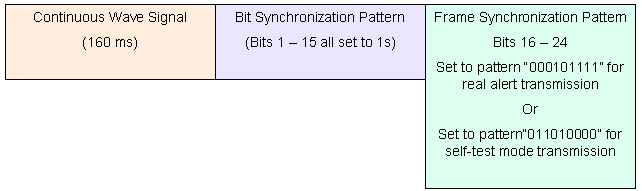
The structure of the 406 MHz message preamble is provided in the diagram below. The preamble of the 406 MHz digital message allows the receiver-processor to:
- detect the incoming signal and lock on its frequency, using the unmodulated carrier transmission;
- lock on the phase and bit timing of the modulation using the bit synchronization pattern; and
- identify the first data bit of the message using the frame synchronization pattern.
Therefore, this preamble must be fixed and identical for all Cospas-Sarsat 406 MHz beacons, and encoded according to the format outlined in the figure below.
Self-Test Mode Preamble
A 406 MHz beacon can be designed to perform a short self-test. The self-test transmission may consist of a short duration emission of a single burst. If the beacon transmits in the self-test mode, the self-test signal must have a frame synchronization pattern of 011010000 to ensure that the satellite or ground equipment will NOT process this test transmission. This eliminates the risk of a false alert being generated by the self-test burst. In addition, self-test transmissions must be kept to a minimum as they may interfere with “real” 406 MHz distress alerts.
In the self-test transmission mode the complete test transmission must be limited to one burst only, of a maximum duration of 440 ms for a short message or 520 ms for a long message. If a 440 ms transmission is used for a beacon encoded with the long format message, the message should be truncated without changing the format flag (bit 25).
Structure of Message Preamble
-
Languages of the Programme
Languages of the Programme
The International Cospas-Sarsat Programme Agreement (ICSPA) stipulates that the languages of the Council are English, French and Russian.
Simultaneous translation to and from the three languages of the Programme is provided at Council meetings.
Meetings of subsidiary organs will normally be held in the English language only, with no interpretation.
-
INTERNATIONAL COSPAS SARSAT Terms of Service (“Agreement”)
This Agreement was last modified on February 24, 2014.
Please read these Terms of Service (“Agreement”, “Terms of Service”) carefully before using http://www.cospas-sarsat.int (“the Site”) operated by INTERNATIONAL COSPAS SARSAT (“us”, “we”, or “our”). This Agreement sets forth the legally binding terms and conditions for your use of the Site at http://www.cospas-sarsat.int.
By accessing or using the Site in any manner, including, but not limited to, visiting or browsing the Site or contributing content or other materials to the Site, you agree to be bound by these Terms of Service. Capitalized terms are defined in this Agreement.
Intellectual Property
The Site and its original content, features and functionality are owned by INTERNATIONAL COSPAS SARSAT and are protected by international copyright, trademark, patent, trade secret and other intellectual property or proprietary rights laws.Termination
We may terminate your access to the Site, without cause or notice, which may result in the forfeiture and destruction of all information associated with you. All provisions of this Agreement that by their nature should survive termination shall survive termination, including, without limitation, ownership provisions, warranty disclaimers, indemnity, and limitations of liability.Links To Other Sites
Our Site may contain links to third-party sites that are not owned or controlled by INTERNATIONAL COSPAS SARSAT.INTERNATIONAL COSPAS SARSAT has no control over, and assumes no responsibility for, the content, privacy policies, or practices of any third party sites or services. We strongly advise you to read the terms and conditions and privacy policy of any third-party site that you visit.
Governing Law
This Agreement (and any further rules, polices, or guidelines incorporated by reference) shall be governed and construed in accordance with the laws of Quebec, Canada, without giving effect to any principles of conflicts of law.Changes To This Agreement
We reserve the right, at our sole discretion, to modify or replace these Terms of Service by posting the updated terms on the Site. Your continued use of the Site after any such changes constitutes your acceptance of the new Terms of Service.Please review this Agreement periodically for changes. If you do not agree to any of this Agreement or any changes to this Agreement, do not use, access or continue to access the Site or discontinue any use of the Site immediately.
Contact Us
If you have any questions about this Agreement, please contact us. -
Observers at Cospas-Sarsat Meetings
Subject to a specific Cospas-Sarsat Council decision, administrations or agencies of States that have not completed the notification of their association with the Cospas-Sarsat Programme may be invited to attend Cospas-Sarsat meetings as observers.
Normally, observer status at a particular meeting will be granted to an agency or administration only if that agency or administration has formally stated a firm intention to implement the association procedure in the near future, or when confirmation has been provided to the Cospas-Sarsat Council that the formal notification procedure was in progress. Invitations may be issued on the Council’s instruction only.
The Cospas-Sarsat Council may also decide to invite national or international organisations as observers to specific Cospas-Sarsat meetings, where their competencies and expertise might assist the discussion of technical or operational matters.
Further information is available in documents C/S P.007, and C/S P.011, which can be accessed on the Professionals website (Pro/Documents/System Documents).