Category: Uncategorised

  • Satellite Constellation Configuration

    The Cospas-Sarsat satellite constellation is composed of search and rescue satellites in low Earth orbit (LEOSAR) and geostationary orbit (GEOSAR).

    LEOSAR Satellite Constellation

    The present system configuration includes six LEOSAR satellites placed in sun-synchronous, near-polar orbits at about 850 km altitude, and equipped with SAR instrumentation at 406 MHz supplied by Canada, France, the USA and EUMETSAT.

    Each satellite makes a complete orbit of the Earth around the poles in about 100 minutes, traveling at a velocity of 7 km per second. The satellite views a “swath” of the Earth of approximately 6000 km wide as it circles the globe, giving an instantaneous “field of view” about the size of a continent. When viewed from the Earth, the satellite crosses the sky in about 15 minutes, depending on the maximum elevation angle of the particular pass.


    GEOSAR Satellite Constellation

    The GEOSAR constellation is comprised of satellites provided by the USA (GOES series), India (INSAT series), EUMETSAT (MSG series), and Russia (Electro-L and Louch series).

  • System Templates

    A new template has been made available to provide a MCC/SPOC Model Agreement to address the distribution and reception of Cospas-Sarsat distress alert data between Cospas-Sarsat Mission Control Centres and their supported search and rescue points of contact. MCC/SPOC Model Agreement 

  • System Monitoring Templates

    Ground Segment Change Reporting

    SUBMISSION DEADLINE: 1 APRIL 2026

    At CSC-73, the Council decided to approve the list of new changes to ground segment equipment (GSE) and associated implementation dates agreed at JC-39, as shown at Annex 26 to the JC-39 Report, as amended at CSC-73/OPN/SR/Annex 10. The Council invited Ground Segment Providers to report their status of implementation of approved changes to GSE using the survey tool provided by the Secretariat, with a submission deadline of 1 April 2026, to enable consideration at JC-40.

    Please note that some of these surveys contain questions for over 200 action items – there is no facility to save and resume your work, please be prepared to complete it entirely before proceeding. A PDF version of this list (for reference purposes only) can be found here: https://www.cospas-sarsat.int/images/cospas_sarsat/pdf_uploads/2025-06-GSE_changes_complete_list_approved_at_CSC-73.pdf

    Survey links:

     SPOC Comm Tests and Interference Reports

     Click on the name to download the zipped file below. Please remember to extract the databases in order to use them.

    MCC-SPOC Communication Test (MS Windows and Access 2003 or higher – 32bit)

    MCC-SPOC Communication Test (MS Windows and Access 2016 or higher – 64bit)

    Monthly Interference Report (MS Excel)


    Problems uploading? Please contact mail@cospas-sarsat.int

  • Meeting Templates

    Meeting Calendar 

    Click here to view or download the current calendar of meetings and paper submission deadlines

    See section 2.4.4 of System document C/S P.011 for more information on deadlines for submissions.

    Document Templates

    see the respective meeting webpages (Meetings / List of Meetings)

    Submissions

    Video instructions on How to format a document
    Video instructions on How to submit a document
    Use the upload tool to Submit a document

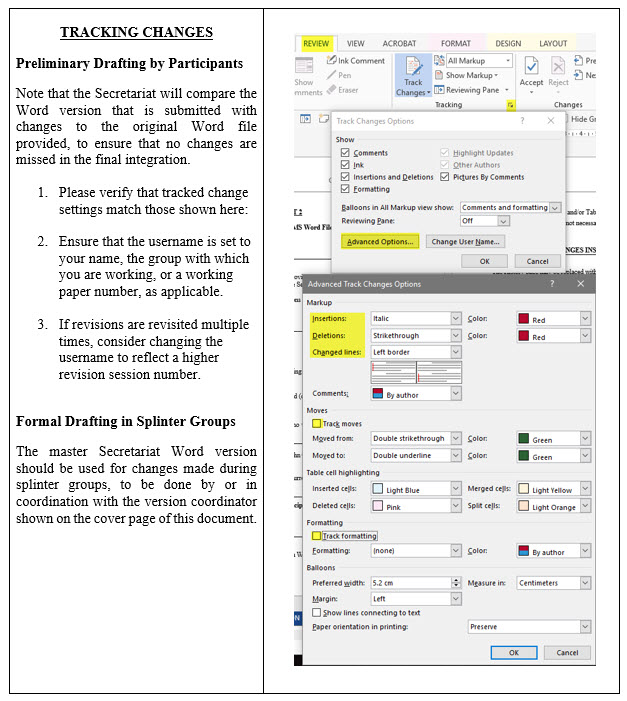
    Please prepare and submit the MS Word version of input documents using the templates available at the respective meeting webpages and upload them to the Secretariat using the Meetings/Submit Meeting Documents tool. The instructions for tracking your changes on corrigenda and revisions are here. Other documents for reference only may also be uploaded there in PDF format or other file types of up to 8 MB in size. If you encounter any difficulties, please e-mail <conference @ cospas-sarsat.int>.

  • IBRD Templates

    To download a template form please click: IBRD User Account Request Form

    To have access to the IBRD located at www.406registration.com, Cospas-Sarsat policy requires that an official letter be sent to the Cospas-Sarsat Secretariat to request the issuing of user accounts for accessing the IBRD. An IBRD usage manual may be downloaded here.

    Please use the “IBRD User Account Request Form” provided above, to appoint a national IBRD Point of Contact. This letter must be signed by either the Cospas-Sarsat Representative, the national ICAO (International Civil Aviation Authority) or IMO (International Maritime Organization) representative of the Administration requesting access.

    The letter should also indicate whether the Administration wishes to allow registration of beacons with their country code in the IBRD.  If so desired, beacon owners may be authorized to register their beacons directly, or via a central authority designated by the Administration. The national IBRD Point of Contact will be the resource person for all questions concerning beacon registration in the Administration (maritime (EPIRB), aviation (ELT) and personal locator beacons (PLB)).

    The IBRD bulk upload software and IBRD user manual is available for you to download on www.406registration.com.


  • Submit Operational Data

    link to Brazil site: ____________________


    Need to create custom input page where users can submit data to us (password protected) for the following:


    REPORTED DATA

    SAR SAVES needs to be added as was on last site


  • Orbitography Beacons

    Orbitography Beacons

    The same orbitography / reference beacon should not be used for both Doppler location accuracy assessment and orbit updates.

    Cospas-Sarsat System Orbitography Beacons

    Identification

    Lat. / Long.

    Location

    Elevation (metres)

    Time Interval (secs)

    Transmit Frequency (MHz)

    DENMARK
    9B621 97CA7 03500

    77°27.885′ N
    069°13.033′ W

    near Thule

    36.59

    30

    406.021870

    FRANCE
    9C600 00000 00001

    43°33.60′ N
    001°28.80′ E

    Toulouse

    214.27

    30

    406.022000

    FRANCE *
    9C634 E2AB5 09240

    43°33.60′ N
    001°28.80′ E

    Toulouse

    214.27

    30

    406.034000

    NORWAY
    A0234 BF8A7 335D0

    78°13.739′ N
    015°23.730′ E

    Longyearbyen

    502.4

    30

    406.022001

    USA
    ADC389B8AA1B9D0 **

    77°50.762′ S
    166°42.707′ E

    McMurdo Station, Antarctica

    170.962

    30

    406.022000

    Notes:

    * This second French beacon has all the characteristics of an orbitography beacon, except the transmit frequency of 406.034 MHz, set to avoid interference with the Sarsat time calibration beacon. The beacon will be equipped by default with an LHCP antenna to support MEOSAR applications with the DASS proof-of-concept constellation.

    ** Indicates that this location was provided in the International Earth Rotation System (IERS) Terrestrial Reference Frame or ITRF-93. Other locations are provided in the Bureau International de l’Heure (BIH) Geodetic Reference System.

  • Reference Beacons

    Cospas-Sarsat Reference Beacons

    Identification

    Lat. / Long.

    Location

    Elevation
    (metres)

    Time Interval
    (secs)

    Transmit Frequency (MHz)

    CANADA 
    A79EE E26E3 2E1D0

    53°40.72’N 
    113°18.90′ W

    Edmonton

    654

    50

    406.021843

    FRANCE 
    9C7FEC2AACD3590 *

    49°21.09′ S 
    070°15.36′ E

    Kerguelen

    80

    30

    406.021856

    RUSSIA 
    A23C0 00000 00000 *

    55°37.20′ N 
    037°30.48′ E

    Moscow

    T.B.D.

    50

    406.022103

    UK 
    9D1FC FA7AB 0D990

    51°10.20′ N 
    004°03.06′ W

    Combe Martin

    265

    50

    406.022000

    Notes:

    * Indicates that this location has not yet been provided in the Bureau International de l’Heure (BIH) Geodetic Reference System

    Reference beacons are beacons which are installed and operated on a semi-permanent basis. Users should consult the national MCC for current status information. These beacons may not meet the orbitography specifications. Reference beacons must meet the following requirements:

    – be encoded with a test protocol; transmit with a repetition period of 50 + 2.5 sec and preferably be varied over that range; and
    – transmit at 406.022 MHz + 1 kHz.

  • SSAS Beacons

    Ship Security Alert System (SSAS)

    • 05 May 2005 A new system that contributes to the International Maritime Organization’s (IMO) efforts to strengthen maritime security and suppress acts of terrorism against shipping has been implemented by Cospas-Sarsat. Modifications have been made to the Cospas-Sarsat System to provide discrete security alerts and the Cospas-Sarsat 406 MHz Ship Security Alert System (SSAS) now complies with IMO requirements.

      System Status

      In 2004, two system tests were performed to demonstrate that the Cospas-Sarsat system was capable of supporting SSAS processing. Type-approval of several new 406 MHz beacons for SSAS use has been completed. A comprehensive list of Cospas-Sarsat approved SSAS beacons, with associated manufacturer information, is available on the Cospas-Sarsat website.

      Implementation History

      At its 31 st Session in October 2003 the Cospas-Sarsat Council approved the implementation of a 406 MHz Ship Security Alerting System (SSAS) in the Cospas-Sarsat System. The Cospas-Sarsat SSAS implementation complies with IMO requirements as outlined in SOLAS Chapter XI-2 “Special Measures to Enhance Maritime Security” and Resolutions MSC.136(76) and MSC.147(77) on performance standards for SSAS. The required minimal modifications to the System were initially implemented and tested in May and September 2004. On the basis of those tests and in view of the redundancy in the Cospas-Sarsat Ground Segment, the System is now considered capable of supporting SSAS processing .

      Cospas-Sarsat, as an intergovernmental organization, will provide this service on a long-term basis free-of-charge to the end user. Additionally, Cospas-Sarsat provides a robust alerting capability with satellites in both low-earth and geostationary orbits, an automated data distribution network over reliable communication links, a process to register beacon owner information with national authorities and a process to type approve devices to ensure reliable operations.

      Implementation Details

      There are two major elements to the 406 MHz SSAS: the transmitter required for initiating SSAS alerts and a methodology for distribution of SSAS alert messages in the Cospas-Sarsat Ground Segment.

      A specific 406 MHz beacon coding protocol defined in document C/S T.001, “Specification for Cospas-Sarsat 406 MHz Distress Beacons”, is used to discriminate a ship security alert from a distress alert. The agreed specification for the SSAS beacon provides for accurate Global Navigation Satellite System (GNSS) encoded location information in the beacon message and requires the inclusion of the vessel MMSI for the beacon identification. The specification prohibits use of a homing device in order to make beacon transmissions covert.

      The Cospas-Sarsat specification only deals with the electrical and transmission requirements that ensure the compatibility of the SSAS beacon with the satellite processing system. National Administrations and standards organizations (e.g. RTCM in the United States) have defined additional requirements for 406 MHz SSAS beacon activation and installation.

      Alert Distribution Procedures

      The distribution of SSAS alerts within the Cospas-Sarsat Ground Segment uses a modified version of the standard data distribution procedure. As in normal Cospas-Sarsat operations, all Local User Terminals (LUTs) receive the 406 MHz SSAS beacon messages, retrieve the GNSS encoded location, and generate a Doppler location (LEOLUTs only). The ship security alert data is then passed to a Mission Control Centre (MCC) where it is automatically routed to the MCC that serves the Flag State identified in the beacon message, regardless of the physical location of the beacon. That MCC then delivers the ship security alert to a single point of contact identified by the Flag State as its “competent authority”, per SOLAS Chapter XI-2 Regulation 6.2.1. In the Cospas-Sarsat implementation of SSAS, a vessel cannot send a ship security alert directly to its Company. A sample alert message can be found below.

      System Level Tests

      The SSAS functionality of the Cospas-Sarsat System was tested in 2004. In the future, the Cospas-Sarsat SSAS will be routinely tested as part of the annual System-wide test of the Cospas-Sarsat Ground Segment.

      Competent Authorities

      IMO has made available (Circular letter No. 2514, 8 December 2003) a web-based reporting system that allows Administrations to supply the information required by SOLAS regulation XI-2/13, including points of contact for competent authorities for distribution of ship security alerts. IMO invited SOLAS Contracting Governments to nominate a single national point of contact for maritime-security matters. Details on use of the IMO Global Integrated Shipping Information System (GISIS) database are available on the IMO website www.imo.org.

      In addition to providing the required information to IMO, Administrations that decide to use the Cospas-Sarsat System for ship security alerting should contact their supporting Cospas-Sarsat MCC to coordinate a method for distribution of SSAS alerts.

      Point of contact lists are provided on the Cospas-Sarsat website under the <Contacts> tab at https://www.cospas-sarsat.int/en/contacts-pro/contacts-details-all. The associated MCC for every Flag State is identified in the SPOC drop down menu and contact information for each MCC can be found under the Mission Control Centre drop down menu.

      Sample SIT 185 Ship Security Alert

      SIT 185

      406 MHz SHIP SECURITY ALERT

      (to be transmitted only to competent security authority)

      (LEOSAR – with encoded position)

      1. SHIP SECURITY COSPAS-SARSAT POSITION RESOLVED ALERT

      2. MSG NO. 17002 UKMCC REF 12345

      3. DETECTED AT 10 JUL 04 2130 UTC BY SARSAT 09

      4. DETECTION FREQUENCY 406.0281 MHZ

      5. COUNTRY OF BEACON REGISTRATION 232/G.BRITAIN

      6. USER CLASS – SHIP SECURITY WITH ENCODED POSITION – MMSI LAST SIX DIGITS 387718

      7. EMERGENCY CODE – NIL

      8. POSITIONS

      RESOLVED – 55 23.2N 022 29.9W

      DOPPLER A – 55 19.1N 022 25.4W

      DOPPLER B –

      ENCODED – 55 23.2N 022 27.0W UPDATE TIME UNKNOWN

      9. ENCODED POSITION PROVIDED BY EXTERNAL DEVICE

      10. NEXT PASS TIMES

      RESOLVED – 10 JUL 04 2201 UTC

      DOPPLER A – NIL

      DOPPLER B – NIL

      ENCODED – NIL

      11. HEX ID 1D18BD50C0FFBFF

      12. ACTIVATION TYPE – MANUAL

      13. BEACON NUMBER ON AIRCRAFT OR VESSEL – NIL

      14. OTHER ENCODED INFORMATION

      A. ENCODED POSITION ACCURACY – 4 SECONDS

      15. OPERATIONAL INFORMATION

      REGISTRATIONAL INFORMATION AT UKMCC

      TELEX: 75194 UKMCCK G

      AFTN: EGQPZSZX

      TELEPHONE: (44-1343) 836015

      16. REMARKS – This is a ship security alert. Process this alert according to relevant security requirements.

      END OF MESSAGE
  • Detailed Beacon Types

    A 406-MHz beacon designed for use in an aircraft is known as an Emergency Locator Transmitter (ELT). One designed for use aboard a marine vessel is called an Emergency Position-Indicating Radio Beacon (EPIRB). More information on SSAS beacons is available in the first tab below.  A beacon designed to be carried by an individual is known as a Personal Locator Beacon (PLB).  Sometimes PLBs are carried aboard aircraft or vessels, but you must check with local authorities about the circumstances under which this is permitted.  

    Only beacons operating at 406 MHz are compatible with the Cospas-Sarsat System.

    Information regarding beacon selection and purchase is provided at “How Do I Select and Purchase a 406 MHz Cospas-Sarsat Beacon?” (Public/Beacon Ownership).

    Our “Beacon Coding Guide & Tutorial” (Pro/Beacons/Beacon Information) provides both an interactive description on beacon message protocol selection and guidelines on beacon message coding.

    The information provided in this portion of the website is intended as a summary of the information provided in the following Cospas-Sarsat System documents (Pro/Documents):

    • C/S G.005 “Cospas-Sarsat Guidelines on 406 MHz Beacon Coding, Registration, and Type Approval”.

    • C/S S.007 “Handbook of Beacon Regulations”; 

    • C/S T.001 “Specification for Cospas-Sarsat 406 MHz Distress Beacons”; and
    • C/S T.015 “Cospas-Sarsat Specification and Type Approval Standard for 406 MHz Ship Security Alert System (SSAS) Beacons”;

    The above documents can be downloaded free of charge from the Professionals website at Pro/Documents/System Documents. If the information provided on the website conflicts with that provided in documents C/S G.005, C/S T.001 and C/S T.015, the official System documents shall take precedence.

    Furthermore, individual administrations may have additional national beacon technical and coding requirements that are not addressed in the above documents.

    Special Purpose Beacons

    Further information about three types of special purpose beacons are presented in the tabs below. 


     [module-204]


This site is registered on wpml.org as a development site. Switch to a production site key to remove this banner.