Author: kevin

  • Rescue Stories


    Operational use of Cospas-Sarsat by SAR agencies started with the crash of a light aircraft in Canada, in which three people were rescued (September 10, 1982).  Since then, the System has been used for thousands of SAR events and has been instrumental in the rescue of over 50,000 lives worldwide.

    To read about recent rescue stories assisted by Cospas-Sarsat, you can view the “Latest NEWS” box at the right of the screen on the homepage.


  • Serial User Protocol Bit Settings

    Serial User Protocol Coded with a Unique Beacon Serial Number –
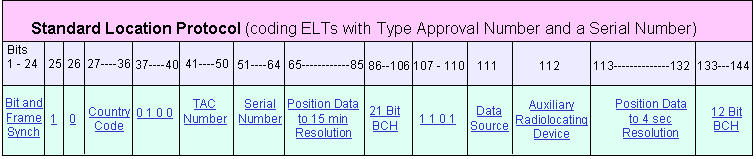
    ELT Serial Number (bits 44 to 63)

    Administrations are responsible for ensuring that each beacon is coded in accordance with their own and Cospas-Sarsat requirements and has a unique 15 hexadecimal identification (bits 26 – 85). The serial number (bits 44 – 63) to be used in coding an ELT with this implementation of the Serial User Protocol may be directly assigned by the competent administration. Alternatively, the number can be assigned by the beacon manufacturer in accordance with the specific requirements adopted by the administration for controlling the allocation of serial numbers (e.g. the series of sequential numbers allocated to each manufacturer model approved by the administration)*.

    If no allocation scheme has been defined by an administration, a unique identification can be achieved for a particular country code, by:

    • setting bit 43 to “1”,
    • including the beacon’s Cospas-Sarsat type approval certificate number in bits 74 – 83, and
    • including the manufacturer unique beacon serial number in bits 44 – 63, in accordance with the coding provisions described in Cospas-Sarsat document C/S T.001 (Note: if this approach is adopted, the manufacturer must ensure that each beacon (of the type identified by the Cospas-Sarsat certificate number) has a different serial number).

    *Note: Even when bit 43 is set to “1”, it still remains the responsibility of the relevant administration to decide policy regarding whether the serial number coded in bits 44 – 63 should be allocated by the administration or by the manufacturer. To minimise the possibility of a duplication of serial numbers individual competent administrations should provide a single policy on this issue (e.g. EITHER require the manufacturer to allocate the serial number for beacons coded with the administration’s country code, OR require the administration to allocate the serial number directly). Administrations should not allow both these policies to exist at the same time.


    Serial User Protocol Coded with the Aircraft Operator Designator and a Serial Number (bits 44 to 61 and 62 to 73)

    For an ELT using the Serial User Protocol coded with the aircraft operator designator and a beacon serial number:

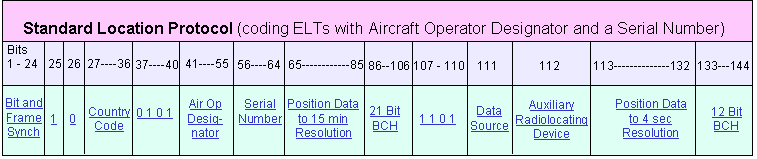
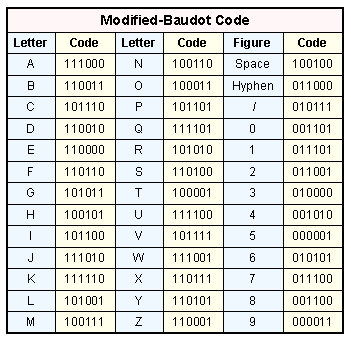
    • The aircraft operator is identified with a 3 letter designation agreed by ICAO (see ICAO DOC 8585). These three letters are encoded into bits 44 – 61 using the modified-baudot code provided below.
    • The beacon serial number identification is provided in bits 62 – 73 in binary notation with the least significant bit to the right. This allows for serial numbers ranging from 0001 to 4095. The serial number is normally assigned by the aircraft operator, who must ensure that the resulting beacon identification (bits 26 – 85) is unique and that information on which beacon is installed on each aircraft in its fleet is made available to SAR services on a 24-basis.
    modified_baudot


    Serial User Protocol Coded with the Aircraft 24-Bit Address (bits 44 to 67 and 68 to 73)

    For ELTs using the serial user protocol coded with the aircraft 24-bit address, the following requirements apply:

    • Bits 44 – 67 provide the aircraft 24-bit address as assigned by the responsible administration in accordance with ICAO guidance in Annex 10 of the ICAO convention on Civil Aviation .
    • Bits 68 – 73 is a 6 bit specific ELT number, in binary notation with the least significant bit on the right, when more than one ELT is carried on the same aircraft and encoded with the same 24-bit address. When there is only one ELT with the same 24-bit address, bits 68 – 73 should all be set to “0”.

    Serial User Protocol Coded with a Unique Beacon Serial Number –
    EPIRB Serial Number (bits 44 to 63)

    Administrations are responsible for ensuring that each beacon is coded in accordance with their own and Cospas-Sarsat requirements and has a unique 15 hexadecimal identification (bits 26 – 85). The serial number (bits 44 – 63) to be used in coding an EPIRB with this implementation of the Serial User Protocol may be directly assigned by the competent administration. Alternatively, the number can be assigned by the beacon manufacturer in accordance with the specific requirements adopted by the administration for controlling the allocation of serial numbers (e.g. the series of sequential numbers allocated to each manufacturer model approved by the administration)*.

    If no allocation scheme has been defined by an administration, a unique identification can be achieved for a particular country code, by:

    • setting bit 43 to “1”,
    • including the beacon’s Cospas-Sarsat type approval certificate number in bits 74 – 83, and
    • including the manufacturer unique beacon serial number in bits 44 – 63, in accordance with the coding provisions described in Cospas-Sarsat document C/S T.001 (Note: if this approach is adopted, the manufacturer must ensure that each beacon (of the type identified by the Cospas-Sarsat certificate number) has a different serial number).

    *Note: Even when bit 43 is set to “1”, it still remains the responsibility of the relevent administration to decide policy regarding whether the serial number coded in bits 44 – 63 should be allocated by the administration or by the manufacturer. To minimise the possibility of a duplication of serial numbers it is recommended that individual competent administrations provide a single policy on this issue (e.g. EITHER require the manufacturer to allocate the serial number for beacons coded with the administration’s country code, OR require the administration to allocate the serial number directly). Administrations should not allow both these policies to exist at the same time.

     

    Serial User Protocol Coded with a Unique Beacon Serial Number –
    PLB Serial Number (bits 44 to 63)

    Administrations are responsible for ensuring that each beacon is coded in accordance with their own and Cospas-Sarsat requirements and has a unique 15 hexadecimal identification (bits 26 – 85). The serial number (bits 44 – 63) to be used in coding a PLB with this implementation of the Serial User Protocol may be directly assigned by the competent administration. Alternatively, the number can be assigned by the beacon manufacturer in accordance with the specific requirements adopted by the administration for controlling the allocation of serial numbers (e.g. the series of sequential numbers allocated to each manufacturer model approved by the administration)*.

    If no allocation scheme has been defined by an administration, a unique identification can be achieved for a particular country code, by:

    • setting bit 43 to “1”,
    • including the beacon’s Cospas-Sarsat type approval certificate number in bits 74 – 83, and
    • including the manufacturer unique beacon serial number in bits 44 – 63, in accordance with the coding provisions described in Cospas-Sarsat document C/S T.001 (Note: if this approach is adopted, the manufacturer must ensure that each beacon (of the type identified by the Cospas-Sarsat certificate number) has a different serial number).

    *Note: Even when bit 43 is set to “1”, it still remains the responsibility of the relevent administration to decide policy regarding whether the serial number coded in bits 44 – 63 should be allocated by the administration or by the manufacturer. To minimise the possibility of a duplication of serial numbers it is recommended that individual competent administrations provide a single policy on this issue (e.g. EITHER require the manufacturer to allocate the serial number for beacons coded with the administration’s country code, OR require the administration to allocate the serial number directly). Administrations should not allow both these policies to exist at the same time.
  • Cospas-Sarsat Type Approval Certificate Flag

    Bit 43 in the Serial User Protocol is used as a flag to indicate whether or not the Cospas-Sarsat beacon type approval certificate number is encoded in the beacon message.

    If bit 43 is set to 1:

    • bits 64-73 should either be set to all “0”s or allocated for national use and control (and will be made public when assigned by the responsible administrations) or used as defined for coding the aircraft 24-bit address or aircraft operator designator and a serial number;
    • bits 74-83 should be encoded with the Cospas-Sarsat type approval certificate number which is assigned by the Cospas-Sarsat Secretariat for each beacon model approved according to the type approval procedure of document C/S T.007. The certificate number is to be encoded in binary notation with the least significant bit on the right.

    If bit 43 is set to 0:

    • its 64-83 are for national use and control (and will be made public when assigned by the responsible administration) or used as defined for coding the aircraft 24-bit address or aircraft operator designator and a serial number.
  • Serial User Protocol – Type of Application

    The following types of serial identification data can be encoded in beacons using the serial user protocol:

    • identification serial number;
    • 24-bit aircraft address number;
    • aircraft operator designator and a serial number.

    Bits 40 – 42 indicate the beacon type with serial identification data encoded as follows:

    000 indicates an aviation ELT serial number is encoded in bits 44-63;
    010 indicates a maritime float free EPIRB serial number is encoded in bits 44-63;
    100 indicates a maritime non float free EPIRB serial number is encoded in bits 44-63;
    110 indicates a personal locator beacon (PLB) serial number is encoded in bits 44-63;
    011 indicates the aircraft 24-bit address is encoded in bits 44-67 and each additional ELT on the same aircraft is numbered in bits 68-73;
    001 indicates an aircraft operator designator and a serial number are encoded in bits 44-61 and 62-73, respectively.
  • Aviation User Protocol Coded with the Aircraft Nationality and Registration Marking (bits 40 to 81)

    The aircraft nationality and registration marking is a unique alphanumeric code assigned by national administrations in accordance with Annex 10 to the Convention on International Civil Aviation.

    This information is translated into digital format (1s and 0s) using the modified-baudot code provided below. The data shall be right justified, and the modified-baudot space (“100100”) should be used (placed to the left of the characters) where no characters exist.

    modified_baudot


  • Encoding Position Data in User Location Protocol Beacons

    Position data is provided as latitude and longitude, to 4-minute resolution, encoded in the PDF-2 of the second protected field (bits 108 – 132) as indicated below.

    Bits

    108

    109 ———- 115
    116 ———- 119
    120
    121 ———- 128
    129 ———- 132
    133 — 144

    Latitude Flag

    North = 0

    South = 1

    Latitude Degrees

    (0 to 90) in 1 degree increments

    Latitude Minutes

    (0 to 56) in 4 minute increments

    Longitude Flag

    East = 0

    West = 1

    Longitude Degrees

    (1 to 180) in 1 degree increments

    Longitude Minutes

    (0 to 56) in 4 minute increments

    BCH 2


    The default values indicated below should be coded into bits 108 – 119 and bits 120 – 132 when position data is not available or if the beacon radiates a long message in the self-test mode mode:

    Bits 108 to 119: 011 111 110 000
    Bits 120 to 132: 011 111 111 000 0

    Note: Latitude and longitude data are rounded off (i.e. not truncated) to the available resolution. See table below for an example:


    Real Position Position Encoded in Beacon
    43 deg : 31 min : 59 sec North 43 deg : 32 min North
    01 deg : 29 min : 15 sec East 01 deg : 28 min East


  • Bit Settings

    Format Flag (Bit 25)

    The beacon message format is identified at bit 25 for all message formats. For this implementation of this protocol, this bit is set to the value indicated in the graphic you just clicked on (0 for short message formats, 1 for long message formats).


    Protocol Flag (Bit 26)

    The protocol type is identified at bit 26 for all message formats. For this implementation of this protocol, this bit is set to the value indicated in the graphic you just clicked on (0 for a Standard Location Protocol or National Location Protocol, 1 for a User Protocol or User Location Protocol).


    Fixed Bits

    For the implementation of this protocol, these bits are set to the values indicated in the graphic you just clicked on.


    Non-Protected Data Field (Bits 107 – 112 of short format messages)

    The non-protected data field refers to bits 107 – 112 of short format messages. The term “non-protected” derives from the fact that these bits are not protected by the beacons error correcting code.

    The content of these bits are defined by the specific protocol used in the beacon.


    Specific Beacon Number

    These bits are used to identify the specific beacon in cases where there may be several beacons on the same vessel. The first or the only float free beacon shall be coded with a modified-Baudot zero (001101); additional beacons shall be numbered consecutively using modified-Baudot characters 1 to 9 and A to Z.

    modified_baudot


  • Auxiliary Radio-locating Device Code (Homing)

    Some beacon models integrate an auxiliary radio-locating device which provides a homing signal that enable SAR services in the vicinity of the distress event to home on the distress beacon. The type of auxiliary radio-locating device integrated into the beacon is coded in bits 84 – 85 as indicated below.


    Auxiliary Radio-locating Device Code

    00

    No Auxiliary Radio-locating Device

    *01

    121.5 MHz Auxiliary Radio-locating Device

    10

    9 GHz SART Locating Device

    11

    Other Auxiliary Radio-locating Device(s)

    *

    If other auxiliary radio-locating device(s) are used in conjunction to 121.5 MHz, the code for 121.5 MHz (i.e.01) should be used.

    Note: IMO and ICAO require that 406 MHz EPIRBs/ELTs carried on-board vessels/aircraft in accordance with the applicable carriage requirements, include an auxiliary radio-locating device which transmits at 121.5 MHz. For other applications, administrations may require other types of homing devices.

  • Coding an ELT with the National Location Protocol

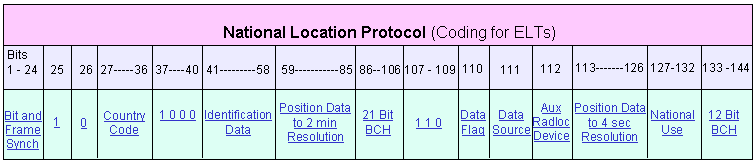
    You have selected the National Location Protocol to code your ELT. An interactive diagram of this option, depicting the information which should be coded into the beacon is provided below. Click on the hyperlinked fields of the diagram for additional information concerning the format, structure and content of the coding for that field.

    Nationallocation-ELT

    Final Step: Register your beacon.

    Having purchased and coded your beacon, one of the most important actions that you must take to maximize its effectiveness is to register the beacon with the appropriate national authority. Click here for details regarding the organizations responsible for beacon registration in your country (Pro/Contact Lists/406 MHz Beacon Registers). Registering your beacon provides search and rescue authorities with access to vital information (e.g. telephone numbers for emergency points of contact, type of aircraft, etc.) that is absolutely critical for efficiently conducting any search and rescue operation.

    For further details concerning beacons refer to the following documents (available for downloading):

    • C/S T.001, Specification for Cospas-Sarsat 406 MHz Distress Beacons;
    • C/S G.005, Cospas-Sarsat Guidelines on 406 MHz Beacon Coding, Registration and Type Approval.
  • Coding an ELT with a Standard Location Protocol

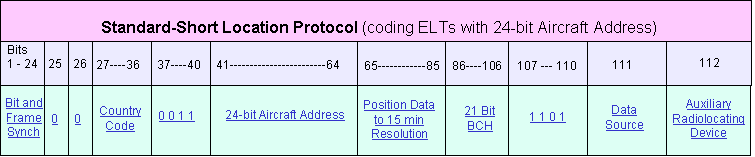
    You have selected the Standard Location Protocol to code your ELT. There are three coding options of this protocol that can be used with ELTs. An interactive diagram of each, depicting the information which should be coded into the beacon is provided below. Click on the hyperlinked fields of the diagram for additional information concerning the format, structure and content of the coding for that field.

    Standardshortlocation-ELT_24_bit_address

    Final Step: Register your beacon.

    Having purchased and coded your beacon, one of the most important actions that you must take to maximize its effectiveness is to register the beacon with the appropriate national authority. Click here for details regarding the organizations responsible for beacon registration in your country (Pro/Contact Lists/406 MHz Beacon Registers). Registering your beacon provides search and rescue authorities with access to vital information (e.g. telephone numbers for emergency points of contact, type of aircraft, etc.) that is absolutely critical for efficiently conducting any search and rescue operation.

    For further details concerning beacons refer to the following documents (available for downloading):

    • C/S T.001, Specification for Cospas-Sarsat 406 MHz Distress Beacons;
    • C/S G.005, Cospas-Sarsat Guidelines on 406 MHz Beacon Coding, Registration and Type Approval.
This site is registered on wpml.org as a development site. Switch to a production site key to remove this banner.