Author: kevin

  • Beacon Regulations Handbook

    Document C/S S.007 provides information concerning:

    • the status of 406 MHz beacon regulations in specific countries;

    • points of contact for beacon registration matters in various countries; and

    • extracts of some international regulations pertaining to 406 MHz beacons.

    C/S Ref.

    Document Title

    Dated

    S.007

    Handbook of Beacon Regulations

    Issue 1 – Revision 4

    Sept. 2013

    beacon

    NOTES:

    • Copies of beacon registration forms for some countries are available at the Secretariat upon request.

    • Satellite processing of 121.5 MHz emissions ceased on 1 February 2009 [read more].   Document C/S S.007 was updated accordingly.

  • LEOSAR Satellite Coverage


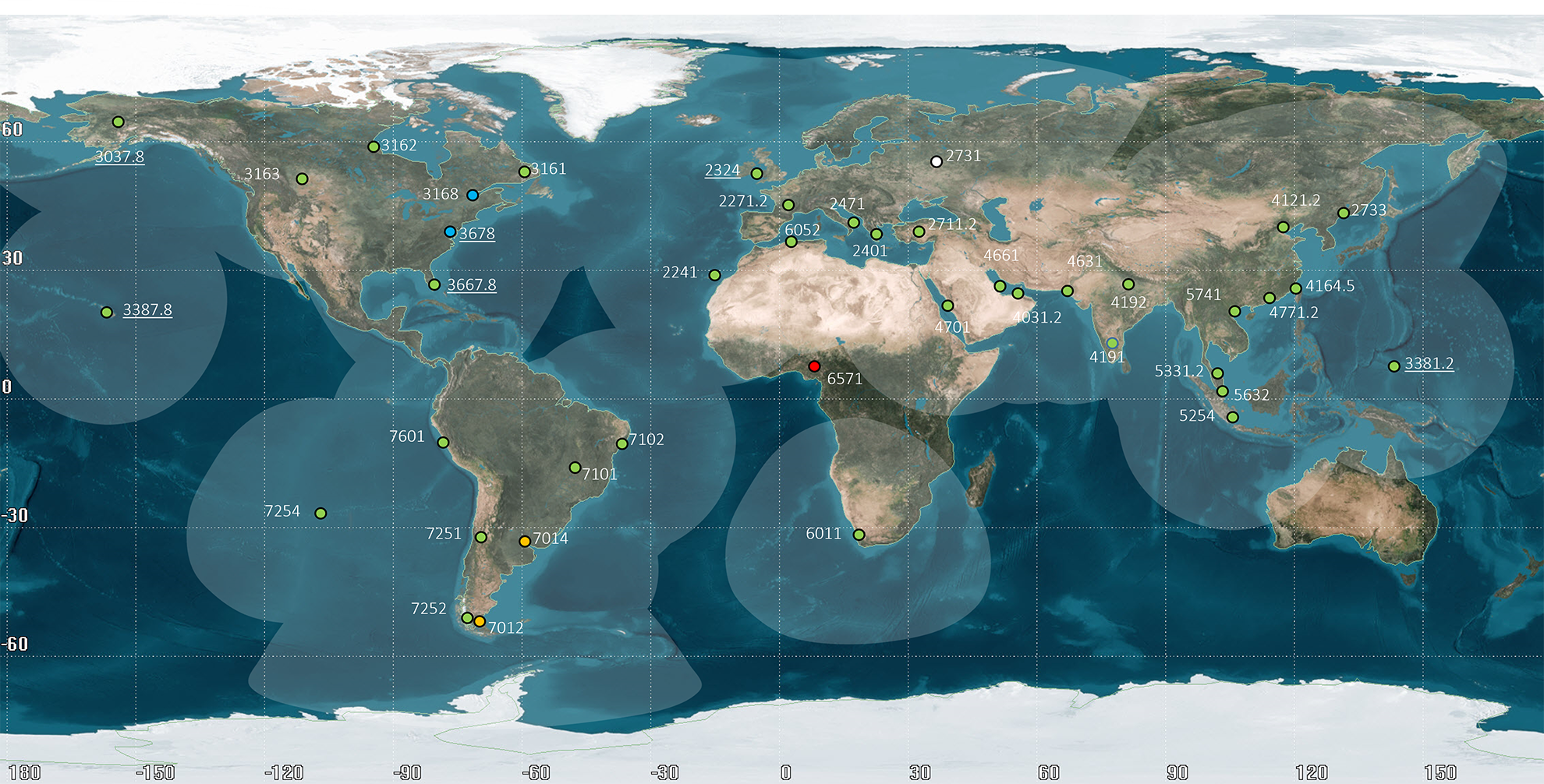
    The Cospas-Sarsat LEOSAR system provides global coverage for 406-MHz beacons. Light-blue areas on the figure above show areas where LEOSAR satellites and operational LEOLUTs have mutual visibility. When a satellite is actively tracked, detected beacons have their signals directly relayed to the tracking LEOLUT for processing. When a satellite is outside a light-blue area and detects beacons, detected beacon signals are processed, data is stored and sent over the downlink, and received by a LEOLUT, when the satellite is tracked again entering a light-blue area. This map above was created assuming a satellite orbit altitude of 850 km with a 5° minimum elevation angle at each LEOLUT.

    2025-12-18 LEOLUT Coverage


    Click here for a List of LEOLUTs/GEOLUTs

  • Current Space Segment Status and SAR Payloads


  • Beacon Type Approval Policy

    General

    Type approval of 406 MHz beacons is a national responsibility. However, to assist administrations, Cospas-Sarsat has developed a type approval procedure. A Cospas-Sarsat Type Approval Certificate is delivered by the Cospas-Sarsat Secretariat to manufacturers whose beacons have been successfully tested, according to the Cospas-Sarsat procedure, at Cospas-Sarsat accepted laboratories. The Cospas-Sarsat type approval procedure covers only the transmission characteristics of the beacons.

    The purpose of the Cospas-Sarsat type approval is to ensure that:

    • beacons, when activated, will not degrade nominal system performance

    • beacon transmissions will be compatible with satellite on-board equipment

    • the content of coded information transmitted by the beacons will be compatible with LUT processing

    Successful completion of Cospas-Sarsat type approval testing does not relieve the manufacturer from the obligation to obtain national type acceptance and/or relevant authorizations from national administrations.

    National regulations may include requirements concerning beacon packaging, installation and operation which are not included in the Cospas-Sarsat specification (e.g. homing frequencies, automatic release mechanism).

    A list of 406-MHz beacon manufacturers and a list of Cospas-Sarsat type-approved beacon models are available in the Contact Lists and Beacons sections of the Professionals website, respectively.


    Reference Documents

    Reference documents for the development, manufacturing and testing of 406 MHz distress beacons are:

    • Cospas-Sarsat document C/S T.001 “Specification for Cospas-Sarsat 406 MHz Distress Beacons”

    • ITU-R Recommendation M.633, “Transmission characteristics of a satellite emergency position-indicating radiobeacon (satellite EPIRB) system operating through a low polar-orbiting satellite system in the 406 MHz band”

    • Cospas-Sarsat document C/S T.007 “Cospas-Sarsat 406 MHz Distress Beacons Type Approval Standard”

    • Cospas-Sarsat document C/S T.015 “Cospas-Sarsat Specification and Type Approval Standard for 406 MHz Ship Security Alert (SSAS) Beacons”

    • Cospas-Sarsat document C/S G.005 “Guidelines on 406 MHz Beacon Coding, Registration and Type Approval”

    • Relevant national specifications and requirements based on IMO performance standards for 406 MHz EPIRBs or ICAO standards for 406 MHz ELTs.


    Cospas-Sarsat Type Approval Testing

    Cospas-Sarsat type approval testing should be performed at 406-MHz beacon test facilities that have been accepted by the Cospas-Sarsat Council, listed in the Contact Lists section of the Professionals website.

    Manufacturers seeking Cospas-Sarsat type approval of 406-MHz beacons should contact the Cospas-Sarsat Secretariat for further details concerning the type approval procedures described in the document C/S T.007.

    The cost of type approval testing will be borne by the manufacturers.


    Use of Logos

    Cospas-Sarsat trademarks registered in several countries and protected by the laws of those nations and the Berne Convention and the Universal Copyright Convention. Additionally, the trademarks are protected under Article 6ter of the Paris Convention of the World Intellectual Property Organization.

    To avoid diminishing or compromising the reputation of Cospas-Sarsat’s service or that of type-approved beacons, the association of the trademark or service mark with devices or services is only permitted for those devices or services that have been tested as conforming to the required standards and have received approval by the Programme. Use of the marks by beacon manufacturers is specifically allowed for labelling, instruction materials and marketing of a specific device that has received a Cospas-Sarsat type approval or letter of compatibility. This use does not extend to marketing materials generally of a manufacturer when non-approved devices are included in the materials. This authorization will be reflected in new type-approval certificates issued by the Secretariat.

    Cospas-Sarsat welcomes innovation in the development of beacon products, and companies’ interest as manufacturers of beacon technologies. However, it is to the mutual benefit of your company, other manufacturers and the Cospas-Sarsat Programme that the reputation of high standards, independently tested, is maintained by ensuring that only approved products carry the Cospas-Sarsat name and logos. 

    For more information, please see document C/S P.011, “Cospas-Sarsat Programme Management Policy”, section 6.
  • Beacon Coding Guide & Tutorial

    NOTE: The information provided in the Beacon Coding Guide & Tutorial is intended to amplify the information provided in the following Cospas-Sarsat “System Documents”, available on the Professionals website (Pro/Documents):

    • C/S G.005 “Cospas-Sarsat Guidelines on 406 MHz Beacon Coding, Registration, and Type Approval”, and

    • C/S T.001 “Specification for Cospas-Sarsat 406 MHz Distress Beacons”.

    The Beacon Coding Guide and Tutorial is undergoing a redesign and rewriting based on the updates to these System documents. For further information, please contact the Secretariat.

  • Registering a 406 MHz Beacon

    It is crucial that 406 MHz distress beacons be registered in recognized beacon registration databases which will be accessible to search and rescue authorities at all times. The information contained in these databases concerning the beacon, its owner, and the vehicle/vessel on which the beacon is mounted is vital for the effective use of Search and Rescue resources. The proper registration of a beacon could make the difference between success and failure of a search and rescue mission [examples of how the registration information may be used to enable the proper SAR response].

    Process for Registering a Beacon – If the Administration has Identified a Registration Point of Contact

    Contact the representative in your country responsible for 406 MHz distress beacons to:

    • obtain guidance regarding national regulations concerning beacon coding and registration (it should be noted that there are many beacon message protocols which are compatible with the Cospas-Sarsat System; it is the responsibility of National Administrations to select the protocols for use within their jurisdiction); and

    • obtain the necessary forms to register the beacon.

    Click here for a beacon registration contact information in various countries.

    Process for Registering a Beacon in the Cospas-Sarsat International 406 MHz Beacon Registration Database (IBRD).  A usage guide may be downloaded here.

    Your country may have elected to allow you to directly register your beacon in the International 406 MHz Beacon Registration Database (IBRD), available online and free of charge at www.406registration.com.

    The IBRD became operational on the 16 January 2006. It provides capability to register 406 MHz distress beacons and has extensive online help capabilities.

    Individual beacon owners may register their beacons and select their own passwords during the registration process if this use of the IBRD has been allowed by their national Administration.

    You will need the following information to register a beacon:

    • Beacon Hexadecimal Identification (15 Hexadecimal characters)

    • Owner name and phone number

    • Emergency contact name and phone number

    • Vehicle type (selectable from a menu)

    • Vehicle name, MMSI, call sign or identification number (except for PLBs).

    Cospas-Sarsat will only accept beacon registrations submitted via the online facilities of the IBRD. Beacon registrations submitted in paper format or via other communication facilities will not be accepted.

    The Cospas-Sarsat Secretariat is available to answer questions from National Administrations concerning beacon coding and registration matters.

    Administration User Accounts

    The IBRD is freely available to users with no access to national registration facilities and to Administrations who wish to avail themselves of the facility to make their national beacon registration data more available to SAR services.

    SAR Services and others wishing to query the IBRD will require passwords issued by the Cospas-Sarsat Secretariat. In order to acquire appropriate passwords to access the IBRD, National Administrations should:

    • designate a National IBRD Point of Contact, and

    • request that the Cospas-Sarsat Secretariat allocate user identifications and passwords to their National IBRD Point of Contact.

    The password and user identification request must be provided in writing to the Database Administrator (i.e. the Cospas-Sarsat Secretariat) and must carry the signature of the Cospas-Sarsat/IMO/ICAO Representative of the Administration.  An IBRD User Account Request Form is available under the “Document Templates” section of our website by selecting IBRD Templates.

  • Type Approved Models

    Detailed beacon reports can be accessed via:

    Notes:

    • A particular beacon model may be sold under several different names. All alternative beacon model names provided to the Cospas-Sarsat Secretariat by the beacon manufacturer are listed in the detailed report.

    • Some manufacturers use the same beacon model names for beacons with different type approval numbers.

    • Cospas-Sarsat Numbers (No.) starting at 700 identify special use beacons. These beacon models are compatible with the Cospas-Sarsat System; however, they do not satisfy all Cospas-Sarsat technical and testing requirements as detailed in Cospas-Sarsat documents C/S T.001 (406 MHz beacon specification) and C/S T.007 (406 MHz beacon type approval standard). Therefore, they have not received a Cospas-Sarsat Type Approval Certificate.

    • In the maritime domain, EPIRBs are designated as either float free (FF) or a non-float free (Non FF). FF EPIRBs are designed to float away from a sinking vessel and activate automatically, whereas Non FF EPIRBs can only be activated manually.

    • In the aviation domain, beacons are designated as either automatic or manual ELTs. Automatic ELTs are designed to be activated automatically using a crash sensor or G-switch, whereas manual ELTs can only be activated by the ELT operator.

  • MEOSAR

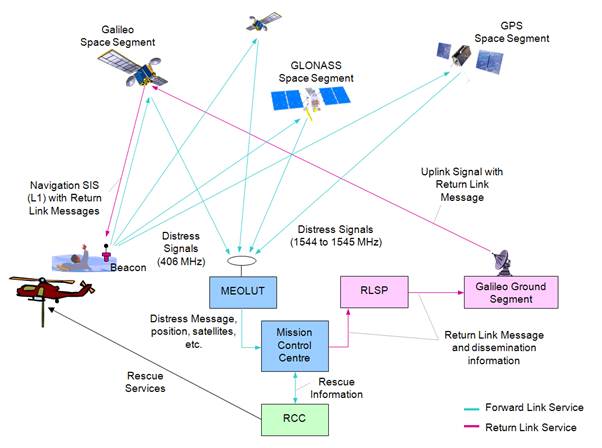
    Cospas-Sarsat is in the process of upgrading its satellite system by placing search-and-rescue receivers (i.e., repeaters or transponders) on new GPS satellites operated by the United States, navigation satellites of Russia (GLONASS) that began deployment last year, and European GALILEO navigation satellites that began launching 12 October 2012. Once qualified as operational, this system augmentation will dramatically improve both the speed and location-accuracy for detecting beacons.

    Those satellites orbit the Earth at an altitude between 19,000 and 24,000 km, a range considered as medium-altitude Earth orbit. Hence this component of Cospas-Sarsat is known as the Medium-altitude Earth Orbit Search and Rescue system or MEOSAR. It will complement the existing LEOSAR and GEOSAR systems.

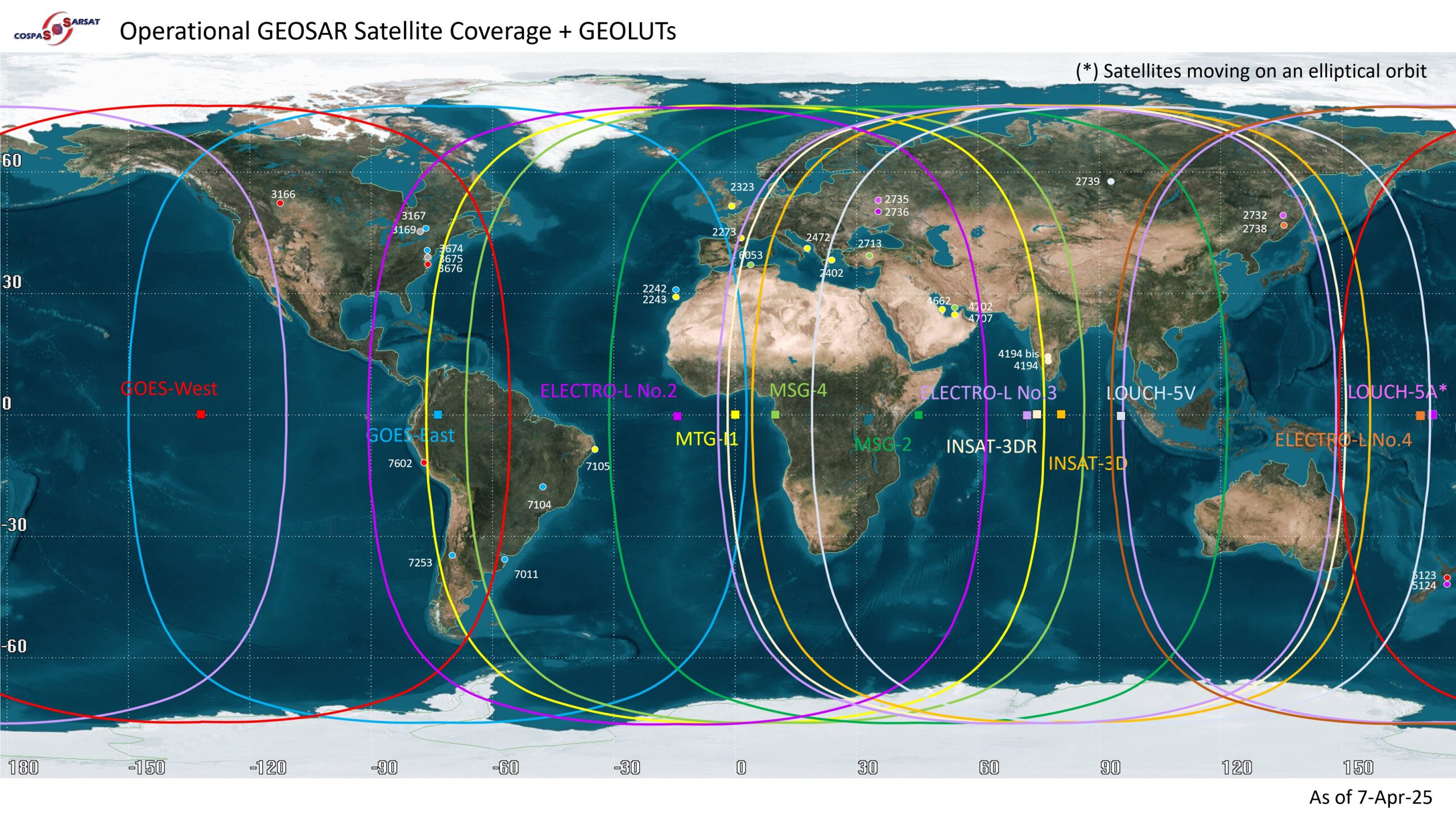
    The current LEOSAR and GEOSAR systems contribute respective advantages to the detection and location of distress beacons that have been activated. The GEOSAR system constantly covers the entire Earth except for the high-latitude (e.g., polar) regions. While the GEOSAR system can receive beacons distress messages across most of the globe, it cannot locate the beacon unless the location is encoded in the beacon’s message from a local navigation receiver. The LEOSAR system can locate a beacon without the aid of a GPS or other navigation signal to the beacon, but the LEOSAR satellites have a view of only a small part of the Earth at any given time, so there may be a delay in receiving the distress signal over LEOSAR.

    Once fully operational, the MEOSAR system will offer the advantages of both LEOSAR and GEOSAR systems without their current limitations by providing transmission of the distress message, and independent location of the beacon, with a near real-time worldwide coverage.

    The MEOSAR system also will facilitate other planned enhancements for Cospas-Sarsat beacons, such as a return link transmission that will allow the beacon to provide to the user a confirmation that the distress message has been received.

    The large number of MEOSAR satellites that will be in orbit when the system is fully operational will allow each distress message to be relayed at the same time by several satellites to several ground antennas, improving the likelihood of detection and the accuracy of the location determination.

    The MEOSAR System Concept

    MEOSAR concept 20121


  • GEOSAR

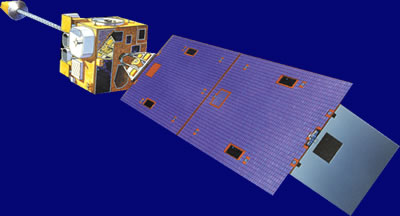
    goes1The GEOSAR system consists of 406 MHz repeaters carried on board various geostationary satellites, and the associated ground facilities called GEOLUTs which process the satellite signal.

    As a GEOSAR satellite remains fixed relative to the Earth, there is no Doppler effect on the received frequency and Doppler radio location positioning techniques cannot be used to locate distress beacons. To provide rescuers with beacon position information, such information must be either:

    • acquired by the beacon through an internal or an external navigation receiver and encoded in the beacon message, or

    • derived, with possible delays, from the LEOSAR System.

      [GEOSAR Coverage Map]

This site is registered on wpml.org as a development site. Switch to a production site key to remove this banner.