Current Space Segment Status and SAR Payloads
Space Segment Tentative Launch Schedule (private)
The International Cospas-Sarsat Programme is a satellite-based search and rescue (SAR) distress alert detection and information distribution system, best known for detecting and locating emergency beacons activated by aircraft, ships and backcountry hikers in distress.
The International Cospas-Sarsat Programme (the Programme) began as a joint effort of Canada, France, the United States, and the former Soviet Union in 1979. It was formally constituted as an intergovernmental organisation in 1988 through the International Cospas-Sarsat Programme Agreement (the Agreement or ICSPA) signed by the four “Parties” to the Agreement: Canada, France, the USA and the former USSR. The Russian Federation replaced the USSR as Party to the Agreement in January 1992.
Including the four Parties to the Agreement, 43 States and 2 organisations (the Participants) are now currently formally associated with the Programme and actively participate in the management and the operation of the Cospas-Sarsat System (the System).
COSPAS (КОСПАС) is an acronym for the Russian words “Cosmicheskaya Sistema Poiska Avariynyh Sudov” (Космическая Система Поиска Аварийных Судов), which translate to “Space System for the Search of Vessels in Distress”. SARSAT is an acronym for Search And Rescue Satellite-Aided Tracking.
[module-209]
http://cospas-sarsat.int/en/search-and-rescue/programme-videos-en
Archival Footage:
Length: 15 minutes
Source: National Search and Rescue Secretariat and Communications Research Centre
Special abreviated version for launch of Cospas-Sarsat in Montreal (2005)
Operational use of Cospas-Sarsat by SAR agencies started with the crash of a light aircraft in Canada, in which three people were rescued (September 10, 1982). Since then, the System has been used for thousands of SAR events and has been instrumental in the rescue of over 50,000 lives worldwide.
To read about recent rescue stories assisted by Cospas-Sarsat, you can view the “Latest NEWS” box at the right of the screen on the homepage.
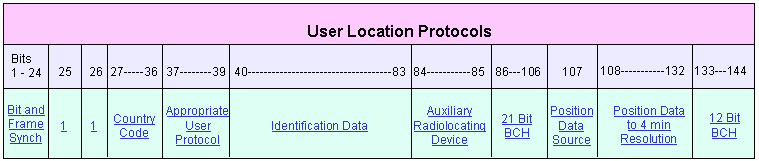
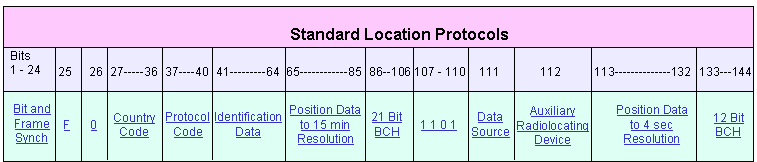
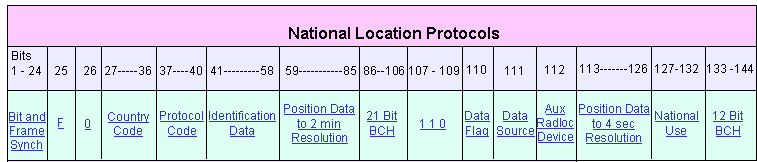
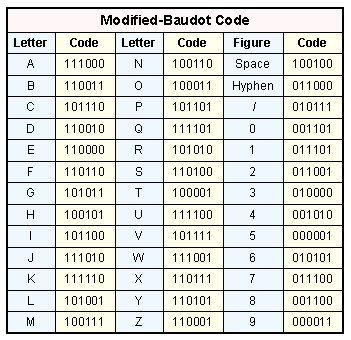
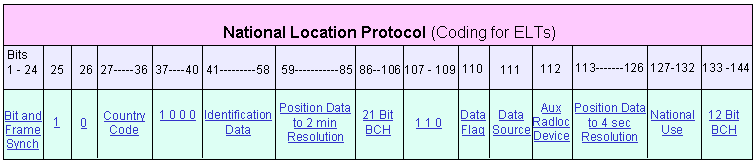
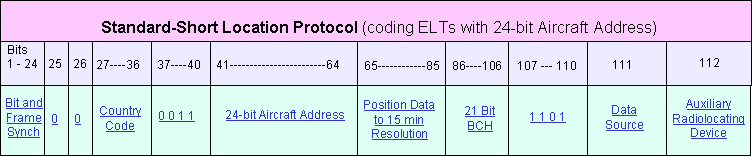
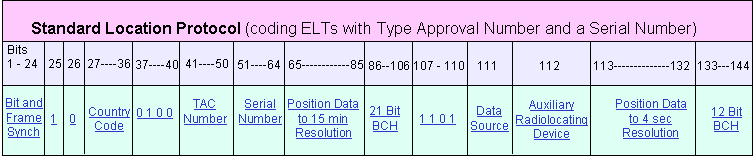
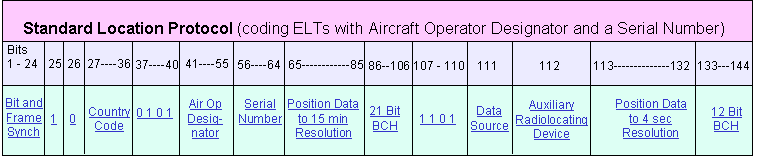
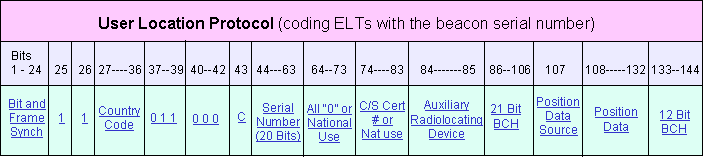
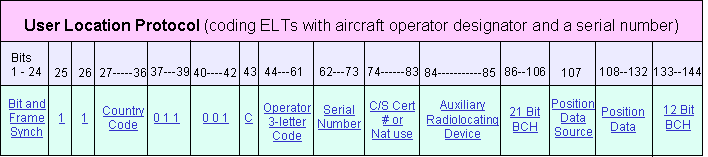
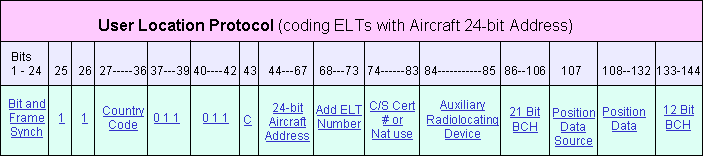
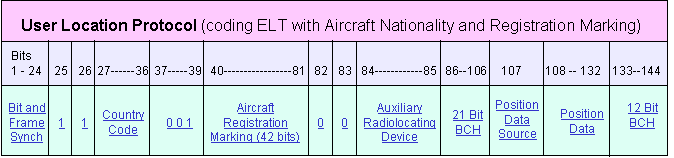
The beacon message format is identified at bit 25 for all message formats. For this implementation of this protocol, this bit is set to the value indicated in the graphic you just clicked on (0 for short message formats, 1 for long message formats).
The protocol type is identified at bit 26 for all message formats. For this implementation of this protocol, this bit is set to the value indicated in the graphic you just clicked on (0 for a Standard Location Protocol or National Location Protocol, 1 for a User Protocol or User Location Protocol).
For the implementation of this protocol, these bits are set to the values indicated in the graphic you just clicked on.
The non-protected data field refers to bits 107 – 112 of short format messages. The term “non-protected” derives from the fact that these bits are not protected by the beacons error correcting code.
The content of these bits are defined by the specific protocol used in the beacon.
These bits are used to identify the specific beacon in cases where there may be several beacons on the same vessel. The first or the only float free beacon shall be coded with a modified-Baudot zero (001101); additional beacons shall be numbered consecutively using modified-Baudot characters 1 to 9 and A to Z.
You have selected the National Location Protocol to code your ELT. An interactive diagram of this option, depicting the information which should be coded into the beacon is provided below. Click on the hyperlinked fields of the diagram for additional information concerning the format, structure and content of the coding for that field.
Final Step: Register your beacon.
Having purchased and coded your beacon, one of the most important actions that you must take to maximize its effectiveness is to register the beacon with the appropriate national authority. Click here for details regarding the organizations responsible for beacon registration in your country (Pro/Contact Lists/406 MHz Beacon Registers). Registering your beacon provides search and rescue authorities with access to vital information (e.g. telephone numbers for emergency points of contact, type of aircraft, etc.) that is absolutely critical for efficiently conducting any search and rescue operation.
For further details concerning beacons refer to the following documents (available for downloading):
You have selected the Standard Location Protocol to code your ELT. There are three coding options of this protocol that can be used with ELTs. An interactive diagram of each, depicting the information which should be coded into the beacon is provided below. Click on the hyperlinked fields of the diagram for additional information concerning the format, structure and content of the coding for that field.
Final Step: Register your beacon.
Having purchased and coded your beacon, one of the most important actions that you must take to maximize its effectiveness is to register the beacon with the appropriate national authority. Click here for details regarding the organizations responsible for beacon registration in your country (Pro/Contact Lists/406 MHz Beacon Registers). Registering your beacon provides search and rescue authorities with access to vital information (e.g. telephone numbers for emergency points of contact, type of aircraft, etc.) that is absolutely critical for efficiently conducting any search and rescue operation.
For further details concerning beacons refer to the following documents (available for downloading):
You have selected the User Location Protocol to code your ELT. There are four variants of this protocol that can be used with ELTs. An interactive diagram of each, depicting the information which should be coded into the beacon is provided below. Click on the hyperlinked fields of the diagram for additional information concerning the format, structure and content of the coding for that field.
Final Step: Register your beacon.
Having purchased and coded your beacon, one of the most important actions that you must take to maximize its effectiveness is to register the beacon with the appropriate national authority. Click here for details regarding the organizations responsible for beacon registration in your country (Pro/Contact Lists/406 MHz Beacon Registers). Registering your beacon provides search and rescue authorities with access to vital information (e.g. telephone numbers for emergency points of contact, type of aircraft, etc.) that is absolutely critical for efficiently conducting any search and rescue operation.
For further details concerning beacons refer to the following documents (available for downloading):
Maritime User Protocol with MMSI
Radio Call Sign User Protocol
Aviation User Protocol (Aircraft Nationality and Registration Marking)
Serial User Protocol ELT Coded with Serial Identification
Serial User Protocol ELT Coded with Aircraft Operator Designator and a Serial Number
Serial User Protocol ELT Coded with Aircraft 24-Bit Address
Serial User Protocol EPIRB Coded with Serial Identification
Serial User Protocol PLB Coded with Serial Identification
National User Protocol
Test User Protocol
User Location Protocol (with EPIRB Serial Identification)
Standard Location Protocol (with MMSI)
National Location Protocol
There are three types of protocols which can be used for encoding beacon position data, as well as identification data, in the digital message transmitted by a 406 MHz distress beacon. These three protocol types are referred to as: