Author: kevin

  • Maritime User Protocol Details

    Coding the Maritime User Protocol (General)

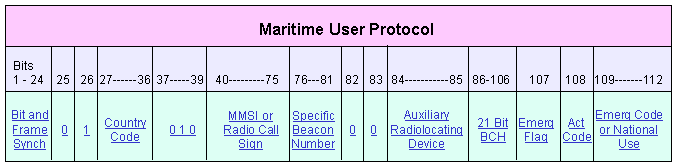
    The Maritime User Protocol can be used to code either the vessel’s mobile service identity number (MMSI) or its Radio Call Sign (if it has 6 or fewer characters). Confusion between the two options is eliminated because the Radio Call Sign includes letters whereas the MMSI is composed entirely of digits.

    Coding the Maritime User Protocol with MMSI

    Bits 40 – 75 can be coded to designate the last 6 digits of the 9-digit MMSI using the modified-Baudot code shown in the table below.

    Special care must be taken when coding this protocol in situations where the National administration has been allocated more than one country code (bits 27 – 36). When this option is used it is critical that the country code provided in bits 27 – 36 correspond to the first 3 digits of the vessel’s MMSI code.

    Coding the Maritime User Protocol with the Radio Call Sign

    Radio call signs of up to six characters can be encoded if the call sign complies with the ITU Radio Regulations on the formation of call signs (Article S19 of the Radio Regulations). This regulation requires that if alphabetic characters exist in the call sign, they can only occur in the first 4 characters. Consult the Radio Regulations for the complete requirements for establishing radio call signs.

    Up to 6 alphanumeric characters using the modified-Baudot code presented in the table below can be accommodated with this protocol. If the radio call sign has fewer than 6 characters, blank spaces should be encoded to the left of the characters using the modified-Baudot symbol “100100”. If the radio call sign has seven characters it can only be encoded using the Radio Call Sign Protocol.


    Modified-Baudot Code
    Letter Code Letter Code Figure Code
    A 111000 N 100110 Space 100100
    B 110011 O 100011 Hyphen 011000
    C 101110 P 101101 / 010111
    D 110010 Q 111101 0 001101
    E 110000 R 101010 1 011101
    F 110110 S 110100 2 011001
    G 101011 T 100001 3 010000
    H 100101 U 111100 4 001010
    I 101100 V 101111 5 000001
    J 111010 W 111001 6 010101
    K 111110 X 110111 7 011100
    L 101001 Y 110101 8 001100
    M 100111 Z 110001 9 000011

    The coding information to be used for each protocol is further described by clicking on the appropriate section of the table below.

    Maritime User Protocol

      Unmodulated Carrier (160ms)
     
     
    Bit Synch Bit Synch Pattern Bits 1 – 15 15 Bits
    Frame Synch Frame Synch Pattern Bits 16 – 24 9 Bits
    First 
    Protected 
    Data Field
    0
    1
    Country Code
    Identification
    0 1 0
    MMSI or Radio Call Sign Bits 40 – 75 36 Bits
    Specific Beacon Number Bits 76 – 81 6 Bits
    0 Bit 82 1 Bit
    0 Bit 83 1 Bit
    Auxiliary Radiolocating Device Bits 84 – 85 2 Bits
    BCH-1 21-BIT BCH Code
    Non- Protected
    Data Field
    Emergency Flag Bit 107
    Activation Code
    Emergency Code or National Use


    EXAMPLES OF 406 MHz BEACON CODES

    Maritime User Protocol with MMSI

    Bit Field Name

    Content

    Bit Field

    Bits

    Message Format: Short Message
    25
    0
    Protocol Flag: User Protocol
    26
    1
    Country Code: 257 Norway
    27-36
    0100000001
    User Protocol Type: Maritime
    37-39
    010
    Trailing 6 digits of the Ship Station Identity (modified-Baudot code): 743921
    40-75
    011100001010010000
    000011011001011101
    Specific EPIRB: 2
    76-81
    011001
    Spare Not Used
    82-83
    00
    Radio-locating: 121.5 MHz
    84-85
    01
    BCH-1: 21-bit BCH Code
    86-106
    101001011011010101000
    Emergency Code Flag: Bits 109 – 112 for National Use
    107
    0
    Beacon Activation: Manual Only
    108
    0
    Emergency/National Code
    or National use data:
    Not Used (Default Values)
    109-112
    0000

    Beacon 15 Hex ID (bits 26 to 85): A029C 2900D 97591
    406 MSG (Short) (bits 25 to 112): 5014E 14806 CBAC8 D2DAA 00

     

  • Hexadecimal Representation of Beacon

    406 MHz beacons are identified by the content of the message that they transmit. Within the Cospas-Sarsat System beacon message content is identified using the hexadecimal representation of the binary bits encoded in the beacon, and are presented in either a 15, 22 or 30 hexadecimal character representation.

    15 Hexadecimal Identification

    All 406 MHz beacons, regardless of message format (i.e. long or short) or protocol, should be coded so that the combination of bits 26 through 85 is unique. For beacons coded with variants of the Standard Location or National Location protocols, the 15 hexadecimal identification is calculated assuming the position bits in the first protected field of the message are set to their default values as specified in document C/S T.001 “Specification for Cospas-Sarsat 406 MHz Distress Beacons”.

    The hexadecimal representation of these bits is also unique and is referred to as the beacon 15 Hex ID. See the example below:


    Hexadecimal ID

    The 15 hexadecimal representation is the beacon identification commonly used in referring to a beacon, and is used operationally as the identification in Cospas-Sarsat distress alert messages sent to SAR services.

    22 Hexadecimal Representation

    Short format messages (bit 25 set to “0”) are comprised of 112 bits. Since bits 1 through 24 are required for synchronizing the decode equipment, only bits 25 through 112 are available to be programmed with message content. The hexadecimal representation of bits 25 through 112 is referred to as the beacon 22 Hex representation.

    30 Hexadecimal Representation

    Long format messages (bit 25 set to “1”) are comprised of 144 bits. Bits 1 through 24 are required for synchronizing the decode equipment, therefore, only bits 25 through 144 are available to be programmed with message content. The hexadecimal representation of bits 25 through 144 is referred to as the beacon 30 Hex representation.

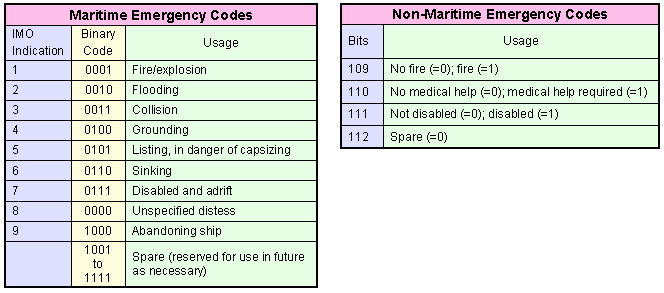
  • Emergency Code Flag (Bit 107) and Emergency Codes/National Use (Bits 109 – 112) for Short Format User Protocols

    Bits 109 – 112 in short message format User protocols (except National User Protocol) can be used to provide an indication of the nature of the emergency which resulted in the beacon being activated, as defined below. If the emergency code flag (bit 107) is set to “1” it indicates that bits 109 to 112 contain one of the agreed emergency codes as provided in the tables below. If bit 107 is set to “0” it indicates that bits 109 to 112 contain other data as defined by the administration designated by the country code.

    If no emergency codes or national-use codes are defined, the default settings should be:

    -Bit 107 = 0
    -Bits 109 to 112 all set to “0”

    The maritime emergency codes can be used with any of the maritime user protocols (i.e. maritime user protocol, maritime serial-user protocol, and radio call sign user protocol).

    The non-maritime emergency codes can be used with any of the non-maritime user protocols.


  • Beacon Message Formats

    Cospas-Sarsat 406 MHz distress beacons are provided in models which transmit either a “short” distress message or a “long” distress message as indicated below. 406-MHz beacon messages are comprised of:

    • a message preamble which is the combination of the 160 ms of unmodulated carrier, the bit synchronization pattern and the frame synchronization pattern,
    • various other data fields which provide a unique beacon identification and, depending on the protocol used, other information that would be useful to Search and Rescue Authorities.

    Note that additional information describing the beacon message characteristics of the fields is provided by clicking on the appropriate section of the message format diagrams below, or via the menu on the right-hand column of this page.

    Fields of the Short Message Format

      Unmodulated Carrier (160ms)
     
     
    Bit Synch Bit Synch Pattern Bits 1 – 15 15 Bits
    Frame Synch Frame Synch Pattern Bits 16 – 24 9 Bits
    First
    Protected
    Data Field
    Format Flag
    Protocol Flag
    Country Code
    Identification
    BCH-1 21-BIT BCH Code
    Non- Protected
    Data Field
    Emergency Code or National Use


    Fields of the Long Message Format

      Unmodulated Carrier (160ms)
     
     
    Bit Synch Bit Synch Pattern Bits 1 – 15 15 Bits
    Frame Synch Frame Synch Pattern Bits 16 – 24 9 Bits
    First
    Protected
    Data Field
    Format Flag
    Protocol Flag
    Country Code
    Identification
    BCH-1 21-BIT BCH Code
    Second
    Protected
    Data Field
    Supplementary and Position
    or National Use Data
    BCH-2 12-BIT BCH Code
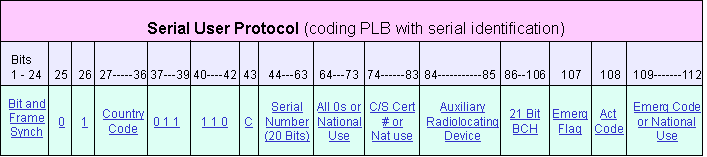
  • Serial User Protocol Coded with PLBs Unique Beacon Serial Number

    You have selected the Serial User Protocol to be coded with a beacon serial number identification. An interactive diagram depicting the information which should be coded into the beacon is provided below. Click on the hyperlinked fields of the diagram for additional information concerning the format, structure and content of the coding for that field.


    serial_user_plb

    Final Step: Register your beacon.

    Having purchased and coded your beacon, one of the most important actions that you must take to maximize its effectiveness is to register the beacon with the appropriate national authority.  Registering your beacon provides search and rescue authorities with access to vital information (e.g. telephone numbers for emergency points of contact, type of aircraft, etc.) that is absolutely critical for efficiently conducting any search and rescue operation.

    For further details concerning beacons refer to the following documents (available for downloading)

    • C/S T.001, Specification for Cospas-Sarsat 406 MHz Distress Beacons;
    • C/S G.005, Cospas-Sarsat Guidelines on 406 MHz Beacon Coding, Registration and Type Approval.
  • Step 4: Non-location Protocol Coding for PLBs

    So far you have confirmed that your distress beacon will be used as a personal locator beacon and that it is a non-location protocol beacon. There is only one coding option that is suitable for this type of beacon. Nevertheless, you should contact your country’s designated authority to confirm that PLBs are authorised for use in your country (additional information concerning the authority/responsibility of States in respect of beacon message protocol selection is described at step 1 of this tutorial).

    Click here for guidance in coding a PLB with the Serial User Protocol.

    Return to Beacon Coding Tutorial Flow Chart

  • Final Step: Register the Beacon

    The final step in coding 406 MHz beacons is registering the beacon with the appropriate national authorities. In accordance with IMO and ICAO requirements national authorities should provide facilities for making this data available to Search and Rescue (SAR) services on a 24-hr basis. The extremely important step of registering your beacon is required to enable the proper SAR response if the beacon is activated. A list of points of contact responsible for beacon matters in countries throughout the world is available under the “Beacon Registration Contact Information” section of our website.

    The Cospas-Sarsat Secretariat operates the International 406 MHz Beacon Registration Databse (IBRD) located at www.406registration.com. National authorities from some countries allow use of the IBRD for registration of beacons with their country codes. Beacon registration can only be accomplished using the online interface of the IBRD.

    Why Register Your 406 MHz Beacon?

    When a 406 MHz beacon is detected by the Cospas-Sarsat System, one of the initial actions taken by SAR services is to try and contact the owner of the beacon, or an emergency point of contact designated by the beacon owner, to confirm the nature of the distress event. Typically the following steps are followed:

    • The beacon is activated.
    • The Cospas-Sarsat System detects the beacon, decodes the digital message it transmitted and forwards this alert to the appropriate Rescue Coordination Centre or SAR Point of Contact.
    • The SAR personnel send an electronic message to the organization responsible for the operation of the beacon registration database associated with the country code transmitted by the beacon. For example if the beacon was coded with a USA country code, a message would be sent to the operators of the USA beacon registration database requesting all the information available in the registration database.
    • Using this registration information the SAR authorities attempt to contact the beacon owner and/or the emergency point of contact identified in the registration details to assist in the planning of the rescue operation.

    The following scenarios highlight the importance of registering 406 MHz beacons:

    • When a non-location protocol beacon is detected by a Cospas-Sarsat Geostationary satellite, the resulting alert message produced by the Cospas-Sarsat System does not include location information. The location of the beacon will not be available until it is detected by the Cospas-Sarsat Low Altitude Earth Orbiting Satellites (LEOSAR). By contacting the emergency point of contact identified in the beacon registration database SAR authorities are often able to determine the general area in which the beacon owner was traveling, thereby enabling the SAR mission to be initiated even before the beacon is detected by the LEOSAR System.
    • When the beacon is detected by one of the Cospas-Sarsat LEOSAR Satellites, the alert includes two Doppler calculated locations. One is the correct location, however, the other is an artifact of the Doppler signal processing. By contacting the emergency point of contact and obtaining information on the general area in which the beacon owner is traveling, it is often possible to identify which of the two locations is correct. This enables the SAR mission to be initiated immediately with no uncertainty as to the correct location.
    • If the beacon is inadvertently activated, SAR authorities may be able to contact the owner using the contact details provided in the beacon registration database to have the beacon deactivated thus canceling a false alarm. If the beacon is not registered SAR personnel would have to be dispatched to the beacon’s location, which may involve high costs to SAR services and expose the rescue personnel to danger.
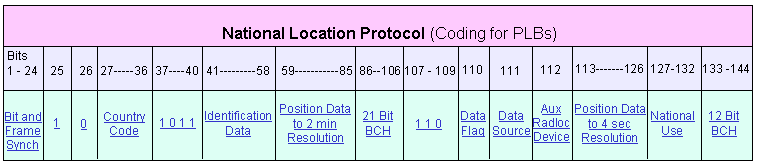
  • Coding a PLB with the National Location Protocol

    You have selected the National Location Protocol to code your PLB. An interactive diagram of this option, depicting the information which should be coded into the beacon is provided below. Click on the hyperlinked fields of the diagram for additional information concerning the format, structure and content of the coding for that field.

    Nationallocation-PLB

    Final Step: Register your beacon.

    Having purchased and coded your beacon, one of the most important actions that you must take to maximize its effectiveness is to register the beacon with the appropriate national authority. Click here for details regarding the organizations responsible for beacon registration in your country (Pro/Contact Lists/406 MHz Beacon Registers). Registering your beacon provides search and rescue authorities with access to vital information (e.g. telephone numbers for emergency points of contact, type of aircraft, etc.) that is absolutely critical for efficiently conducting any search and rescue operation.

    For further details concerning beacons refer to the following documents (available for downloading):

    • C/S T.001, Specification for Cospas-Sarsat 406 MHz Distress Beacons;
    • C/S G.005, Cospas-Sarsat Guidelines on 406 MHz Beacon Coding, Registration and Type Approval.
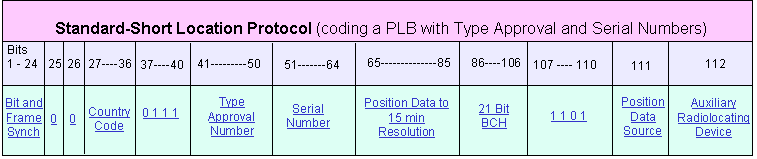
  • Coding a PLB with the Standard Location Protocol

    You have selected the Standard Location Protocol to code your PLB. An interactive diagram depicting the information which should be coded into the beacon is provided below. Click on the hyperlinked fields of the diagram for additional information concerning the format, structure and content of the coding for that field.


    Standardshortlocation-PLB_tac_serial_number

    Final Step: Register your beacon.

    Having purchased and coded your beacon, one of the most important actions that you must take to maximize its effectiveness is to register the beacon with the appropriate national authority. Click here for details regarding the organizations responsible for beacon registration in your country (Pro/Contact Lists/406 MHz Beacon Registers). Registering your beacon provides search and rescue authorities with access to vital information (e.g. telephone numbers for emergency points of contact, type of aircraft, etc.) that is absolutely critical for efficiently conducting any search and rescue operation.

    For further details concerning beacons refer to the following documents (available for downloading):

    • C/S T.001, Specification for Cospas-Sarsat 406 MHz Distress Beacons;
    • C/S G.005, Cospas-Sarsat Guidelines on 406 MHz Beacon Coding, Registration and Type Approval.
This site is registered on wpml.org as a development site. Switch to a production site key to remove this banner.