
По состоянию на декабрь 2010 года Система Коспас-Сарсат предоставила данные, использованные при спасении более 30 700 человек при проведении более 8 300 поисково-спасательных операций. [больше информации]
Автор: kevin
-
Спасательные операции
Эксплуатационное использование Системы Коспас-Сарсат поисково-спасательными (ПС) службами началось с крушения легкого самолета в Канаде, в котором были спасены три человека (10 сентября 1982 г.). С тех пор данные Системы использовались при проведении тысяч поисково-спасательных операций и способствовали спасению более чем 50 тыс. человеческих жизней во всем мире.
Чтобы ознакомиться с поисково-спасательными операциями, в которых использовались данные Коспас-Сарсат, обратитесь в раздел «What’sNew» в правой части экрана.
Чтобы прочитать представленную Участниками Коспас-Сарсат информацию о поисково-спасательных операциях прошедшего года, обратитесь в Documents / C/S System Documents / R.000 Series и нажмите на «Annex C Only» документа C/S R.007.
-
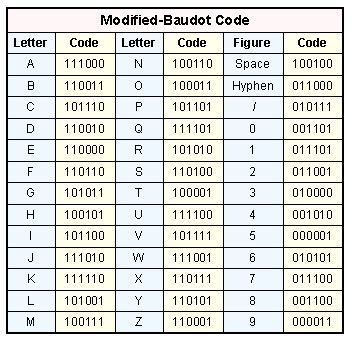
Кодирование авиационного протокола пользователя кодом национальной принадлежности и регистрационной маркировкой воздушного судна (биты с 40 по 81)
The aircraft nationality and registration marking is a unique alphanumeric code assigned by national administrations in accordance with Annex 10 to the Convention on International Civil Aviation.
This information is translated into digital format (1s and 0s) using the modified-baudot code provided below. The data shall be right justified, and the modified-baudot space («100100») should be used (placed to the left of the characters) where no characters exist.
-
Установка битов
Format Flag (Bit 25)
The beacon message format is identified at bit 25 for all message formats. For this implementation of this protocol, this bit is set to the value indicated in the graphic you just clicked on (0 for short message formats, 1 for long message formats).
Protocol Flag (Bit 26)
The protocol type is identified at bit 26 for all message formats. For this implementation of this protocol, this bit is set to the value indicated in the graphic you just clicked on (0 for a Standard Location Protocol or National Location Protocol, 1 for a User Protocol or User Location Protocol).
Fixed Bits
For the implementation of this protocol, these bits are set to the values indicated in the graphic you just clicked on.
Non-Protected Data Field (Bits 107 — 112 of short format messages)
The non-protected data field refers to bits 107 — 112 of short format messages. The term «non-protected» derives from the fact that these bits are not protected by the beacons error correcting code.
The content of these bits are defined by the specific protocol used in the beacon.
Specific Beacon Number
These bits are used to identify the specific beacon in cases where there may be several beacons on the same vessel. The first or the only float free beacon shall be coded with a modified-Baudot zero (001101); additional beacons shall be numbered consecutively using modified-Baudot characters 1 to 9 and A to Z.
-
Код вспомогательного радиолокационного устройства
Some beacon models integrate an auxiliary radio-locating device which provides a homing signal that enable SAR services in the vicinity of the distress event to home on the distress beacon. The type of auxiliary radio-locating device integrated into the beacon is coded in bits 84 — 85 as indicated below.
Auxiliary Radio-locating Device Code
00
No Auxiliary Radio-locating Device
*01
121.5 MHz Auxiliary Radio-locating Device
10
9 GHz SART Locating Device
11
Other Auxiliary Radio-locating Device(s)
*
If other auxiliary radio-locating device(s) are used in conjunction to 121.5 MHz, the code for 121.5 MHz (i.e.01) should be used.
Note: IMO and ICAO require that 406 MHz EPIRBs/ELTs carried on-board vessels/aircraft in accordance with the applicable carriage requirements, include an auxiliary radio-locating device which transmits at 121.5 MHz. For other applications, administrations may require other types of homing devices.
-
Аккаунт пользователя для ограниченных областей
The password protected portion of the Cospas-Sarsat website contains working papers and reports for the exclusive use of participants in the Cospas-Sarsat Programme. When logged on, access to the System Monitoring section is also granted.
All approved Cospas-Sarsat documents are freely downloadable from our public web site and do not require a password to access.
If you encounter any problems when trying to log in, please contact the Secretariat by email.
-
В помощь пользователю
General
Search and Rescue Services and Authorized Inspectors
-
Передаточные характеристики радиобуя
Cospas-Sarsat 406 MHz distress beacons are provided in models which transmit either a «short» distress message or a «long» distress message as indicated below. 406-MHz beacon messages are comprised of:
- a message preamble which is the combination of the 160 ms of unmodulated carrier, the bit synchronization pattern and the frame synchronization pattern,
- various other data fields which provide a unique beacon identification and, depending on the protocol used, other information that would be useful to Search and Rescue Authorities.
Note that additional information describing the beacon message characteristics of the fields is provided by clicking on the appropriate section of the message format diagrams below, or via the menu on the right-hand column of this page.
Fields of the Short Message Format
Fields of the Long Message Format
-
Кодирование авиационного протокола пользователя кодом национальной принадлежности и регистрационной маркировкой воздушного судна
You have selected the Aviation User Protocol coded with the aircraft nationality and registration marking. An interactive diagram depicting the information which should be coded into the beacon is provided below. Click on the hyperlinked fields of the diagram for additional information concerning the format, structure and content of the coding for that field.
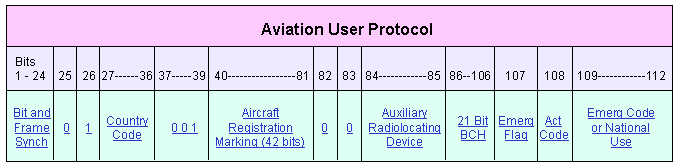
An Example of a beacon coded with the Aviation User Protocol is provided here.
Final Step: Register your beacon.
Having purchased and coded your beacon, one of the most important actions that you must take to maximize its effectiveness is to register the beacon with the appropriate national authority. Click here for details regarding the organizations responsible for beacon registration in your country. Registering your beacon provides search and rescue authorities with access to vital information (e.g. telephone numbers for emergency points of contact, type of aircraft, etc. ) that is absolutely critical for efficiently conducting any search and rescue operation.
For further details concerning beacons refer to the following documents (available for downloading):
- C/S T.001, Specification for Cospas-Sarsat 406 MHz Distress Beacons;
- C/S G.005, Cospas-Sarsat Guidelines on 406 MHz Beacon Coding, Registration and Type Approval.
-
Прекращение обслуживания частот 121,5/243 МГц
¡Cambiar a 406 MHz!
El Sistema Internacional Cospas-Sarsat cesó el procesamiento de balizas de 121.5/243 MHz el 1er de febrero de 2009. Todos los propietarios y usuarios de estas balizas deben reemplazarlas lo antes posible por balizas de 406 MHz.
El Sistema de Satélites Cospas-Sarsat ya sólo detecta las balizas de 406 MHz. Esto afectará a todas las balizas tanto marítimas (EPIRBs), como aéreas (ELTs) y personales (PLBs). Sin embargo, otros dispositivos (tales como radiobalizas personales de hombre al agua y sistemas de localización guiada) que funcionan en 121.5 MHz y no están basados en detecciones por satélite no se ven afectados por la desactivación del procesado de los satélites en 121.5 MHz.
¿Por qué cambiar?
El Sistema Cospas-Sarsat tomó la decisión de cesar el procesamiento de balizas de 121.5/243 MHz como respuesta a las directrices marcadas por la Organización de Aviación Civil Internacional (OACI) y la Organización Marítima Internacional (OMI). Estas organizaciones de Naciones Unidas determinan los requisitos de seguridad para aeronaves y embarcaciones marítimas y han reconocido las limitaciones de las balizas de 121.5/243 MHz y la superioridad de las prestaciones del sistema de alertas de 406 MHz.
Las balizas digitales de 406 MHz proporcionan muchas ventajas frente a las balizas analógicas de 121.5/243 MHz. Con una radiobaliza de 406 MHz, la posición de la emergencia se puede retransmitir a los servicios de rescate más rápidamente y con mayor fiabilidad y precisión.
Baliza de 406 MHz Baliza de 121.5/243 MHz Señal Digital: identificación única, el registro proporciona información del propietario Analógica: no hay datos codificados, alta tasa de falsas alertas Potencia de la señal Pulsos de 5 W Señal continua de 0.1 W (típico) Cobertura Global Local Precisión de localización Inferior a 5 Km, si hay Doppler
Inferior a 100 m, si la posición GNSS (GPS) está codificada en el mensaje
Inferior a 20 Km (sólo posición Doppler) Tiempo de detección de la alerta Alerta GEO antes de 5 minutos Tiempo medio entre pases de satélites LEO, 45 minutos Resolución de ambigüedad de la posición debida al Doppler Posiblemente en el primer pase de satélite Se necesitan dos pases de satélites Sólo una de cada 50 alertas de balizas de 121.5/243 MHz es una situación de emergencia real. Esto afectó directamente a los recursos de los servicios de búsqueda y rescate (SAR). Con balizas de 406 MHz, las falsas alertas se han reducido considerablemente (una de cada 17 alertas es real) y si la baliza está registrada correctamente, las falsas alertas en muchas ocasiones se pueden resolver con una simple llamada telefónica al propietario de la baliza, utilizando el código de identificación de la misma. De esta forma, una alerta real puede recibir la atención que merece.
Cuando se recibe una señal de una baliza de 406 MHz, las autoridades SAR pueden obtener información de una base de datos de registro de balizas. En la cual se incluye información de contacto del propietario de la baliza, información de contacto para emergencias, y características de identificación del barco o la aeronave. Tener esta información disponible, permite a los servicios SAR responder adecuadamente. ¡Asegúrese de que su baliza está registrada correctamente! [read more — solo disponible en inglés]
Información más detallada:
Para mayor información sobre el Cospas-Sarsat Phase Out Plan for 121.5/243 MHz Satellite Alerting Service, véase el documento C/S R.010 «Cospas-Sarsat Phase-Out Plan for 121.5/243 MHz Satellite Alerting» (solo disponible en inglés).
Enlaces de interés:
www.sarsat.noaa.gov/121phaseout.pdf
www.equipped.com/uscgsarsat.htm