Author: kevin

  • 2016-10-11 MEOSAR detects two yachtsmen in distress in the Indian Ocean

    On 10 October 2016, a French Polynesian yacht with two on board had lost power.

    Its Cospas-Sarsat EPIRB was detected by the MEOSAR system at 05:33 UTC, with confirmation at 05:50, providing rescuers with more than a three and a half hour time advantage over LEOSAR.

    Without the MEOSAR data, the Australian JRCC would have had to either manage a response to two locations, or delay the response.

    Instead, the MEOSAR location allowed the Australian JRCC to use one Doppler location to task rescuers to one location without delay.
  • 2016-10-04 Radio is an important means of cancelling false alerts

    A fishing vessel’s EPIRB was intermittently sending out distress calls near the straight between the Isle of Wight and southern England.

    Solent Coastguard had been unable to contact the vessel by VHF radio, and a lifeboat was launched to investigate.

    It is important to stay reachable in order to communicate with search and rescue authorities, conserve resources, and possibly help others.

    Read more here:
    http://www.islandecho.co.uk/news/emergency-beacon-activation-sparks-lifeboat-launch 

  • Completed Meetings

    Completed 2016 Meeting Document Submission Deadlines and Templates in MS Word Format

    TG-1/2016 – Second-Generation Beacon Specifications 
    (4 – 8 April)

    • 22 February: Bulky documents (over 10 pages)*
    • 7 March: Working Paper
    • 21 March: Response Paper
    • 21 March: Information Paper

    TG-2/2016 – MEOSAR Evolution 
    (20 – 24 June)

    JC-30 – 30th Meeting of the Joint Committee 
    (18 – 27 September)

    • 1 March: 2015 Report on System Status and Operations
    • 1 April: 2016 System Level Test Results
    • 8 August: Bulky documents (over 10 pages)*
    • 8 August: New System Documents (including commissioning reports and performance evaluation reports)
    • 22 August: JC-30 Change Management (recommends changes to System technology, current operations or policies; resource estimate required)
      • As outlined in section 6.5 of document C/S P.011, the change management template is to be used for input documents proposing “changes which have a significant, cost effective impact” and contain a change or changes to “elements of the Ground Segment, Space Segment, beacon specifications or beacon type approval standards by participants to the Joint Committee (JC) or specifically
        established Task Groups (TG).”

    • 22 August: JC-30 Working Paper
    • 6 September: JC-30 Response Paper
    • 6 September: JC-30 Information Paper (no recommended actions)
    • 6 September: Revisions and addenda to timely submitted papers (with changes tracked in strikethrough, italics and left track bar)
    • Splinter Group Report Template
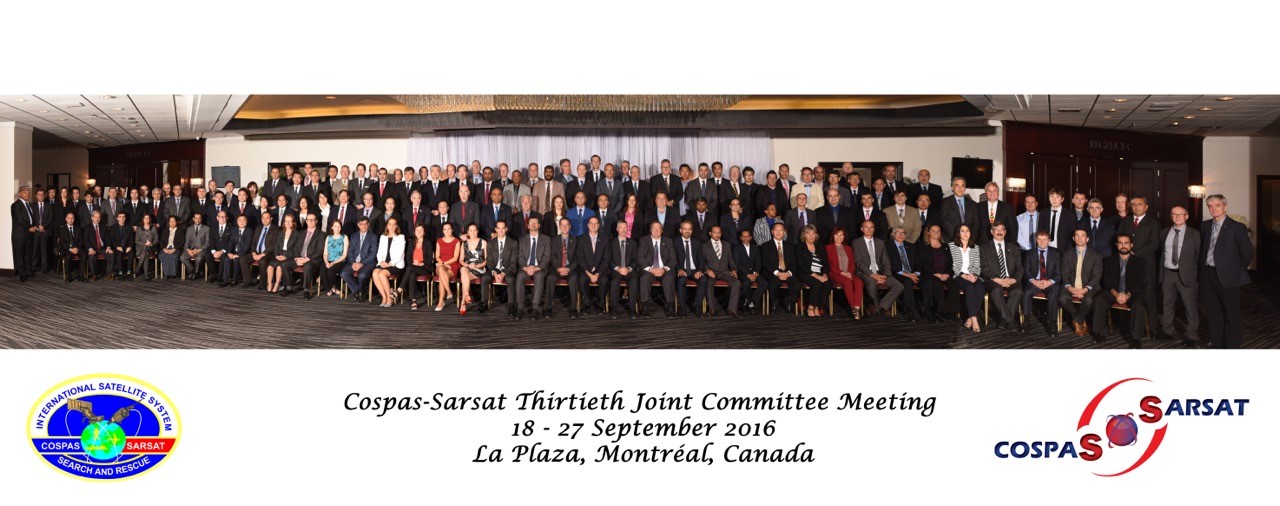
  • 2016-10-03 30th Joint Committee Meeting held in Montreal (18 – 27 September, 2016)

    The Cospas-Sarsat Secretariat hosted the 30th Joint Committee Meeting in Montreal, Quebec, Canada chaired by Mr. Michael Donald from Canada. The OWG and TWG were chaired by Dr. John Ophel from Australia and Mr. Yoan Gregoire from France.

    The meeting was attended by 170 people, and included delegates from the four Cospas-Sarsat Parties, thirty-one Participant countries, five Observer organisations, and members of the Secretariat.

    Link to group photo


  • Reference Material of Other Intergovernmental Organizations

    This section includes references to international agreements which impact on Cospas-Sarsat operations.  

    1  International Maritime Organization 

    • IMO Assembly Resolution A.662(16): Performance Standards for Float-Free Release and Activation Arrangements for Emergency Radio Equipment. 
    • IMO Assembly Resolution A.694(17): General Requirements for Shipborne Radio Equipment Forming Part of the Global Maritime Distress and Safety System (GMDSS) and for Electronic Navigational Aids. 
    • IMO Assembly Resolution A.696(17): Type Approval of Satellite Emergency PositionIndicating Radio Beacons (EPIRBs) Operating in the Cospas-Sarsat System. 
    • IMO Assembly Resolution A.810(19): Performance Standards for Float-Free Satellite Emergency Position-Indicating Radio Beacons (EPIRBs) Operating on 406 MHz, as amended by Resolutions MSC.56(66) and MSC.120(74). 
    • IMO Assembly Resolution A.814(19): Guidelines for the Avoidance of False Distress Alerts. 
    • IMO Assembly Resolution A.887(21): Establishment, Updating and Retrieval of the Information Contained in the Registration Databases of the Global Maritime Distress and Safety System (GMDSS). 
    • MSC/Circ. 861: Measures to Reduce the Number of False Distress Alerts. 
    • MSC/Circ. 863: Recommendation on Prevention of Harmful Interference to 406 MHz EPIRBs Operating with Cospas-Sarsat System. 
    • MSC/Circ.1039: Guidelines for Shore-Based Maintenance of Satellite EPIRBs. 
    • MSC/Circ.1040: Guidelines on Annual Testing of 406 MHz Satellite EPIRBs. 
    • COMSAR/Circ.29: Guidelines for the voluntary use of standardized questionnaire and formats for reporting false alerts in collecting data on false alerts. 
    • International Convention for the Safety of Life at Sea, 1974, as amended.  This document has been superseded by a later version
    • Resolution MSC.147(77): Adoption of the Revised Performance Standards for a Ship Security Alert System.  

    2  International Civil Aviation Organization

    • Annexes to the Convention on International Civil Aviation:  – Annex 6: Operation of Aircraft.  – Annex 10: Aeronautical Telecommunications.  – Annex 12: Search and Rescue. 
    • International Aeronautical and Maritime Search and Rescue (IAMSAR) Manual. 
    • Regional Air Navigation Plans.  

    3  International Telecommunication Union 

    • Recommendation ITU-R M.585: Assignment and use of identities in the maritime mobile service
    • Recommendation ITU-R M.633-4: Transmission Characteristics of a Satellite Emergency Position-Indicating Radio Beacon (Satellite EPIRB) System Operating through a Satellite System in the 406 MHz Band.
    • Recommendation ITU-R M.1478-3: Protection criteria for Cospas-Sarsat search and rescue instruments in the band 406-406.1 MHz
    • Recommendation ITU-R M.1731-2: Protection criteria for Cospas-Sarsat local user terminals in the band 1 544-1 545 MHz
    • Recommendation ITU-R SM.1051-4: Priority of identifying and eliminating harmful interference in the frequency band 406-406.1 MHz and monitoring in the adjacent frequency bands 405.9 406 MHz and 406.1-406.2 MHz
    • Report ITU-R M. 2359-0: Protection of the 406-406.1 MHz band
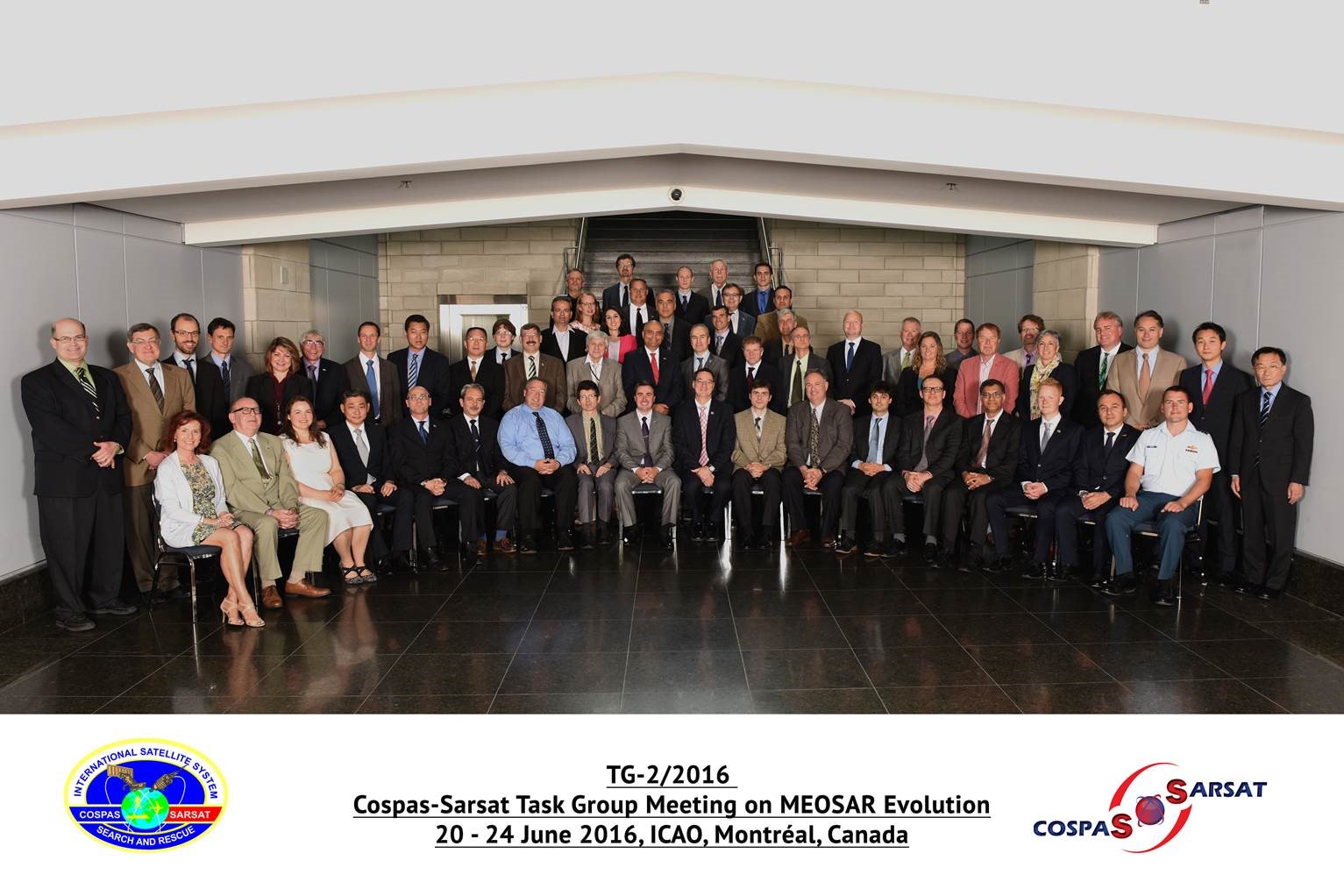
  • 2016-09-07 2016 Task Group Meeting on MEOSAR Evolution

    The 2016 Task Group Meeting on MEOSAR Evolution was held in Montreal, Canada from 20 to 24 June 2016. Mr. Andrey Fedoseev (Russian Federation) chaired the meeting.

    63 people, including members of 14 Cospas-Sarsat Participants, one Observer Organization and the Secretariat took part in the meeting.

    TG 2 2016 Group photo

  • 2016-09-07 2016 Task Group Meeting on MEOSAR Evolution_

    The 2016 Task Group Meeting on MEOSAR Evolution was held in Montreal, Canada from 20 to 24 June 2016. Mr. Andrey Fedoseev (Russian Federation) chaired the meeting.

    63 people, including members of 14 Cospas-Sarsat Participants, one Observer Organization and the Secretariat took part in the meeting.

    TG-2/2016 Photo

  • 2016-08-30 Helicopters locate PLB-toting Swede bound for Estonia

    A Swedish man was travelling by boat from Djurö, Stockholm archipelago to Vormsi, Estonia when he got lost and ran out of fuel.

    Within fifteen minutes of his first PLB message, an encoded position was received and SAR helicopters, Swedish Coast Guard aircraft and surface units were tasked.

    He and his boat were found at the encoded position by a SAR helicopter and he was transported to hospital.

  • 2016-08-30 MEOSAR operational in Australia

    The Australian Maritime Safety Authority’s (AMSA) Medium-altitude Earth Orbit Search and Rescue (MEOSAR) system for emergency distress beacon detection is now operational and supporting search and rescue response in Australia.

    “In one search and rescue incident alone, MEOSAR was able to confirm the location of a person in distress two hours before the existing system,” Kinley said.

    “Australian is the biggest user of distress beacons in the world on a per capita basis, with more than 450,000 beacons currently registered.”

    Read more here:

    http://www.maritime-executive.com/article/australia-gets-new-distress-beacon-detection-system 

  • 2016-08-15 Kayaker spends four days on island after crocodile attack in Queensland, Australia

    An AMSA spokeswoman said the man told rescuers when the beast attacked, it was the “fastest he’s ever paddled”.

    “The kayaker was in good health due to rationing water and food over the time,” they reported.

    “Eventually making the decision to set his beacon off in distress.”

    Although not registered, the AMSA said the beacon was vital to the rescue of the kayaker.

    Read more here:
    http://www.themorningbulletin.com.au/news/update-coast-guard-talks-kayaker-rescue-after-croc/3073426/ 

This site is registered on wpml.org as a development site. Switch to a production site key to remove this banner.